






A digital marketing assistant is a marketing professional who supports online campaigns by managing social media, SEO tasks, content publishing, email marketing, analytics, and paid ads coordination. For growing teams, the role often becomes the execution engine behind campaigns, helping marketing leaders scale output, maintain channel consistency, and reduce operational workload.
When marketing teams run campaigns, tasks like publishing content, scheduling posts, updating pages, and preparing reports can take up a good portion of the week, so many rely on digital marketing assistants to handle that day-to-day execution.
Let’s see what digital marketing assistants do, how much they cost, and which services companies use to hire them.
What Is a Digital Marketing Assistant?
A digital marketing assistant handles the day-to-day execution of digital campaigns. They're not strategists, but they're not just schedulers either. Their core value is operational: turning strategy into action. They publish content, run keyword research, set up email sequences, pull performance reports, manage ad creative, and keep your marketing calendar moving.
They help ensure planned work gets executed on time and that campaign data is organized and reported back to the team so it can inform future decisions.
Digital Assistant vs Digital Marketing Virtual Assistant
The two roles differ mainly in scope and specialization.
A digital assistant typically provides general support. Their work often includes scheduling, inbox management, data entry, and other administrative tasks that are not specific to marketing.
A digital marketing virtual assistant (VA) focuses on marketing execution. They work with platforms such as Google Analytics, Mailchimp, or Meta Ads Manager and support tasks like social media publishing, campaign reporting, keyword research, and email marketing setup.
Hiring someone with marketing-specific experience can shorten onboarding time and help campaigns stay on track.
Digital Marketing Assistant at a Glance
The role focuses on supporting the daily execution of marketing activities across digital channels.
- Core tasks: Social media management, SEO support, content publishing, email marketing, analytics reporting, graphic coordination
- Salary range (US, 2026): $41k-$65k/year in-house, $15-$35/hour remote/offshore
- Ideal for: Marketing agencies, e-commerce brands, SaaS startups, growing SMBs
- Tools used: Google Analytics 4, Canva, Mailchimp, Hootsuite, Semrush, Ahrefs, WordPress, HubSpot
What Does a Digital Marketing Assistant Do?
Digital marketing assistants support campaign execution and day-to-day marketing operations across different areas.
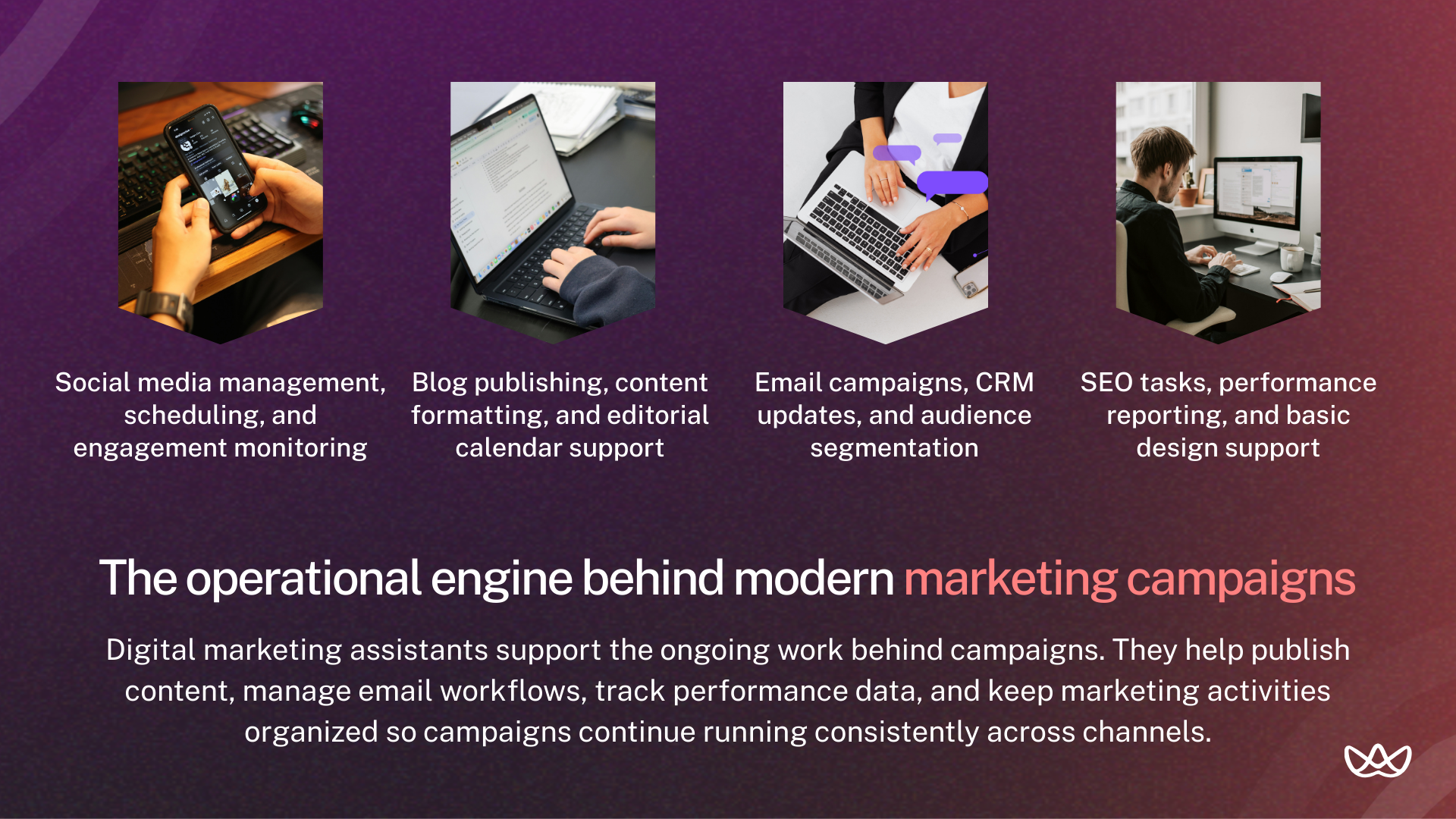
Social Media Management
A digital marketing assistant keeps your brand's social presence consistent and on-schedule. That includes creating or sourcing content, writing captions aligned with brand tone, scheduling posts across platforms, and monitoring comments or DMs that need a response.
For agencies managing multiple client accounts, this is often one of the highest-volume task areas.
Content Creation and Blogging
They support blog production by drafting posts from briefs, optimizing titles and meta descriptions, formatting content in CMS platforms like WordPress, and managing editorial calendars.
At more senior levels, they can research topics, build outlines, and run basic SEO checks before publishing.
Email Marketing and CRM Support
Digital marketing assistants set up and manage email workflows in platforms like Mailchimp or Klaviyo. They build segments, schedule campaigns, run A/B tests, and track open rates and click-through rates.
On the CRM side, they handle contact list hygiene, tag management, and basic automation sequences.
SEO and Keyword Research
They support organic growth by running keyword research using tools like Semrush or Ahrefs, optimizing on-page elements such as title tags, alt text, and meta descriptions, building internal links, and tracking keyword rankings over time.
Their role is to execute the SEO tasks outlined in the strategy and keep ongoing optimizations moving.
Analytics and Campaign Reporting
One of the highest-value tasks for decision-makers. A skilled digital marketing assistant pulls together performance data from Google Analytics 4, Meta Ads, and email platforms into readable reports.
They track the KPIs that matter - traffic, conversions, CPL, ROAS - and present them in a format that helps the team make faster decisions.
Design Support (Graphics, Video)
With tools like Canva and Adobe Express, many digital marketing assistants handle basic visual creation: social graphics, email headers, promotional banners, and short-form video thumbnails.
For teams without a dedicated designer, this keeps content looking consistent without sending every asset to an agency.
Daily Responsibilities by Role Type
In-house, remote, and freelance digital marketing assistants differ mainly in cost, availability, onboarding time, and how closely they integrate with a marketing team.
How We Evaluated These Digital Marketing Assistant Services
Each service was reviewed based on factors that affect how easily a digital marketing assistant can support ongoing campaign work and integrate into a marketing team.
- Digital specialization depth: Whether assistants have real experience with marketing tools and platforms, not just general VA tasks.
- Pricing transparency: Whether pricing is clearly available or only discussed during sales calls.
- Onboarding speed: How quickly an assistant can start supporting campaign work.
- Contract flexibility: Month-to-month options versus longer commitments.
- Skill coverage: Ability to support SEO, paid ads, analytics, and content tasks.
- Support model: Dedicated assistant, shared team, or platform-managed support.
Best Digital Marketing Assistant Services to Hire in 2026
Digital marketing assistant services are offered through several types of providers, including nearshore staffing firms, managed virtual assistant platforms, and freelance marketplaces. Each option differs in hiring speed, pricing models, and the level of marketing specialization available. The providers below represent some of the most commonly used options for companies looking to scale marketing execution.
1. Floowi
Floowi connects U.S. companies, particularly marketing agencies and startups, with pre-vetted digital marketing professionals from Latin America. The focus is on dedicated, full-time talent rather than task-based or gig work.
Their talent pool includes roles marketing teams commonly hire for, such as marketing assistants, SEO specialists, paid media managers, social media managers, content creators, CRM managers, and data analysts. Candidates go through portfolio reviews, skills testing, and background checks.
According to their 2025 LATAM Hiring Benchmarks, the typical time-to-hire through Floowi’s nearshore model is about 9-15 days, compared with 30-45 days for many U.S.-based hires. LATAM professionals also work in time zones that overlap with U.S. teams (GMT-3 to GMT-6), allowing for real-time collaboration.
2. Belay
Belay provides U.S.-based virtual assistants and fractional professionals for businesses that prefer domestic talent. Their assistants support tasks such as social media management, email coordination, content scheduling, and basic marketing operations.
Pricing is not always listed publicly, but many plans fall roughly in the $2k–$5.5k/month range, depending on hours and specialization.
3. Prialto
Prialto offers a managed virtual assistant model where clients receive a dedicated assistant supported by a backup team and an engagement manager. The service focuses heavily on process documentation and workflow support.
Plans typically start around $1.5k/month for about 55 hours of support, making it common among executives and teams looking for structured administrative assistance.
4. Time Etc.
Time Etc. connects businesses with experienced freelance virtual assistants, many of whom previously worked in corporate roles. Companies purchase monthly hour packages, and assistants handle tasks such as content scheduling, research, inbox support, and administrative work.
Plans begin around $360/month for 10 hours, with larger packages available for teams needing more consistent help.
5. Wing Assistant
Wing provides managed virtual assistant plans with assistants trained to handle routine business and marketing tasks. Support often includes social media scheduling, content research, basic email campaigns, and administrative work.
Plans generally start in the hundreds per month for part-time support, making it one of the more budget-oriented managed VA services.
6. MyTasker
MyTasker operates from India and offers a wide range of virtual assistant services, including social media support, SEO assistance, web tasks, and general administrative work.
Their model focuses on affordable monthly plans and flexible task support, with teams available across time zones and optional trial periods before committing.
7. Boldly
Boldly focuses on premium virtual assistants with strong professional backgrounds, often with experience in operations, marketing coordination, or project management. Assistants are typically matched with clients for ongoing work rather than short tasks.
Pricing reflects the senior talent model and usually starts around $2k+ per month depending on hours.
8. Zirtual
Zirtual provides U.S.-based virtual assistants for founders, small teams, and professionals who want domestic support. Assistants commonly help with tasks like content scheduling, inbox management, research, and social media posting.
Plans start at about $599/month for limited hours, with higher tiers offering more time and users.
Assistant Services Comparison - Pricing, Features, and Strengths
The providers differ mainly in pricing, onboarding speed, specialization, and the type of support they offer.
How Much Does a Digital Marketing Assistant Cost?
In the U.S., digital marketing assistants typically earn between $41k and $65k per year, which equals roughly $20-$31 per hour based on recent salary data across several industry reports. Offshore talent in LATAM often costs less.
Experienced digital marketing professionals in the region usually range from $1.5k–$4k per month through managed nearshore models, or $12-$25 per hour on a contractor basis.
Entry-level assistants fall on the lower end of these ranges, while professionals with hands-on experience in SEO, paid media, or CRM management usually sit toward the higher end.
Hourly Rates by Region
Full-Time vs Part-Time Packages
Full-time dedicated assistants (40 hrs/week) typically run $2.5k–$5k/month through managed nearshore services, depending on skill level and region.
Part-time arrangements (15-25 hrs/week) often start around $0.8k-$1.8k/month. Freelance or task-based models vary widely, with many digital marketing freelancers charging $15–$50/hour depending on experience and specialization.
Factors That Affect Cost
Different factors influence how much a digital marketing assistant costs, including experience level, hiring model, and location.
Skills to Look For in a Digital Marketing Assistant
The value of a digital marketing assistant depends largely on the skills they bring to daily campaign execution. The areas below are the ones most marketing teams screen for during hiring.

1. Marketing Tools and Platforms
Before anything else, verify platform fluency. A capable digital marketing assistant should know their way around Google Analytics 4, Meta Business Suite, a CRM like HubSpot or ActiveCampaign, at least one email platform, and a content scheduling tool. Tool familiarity isn't a bonus - it's the baseline.
2. Copywriting and Communication
Even execution-focused assistants write regularly: captions, email subject lines, blog intros, ad copy. Clear, brand-aligned writing is a skill worth screening for, not assuming. Ask for work samples during the hiring process.
3. Project and Time Management
Marketing teams move fast. An assistant who can manage their own task queue, flag blockers early, and stay on schedule without constant check-ins is worth more than one who needs daily micromanagement. Look for familiarity with tools like Asana, Trello, or Notion.
4. Familiarity with SEO & PPC Basics
Assistants don’t need to build full campaign strategies, but they should understand basic search and paid advertising concepts so they can support campaign execution.
Ability to run keyword research
They don't need to build the keyword strategy - but they should be able to use Semrush or Ahrefs to pull keyword volumes, spot opportunities, and work from a brief without needing constant guidance.
Understand CPC & ROAS metrics
When assisting with paid campaigns, a digital marketing assistant should understand cost-per-click and return on ad spend at a working level - enough to flag when something looks off in a report.
Basic GA4 reporting
GA4 is now the standard. A useful assistant should be able to pull traffic breakdowns, conversion data, and channel performance reports - and format them into something the team can actually read.
Tools Commonly Used by Digital Marketing Assistants
Most assistants work inside the same core tools marketing teams already rely on for publishing content, managing campaigns, and reviewing performance.
Content Tools: Canva, Grammarly, WordPress
Canva supports visual creation for social posts and email graphics without requiring advanced design software. Grammarly helps catch writing errors before content is published.
WordPress (or platforms like Webflow or Shopify) is where blog posts and website updates are formatted and published.
Email Tools: Mailchimp, Klaviyo
Mailchimp supports many small-to-mid-size email programs. Klaviyo is widely used by e-commerce brands running behavior-based email flows. Assistants should be comfortable setting up campaigns and managing lists in at least one platform.
Analytics: Google Analytics 4, Meta Ads Manager
GA4 tracks web performance, goals, and user behavior. Meta Ads Manager is where paid social campaigns live - from audience building to creative testing to budget pacing. Familiarity with both is essential for any assistant supporting performance marketing.
Social Scheduling: Buffer, Later, Hootsuite
These tools let assistants schedule posts in advance, monitor engagement, and manage multi-platform publishing without logging into each network individually. Each has different strengths - Later is strong for Instagram, and Hootsuite handles higher-volume agency workflows.
Digital Marketing Assistant vs Marketing Assistant: What's the Difference?
A marketing assistant supports marketing operations that may include coordinating print campaigns, organizing events, managing vendor relationships, and assisting with brand initiatives that are not always digital.
A digital marketing assistant works mainly with online channels and performance data. Their responsibilities focus on digital activities such as paid ads, social media publishing, SEO support, email campaigns, and tracking website performance. They spend much of their time inside marketing platforms and analytics dashboards while supporting campaign execution.
The two roles can overlap, but the skill sets differ. Teams focused on paid advertising, SEO, content marketing, or analytics usually need someone comfortable working directly inside digital tools and reviewing campaign metrics. A general marketing assistant may require additional training before handling those responsibilities.
How to Hire a Digital Marketing Assistant
If you plan to hire a digital marketing assistant, start by identifying the tasks you need help with and then evaluate candidates based on the skills required for those responsibilities.
Step 1: Define Your Marketing Needs
Before you open a job description, map out what's actually falling behind in your marketing operations.
- Is it content output?
- Reporting consistency?
- Social media scheduling?
- Paid ad monitoring?
The more specific your list of tasks, the better you can evaluate whether a candidate's skill set is actually a match.
Step 2: Choose Between Freelancer, Agency, or Employee
Each model has a different risk-reward profile:
- Freelancer: Lower cost, maximum flexibility, but less consistency and higher coordination overhead
- Agency or managed service (like Floowi): Pre-vetted, faster to onboard, includes replacement support - better for teams that can't afford to re-hire every few months
- Direct employee: Maximum alignment, but 30–45 day average hiring timelines and higher fixed costs
For most growing agencies and startups, a managed nearshore service hits the best middle ground: dedicated talent, faster onboarding, and predictable monthly costs.
Step 3: Review Portfolios and Case Studies
Look for work that shows real results, not just activity. A portfolio packed with "managed social media" without any before-and-after performance data is harder to evaluate than a candidate who can show growth in followers, email open rates, or organic traffic over a defined period. Ask for specific examples from past roles.
Step 4: Interview, Test, and Onboard
A short paid test project - a sample social media plan, a reporting template, a keyword research brief - tells you more than an interview alone. Assess their communication style, how they handle a brief, and how quickly they deliver. Then onboard with documented processes and clear SOPs so they can execute without guesswork from day one.
Step 5: Key KPIs for a Digital Marketing Assistant
Set clear performance benchmarks from the start:
- Content output volume (posts, blogs, emails per week)
- Posting consistency and schedule adherence
- Email campaign open rates and click-through rates
- SEO keyword tracking improvements month over month
- Reporting turnaround time and accuracy
- Ad campaign support metrics (CTR, CPL, ROAS where applicable)
Your Next Step
For many marketing teams, the challenge isn’t planning campaigns. It’s keeping execution consistent as the workload grows. Adding a digital marketing assistant gives teams a reliable way to handle that operational volume without expanding senior roles.
If you're considering hiring one, start by identifying which parts of your marketing workflow need consistent support. From there, you can choose the hiring model that fits your team’s structure and pace of work.
Start your search for a dedicated digital marketing assistant with Floowi and build a reliable marketing support team faster. Book your free consultation today.
Frequently Asked Questions
What is the role of a digital marketing assistant?
A digital marketing assistant handles the execution side of digital campaigns — publishing content, managing social media, running email campaigns, supporting SEO tasks, and pulling analytics reports. They work under the direction of a marketing manager or strategist and keep campaign operations moving consistently.
Can a digital marketing assistant manage paid ads campaigns?
At a support level, yes. Many digital marketing assistants can monitor campaign performance, adjust budgets within set parameters, pull reports, and set up ad creatives for review. Full campaign strategy and media buying typically sit with a senior specialist, but day-to-day paid ad support is within the scope of a capable assistant.
Can I start digital marketing with no experience?
Entry-level digital marketing assistants often start with basic social media management, content scheduling, and email support. Most build their skill set through platforms like Google Skillshop (for Google Ads and Analytics), Meta Blueprint, HubSpot Academy, and Semrush Academy - all of which offer free certifications. Experience builds fast with hands-on work.
What's the difference between a digital marketing assistant and a marketing coordinator?
A marketing coordinator typically works at a higher level - managing campaigns from concept to reporting, coordinating across teams, and owning more of the strategic execution. A digital marketing assistant focuses more narrowly on task execution within defined workflows. Coordinators usually have more experience and command higher salaries.
How many hours per week do I need a digital marketing assistant?
It depends on your content volume and campaign complexity. A team running one or two social channels, a basic email program, and light SEO can often get strong support with 20 hours per week. High-output agencies running multi-platform social, regular blog publishing, and active paid campaigns often need a full-time assistant.
What KPIs should I set for a digital marketing assistant?
The most useful KPIs to track include: content publishing consistency, social engagement rates, email open and CTR rates, keyword ranking changes, report delivery timelines, and ad performance support metrics. KPIs should connect directly to what the assistant is executing - not the broader campaign outcome that depends on strategy.
What tools should a digital marketing assistant already know?
At minimum: Google Analytics 4, one CMS (usually WordPress), a social scheduling tool (Buffer, Later, or Hootsuite), an email platform (Mailchimp or Klaviyo), and Canva for basic design. SEO tool familiarity (Semrush or Ahrefs) is a strong plus. CRM experience is valuable for teams using HubSpot or ActiveCampaign.
Can I hire a digital marketing assistant part-time?
Yes, and for many growing teams this is the right starting point. Part-time contracts (15–25 hours per week) are common through both freelance platforms and managed services. As workload grows, many companies convert part-time assistants to full-time - especially when they find someone who already knows the brand and workflow.
What is the average salary of a digital marketing assistant?
In the U.S., average salaries typically range from $41k to $65k per year, with a median around $51.6k annually based on recent salary reports. Offshore and nearshore equivalents are generally lower, with many LATAM-based digital marketing professionals costing significantly less than comparable U.S. roles.
Can a digital marketing assistant manage Google Ads?
Experienced digital marketing assistants can support Google Ads campaigns - uploading creatives, monitoring performance, pulling reports, and flagging anomalies. Setting up and structuring a campaign from scratch or making advanced bidding decisions is typically the responsibility of a certified paid search specialist. The two roles complement each other well on a performance marketing team.



