


.png)



A marketing assistant supports marketing campaigns by creating content, managing social media, conducting research, updating CRM systems, and assisting with reporting and administrative tasks. The role covers campaign support, content creation, market research, reporting, and team support - making it one of the most flexible entry-level positions in a marketing department.
The position handles the operational work that keeps campaigns moving, from scheduling posts and updating CRM data to organizing campaign assets and preparing reports.
Let’s look at what marketing assistants actually do day to day and how the role can help you keep campaigns organized.
What Is a Marketing Assistant?
Marketing assistants help marketing teams execute campaigns and manage day-to-day marketing operations. While marketing managers focus on strategy and planning, assistants handle many of the operational tasks that keep campaigns running smoothly across channels like social media, email marketing, content marketing, and paid advertising.
Role Overview
Responsibilities vary by company and industry, but the role generally involves supporting routine marketing activities. Tasks may include scheduling social media posts, preparing content drafts, updating CRM systems, gathering campaign data, and organizing marketing materials.
In larger agencies or corporate teams, responsibilities are often tied to specific areas such as content coordination, social media scheduling, or reporting.
The role mainly involves execution and day-to-day marketing support rather than strategic planning.
Why They're Essential in a Marketing Department
Marketing teams manage multiple campaigns, channels, and tools at the same time. A marketing assistant helps handle routine tasks such as organizing campaign assets, updating marketing systems, and preparing basic reports.
This support helps teams keep marketing work organized and allows managers and specialists to spend more time on planning and analysis.
Demand for marketing roles remains steady as well. Robert Half’s analysis of job posting activity in the U.S. reported 376,200 marketing and creative job postings in 2025, with 64,900 listings specifically for digital marketing roles across different seniority levels, indicating ongoing demand for marketing talent across teams.
Marketing Assistant Duties at a Glance
Typical responsibilities of a marketing assistant during a regular work week include:
- Create and edit content: blog posts, email copy, social captions, ad copy drafts.
- Schedule social posts: plan, queue, and monitor content across platforms.
- Support campaigns: coordinate assets, track deadlines, and communicate with vendors or team members.
- Conduct market research: gather competitor insights, audience data, and industry trends.
- Update CRM systems: maintain contact records, tag leads, and log interactions.
Core Responsibilities of a Marketing Assistant
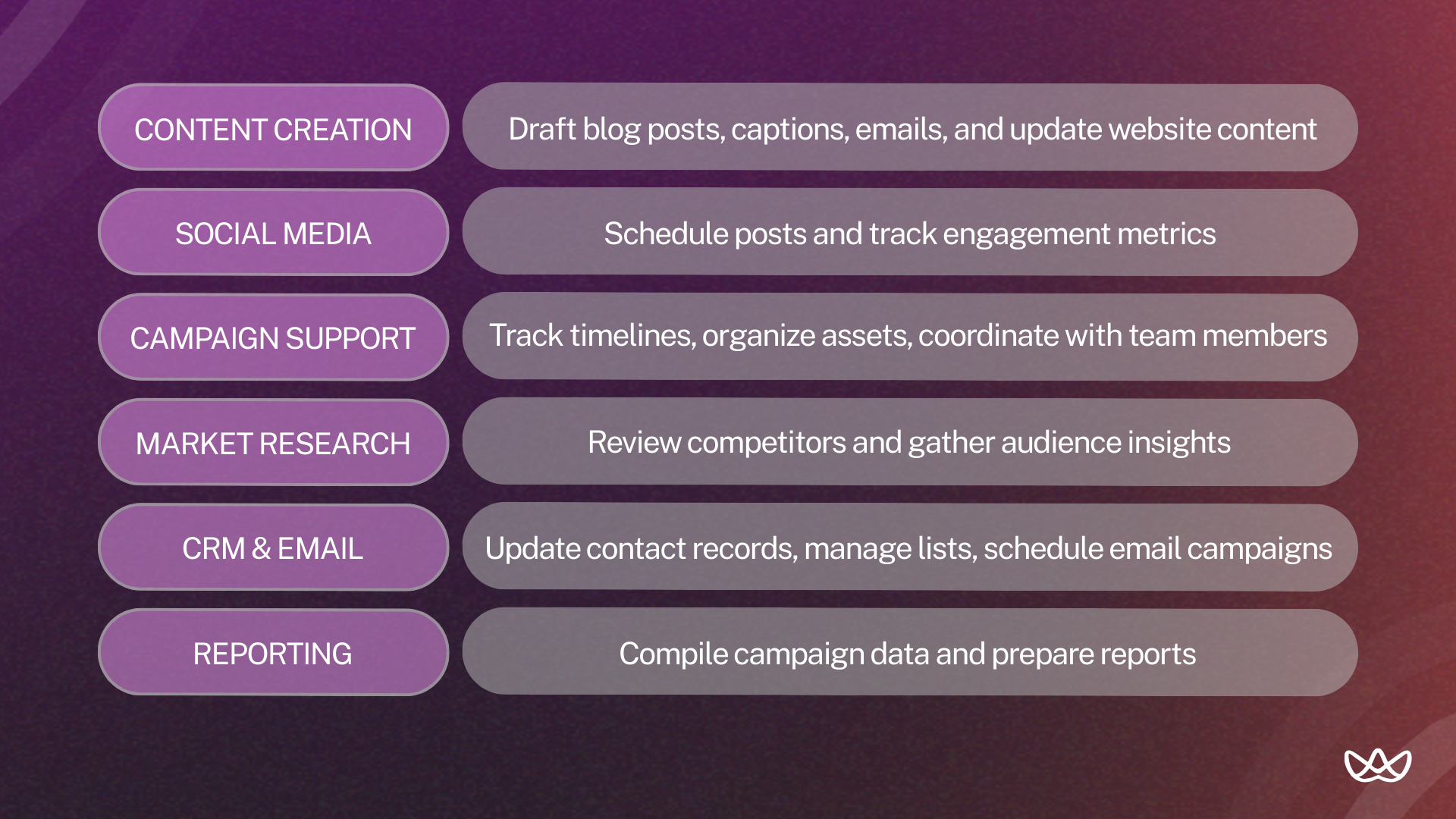
A marketing assistant handles both creative and operational tasks - often in the same day. Here's a closer look at each core area.
1. Content Creation and Editing
Content is the output most visible to audiences, and marketing assistants contribute to it at nearly every stage. They draft blog posts, write or edit social captions, proofread email newsletters, and format landing page copy. In many teams, they also source visuals, resize graphics, or update WordPress pages with new content.
The level of creative ownership varies. Some assistants write first drafts that managers refine. Others take a piece from brief to published post with minimal oversight. Either way, the ability to write clearly and edit carefully is non-negotiable.
2. Social Media Management
Social media management at the assistant level means more execution than strategy. Tasks include scheduling posts using tools like Buffer or Hootsuite, monitoring engagement (comments, mentions, DMs), and pulling basic performance metrics to share with the team.
In smaller teams, an assistant might also brainstorm content ideas, build out monthly calendars, and liaise with designers to get visuals ready on time. In larger organizations, they support a dedicated social media manager - handling the scheduling and monitoring so the manager can focus on platform strategy.
3. Marketing Campaign Coordination
Marketing assistants help organize campaign timelines and tasks. This includes tracking deadlines, ensuring campaign materials are prepared, and coordinating with designers, writers, or other team members.
The role involves keeping campaign activities organized and helping teams prepare assets before launch.
4. Market Research and Competitive Analysis
Research tasks involve collecting and organizing information. Marketing assistants review competitor websites, track industry developments, and gather audience insights.
This information helps marketing managers understand market conditions and evaluate campaign ideas.
5. CRM and Email Marketing Support
Marketing assistants often maintain CRM systems by adding contacts, updating lead information, and organizing lists.
They also assist with email marketing by preparing newsletters, importing contact lists, scheduling campaigns, and tracking metrics such as open rates and click-through rates.
6. Administrative and Reporting Tasks
Marketing teams rely on assistants for routine administrative work. This includes organizing files, preparing reports, and helping track campaign activity.
Assistants also collect data from marketing tools such as Google Analytics or email platforms and organize it into reports for the team.
What Marketing Assistants Do in Agencies vs. Corporate Teams vs. Startups
The responsibilities of a marketing assistant often depend on the type of organization. Agencies, corporate marketing departments, and startups use the role differently based on team size, campaign volume, and internal structure.
Marketing Tools Used by Marketing Assistants
Marketing assistants work with the same tools their team uses to manage campaigns, content, and data. These tools help organize tasks, publish marketing content, track performance, and maintain customer information.
Project Management Tools (e.g., Trello, Asana)
Project management tools help teams organize tasks and track deadlines. Platforms such as Trello, Asana, Monday.com, and ClickUp are widely used across agencies and internal marketing teams.
Marketing assistants often use these tools to update task progress, attach files, manage checklists, and keep campaign activities visible to the team.Email and Automation (e.g., Mailchimp, HubSpot)
Email marketing platforms support newsletter campaigns and automated messaging.
Marketing assistants use tools like Mailchimp or HubSpot to build email campaigns, manage contact lists, schedule sends, and review basic performance metrics such as open and click rates.
HubSpot is often used in organizations that combine marketing automation with CRM management.
Content Tools (e.g., Canva, Grammarly, WordPress)
Canva has become the default graphic design tool for non-designers - marketing assistants use it to resize images, create social templates, and produce basic visual assets without needing a designer for every request.
Grammarly or similar tools help catch errors before content goes live. WordPress (or similar CMS platforms) is where many assistants publish and format blog content.
Analytics (e.g., Google Analytics, SEMrush)
Analytics tools help marketing teams understand how campaigns perform.
Marketing assistants often use Google Analytics to review website traffic, check landing page activity, and track campaign sources. Tools such as SEMrush or Ahrefs support keyword research and competitor analysis.
CRM & Lead Management (e.g., Salesforce, Zoho)
CRM platforms vary by company size and industry. Salesforce dominates enterprise environments. HubSpot CRM is popular with growth-stage startups and agencies. Zoho and Pipedrive appear frequently at smaller organizations.
Marketing assistants don't typically manage the CRM architecture - they work within it, keeping records clean and supporting lead handoff between marketing and sales.
Most Popular Tools by Task Category
The following tools are commonly used across marketing teams to support different types of marketing work.
Essential Skills for a Marketing Assistant
A capable marketing assistant needs strong communication, good organization, and working knowledge of common marketing tools. These skills help them manage daily tasks and support campaign execution.

Strong Communication and Copywriting
A large portion of the work involves writing. This includes email copy, social media captions, short content drafts, and internal summaries.
Clear, direct writing helps teams move faster because content usually requires fewer revisions and explanations.
Creativity and Visual Design Awareness
You don't need a design degree to understand what makes a visual work. Marketing assistants with a sense for layout, color consistency, and brand voice tend to produce better content - and collaborate more effectively with designers.
Tools like Canva make visual execution accessible, but good judgment about what looks right still requires some creative awareness.
Time and Task Management
Marketing teams operate with deadlines everywhere. A marketing assistant who can prioritize competing requests, communicate proactively about capacity, and deliver on time without constant follow-up is worth more than one with better raw skills but poor follow-through. This is consistently one of the first things hiring managers look for.
Adaptability and Problem Solving
Marketing work often involves several tasks running at the same time. Marketing assistants need to keep track of deadlines, organize priorities, and complete tasks within campaign timelines.
Good organization helps the team keep projects moving without constant follow-ups.
Familiarity with Digital Marketing Trends
Marketing assistants also benefit from basic knowledge of digital marketing practices such as social media formats, SEO fundamentals, and email performance metrics.
Many teams also use tools that support content creation, automation, and data analysis, so understanding how these tools fit into marketing workflows can be helpful.
Soft vs. Technical Skills Comparison
Marketing assistants use both interpersonal skills and digital tools as part of their daily work.
A Day in the Life of a Marketing Assistant
Here's what a typical workday looks like for a marketing assistant at a mid-size company or agency.
9:00 AM - Review Campaign Metrics
The day starts by pulling the previous day's performance data. This might mean checking open rates on last night's email send, reviewing social engagement, or looking at traffic to a campaign landing page.
The assistant compiles notes for the weekly report and flags anything unusual for the manager.
10:30 AM - Draft Social Content
Two hours of content work - writing captions for next week's posts, sourcing images, and queuing content in Buffer or Hootsuite.
The assistant works from a monthly content calendar the team has already approved, so this is execution, not ideation. Includes a quick round of edits after feedback from the manager.
1:00 PM - Coordinate with Designer
A campaign launch is coming up. The assistant follows up with the designer on banner ad sizes, confirms the landing page copy is in the shared folder, and checks in on email header artwork.
This kind of coordination is a daily reality - not every deliverable is created by the assistant directly, but they're often responsible for making sure things arrive on time.
3:00 PM - Update CRM
After a batch of inbound leads from a recent webinar, the assistant imports contact data into HubSpot, applies the correct tags, and adds them to the appropriate follow-up sequence. They also clean a handful of duplicate records that sales flagged earlier in the week.
4:30 PM - Prepare Weekly Report
The assistant consolidates data from Google Analytics, the email platform, and social tools into a weekly performance summary. The template is already built - the job is pulling the right numbers, adding brief notes on what drove changes, and formatting it cleanly before it goes to the manager.
Example: Tasks from an Assistant at a SaaS Startup
At a 30-person SaaS startup, a marketing assistant might handle blog publishing (formatting and uploading to WordPress), building out monthly email sequences in ActiveCampaign, monitoring LinkedIn and Twitter engagement, pulling competitor content for a positioning review, and coordinating with an external SEO contractor on keyword briefs - all in the same week.
The role at a startup has less structure but more ownership, which accelerates learning considerably.
Is a Marketing Assistant Role More Creative or Analytical?
It usually includes both. Marketing assistants often work on creative tasks like writing captions or preparing content, and analytical tasks such as collecting campaign data or preparing reports.
In most cases, the role involves more execution than strategy. The exact type of work depends on the team and the type of marketing they focus on.
Marketing Assistant vs. Marketing Coordinator: What's the Difference?
The two roles support marketing teams in different ways and usually indicate different levels of experience.
A marketing assistant handles day-to-day tasks that help campaigns move forward. A marketing coordinator takes on more responsibility for organizing campaigns and managing timelines.
Industry-Specific Marketing Assistant Examples
Daily tasks for marketing assistants can differ depending on the industry and the type of marketing the organization prioritizes.
Real Estate
Marketing assistants in real estate support agents and brokerages in generating leads and maintaining visibility in local markets.
- Schedule property listing posts on Instagram, Facebook, and LinkedIn
- Send email updates to buyer and seller lead lists
- Update the website with new listings and sold properties
- Prepare reports on listing views and website inquiries
Healthcare
Healthcare marketing requires strict attention to compliance alongside traditional marketing execution.
- Schedule educational social media posts about health topics
- Manage patient review requests on platforms like Google or Healthgrades
- Support seasonal campaigns such as flu or preventive care reminders
- Update website pages with staff profiles or services
Tech Startups
At a tech startup, marketing assistants often have broader scope and move faster than in any other environment.
- Write blog posts based on keyword briefs or product updates
- Send newsletters using Mailchimp or HubSpot
- Track performance data from paid campaigns
- Monitor competitor updates or product changes
Retail & Ecommerce
Retail and e-commerce marketing assistants work in high-volume, campaign-driven environments with fast turnaround.
- Coordinate assets for product launches or sales campaigns
- Schedule promotional emails in platforms like Klaviyo
- Maintain marketing calendars for sales events
- Monitor customer reviews and social media feedback
How to Become a Marketing Assistant
Entering this role usually requires basic marketing knowledge, some practical experience, and familiarity with common marketing tools.
Education and Certifications
Many marketing assistants hold a bachelor’s degree in marketing, communications, business, or a related field. While a degree provides general marketing knowledge, employers often value practical skills as well.
Certifications can help show familiarity with widely used marketing platforms. Common options include Google Analytics (GA4), HubSpot Marketing, Meta Blueprint, and SEMrush Academy.
Building Experience with Internships
Internships often provide the first practical exposure to marketing work. They allow candidates to work with marketing tools, support campaigns, and gain experience in a professional environment.
Some candidates also build experience through small freelance projects, such as managing social media accounts, writing blog content, or helping local businesses with email marketing.
Creating a Portfolio or Resume That Stands Out
A portfolio can help show examples of work such as content writing, marketing reports, social media campaigns, or research projects.
Resumes also tend to be stronger when they include measurable outcomes. For example, describing how a campaign performed or how engagement changed provides clearer context than listing tasks alone.
Marketing Assistant Career Outlook
The career trajectory from marketing assistant is genuinely strong - particularly for candidates who develop cross-functional skills early.
Entry-Level Growth Opportunities
According to the U.S. Bureau of Labor Statistics, employment for advertising, promotions, and marketing managers is projected to grow 8% through 2033, which is faster than the average for most occupations.
For people starting as marketing assistants, this steady growth means more opportunities to move into roles such as coordinator, specialist, or manager as they gain experience.
Transitioning to Specialist or Coordinator Roles
Many marketing assistants move into more focused roles after gaining experience. Some transition into specialist positions in areas such as SEO, paid media, email marketing, or social media. Others move toward marketing coordinator roles, which involve more responsibility for organizing campaigns and managing timelines.
Progression often depends on practical experience with marketing tools, campaign workflows, and the ability to manage tasks independently.
Expected Salary Range in 2026
Salary levels vary based on location, industry, and experience. In the United States, the average salary for a marketing assistant is around $55k per year, with most roles falling between $44k and $69k annually.
Entry-level positions often start around $40k–$44k, while assistants with a few years of experience and strong platform skills can earn $55k–$65k in larger markets.
Companies exploring offshore hiring often see different cost structures. According to Floowi’s 2025 LATAM Hiring Benchmarks, hiring a marketing assistant in Latin America through a nearshore model can reduce costs by 50-70% compared with similar U.S. roles, while hiring timelines typically range from 9-15 days, compared with roughly 30-45 days for many domestic hires.
Your Next Move
For many teams, the marketing assistant role provides structured support for ongoing campaigns and marketing operations. It also gives early-career professionals exposure to the tools and workflows used across modern marketing teams.
If your team is handling growing campaign volume, adding a marketing assistant can help distribute routine work more effectively. Many companies now explore remote hiring models as part of that approach.
Start building your marketing team with a remote marketing assistant from Floowi and support your campaigns with reliable day-to-day execution. Book your free consultation today.
Frequently Asked Questions
Can a marketing assistant move into digital marketing?
Yes - and it's one of the most common paths. Many digital marketing specialists start as marketing assistants. The transition typically happens by developing depth in one area (SEO, paid media, email), earning relevant certifications, and taking on more ownership within that channel over time.
What skills do you need for a marketing assistant?
Strong written communication, time management, and basic familiarity with digital marketing tools (CMS, CRM, email platforms, analytics) are the core requirements. Adaptability and attention to detail matter at least as much as technical proficiency.
Is marketing assistant a good career?
It's a strong entry point with clear upward mobility. The role provides hands-on experience across multiple marketing functions quickly, which builds a well-rounded foundation for specialization or management later.
What does a marketing assistant do on a typical day?
A typical day includes some combination of content drafting, social media scheduling, CRM updates, campaign coordination, and report preparation. The mix varies by team and industry, but execution tasks dominate the early months.
Is a marketing assistant more creative or analytical?
Both, but the role leans toward execution rather than deep creative or analytical strategy at the entry level. Assistants who are strong in both areas develop faster and transition to senior roles more quickly.
Does a marketing assistant create content or just support campaigns?
Both - content creation is one of the primary responsibilities, not just a supporting function. Assistants write copy, format posts, build emails, and publish blog content in addition to coordinating campaign logistics.
What is the difference between a marketing assistant and a marketing coordinator?
A marketing assistant handles task-level execution within defined workflows. A marketing coordinator owns projects end-to-end, exercises more independent judgment, and may supervise junior staff. Coordinators are the next step up from the assistant role.
Can a marketing assistant work remotely?
Yes. Remote marketing assistant roles are common and have become standard at many agencies, SaaS companies, and startups. The role translates well to remote work because most of the output is digital - content, reports, scheduled posts, CRM updates, and most tools are cloud-based.
Do marketing assistants talk to clients or just internal teams?
It depends on the organization. At agencies, marketing assistants may occasionally join client calls or respond to client emails, usually with guidance. In corporate environments, the role is typically internal-facing. At startups, client communication varies by structure.
What is the main responsibility of a marketing assistant?
Supporting campaign execution. That means ensuring content is created, scheduled, and published; data is tracked and reported; systems are updated; and the team has everything it needs to keep marketing activities running on time.
Do marketing assistants create content?
Yes. Content creation - drafting blog posts, writing email copy, creating social captions, and editing existing materials - is a core part of the role at most organizations.


