

.png)
.png)



Most businesses don’t have a strategy problem. They have an execution problem. The ideas are there, the channels are chosen, but no one consistently writes the captions, sends the newsletter, publishes the blog, or pulls the reports. Marketing usually loses momentum not because the plan was wrong, but because the daily work falls behind when the team gets busy.
A Virtual Marketing Assistant fixes that gap by making sure your strategy actually gets executed, not replaced.
Let’s break down what they do, what they cost, when hiring one makes sense, and how to find the right fit without wasting time.
Key Takeaways
- What they do: Handle content creation, social media, email campaigns, SEO support, paid ads monitoring, and reporting - all remotely.
- Average cost range: $8-$25/hour depending on location and experience. Monthly retainers typically run $1,200-$4,000.
- When to hire: When marketing tasks consistently pull you away from revenue-generating work, or your output quality has dropped due to bandwidth.
- Who benefits most: Small business owners, agency founders, e-commerce operators, and startups that need consistent marketing execution without full-time overhead.
What Is a Virtual Marketing Assistant?
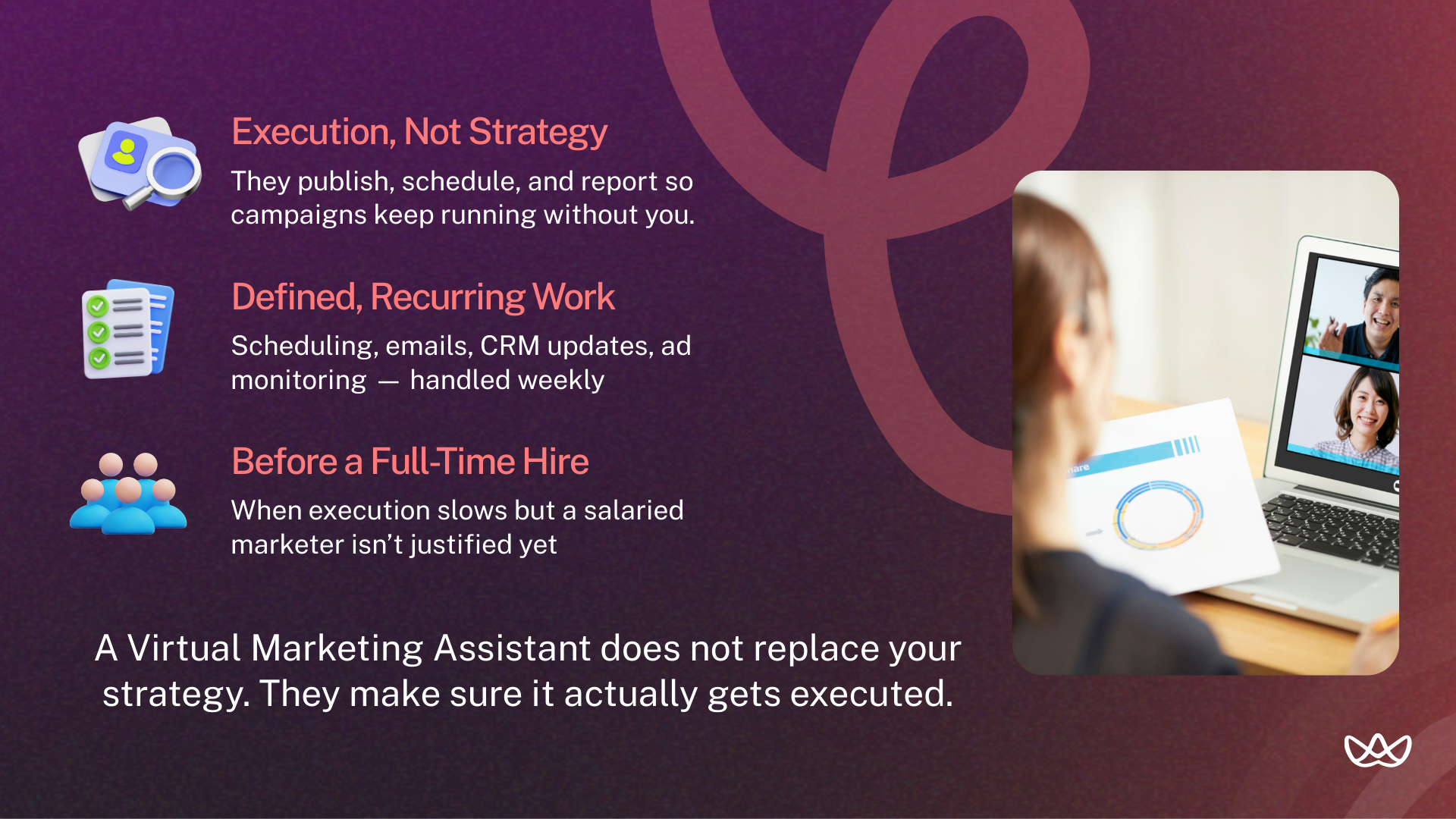
A virtual marketing assistant is a remote marketing professional who handles defined digital tasks such as scheduling social media posts, publishing blog content, building email campaigns, conducting basic keyword research, updating CRM systems, monitoring ad performance, and preparing reports, usually at a lower cost than hiring a full-time in-house employee.
They are brought in when marketing execution becomes irregular but the business does not yet need a salaried marketer. Instead of founders or account managers manually publishing content or pulling reports, the Virtual Marketing Assistant handles those recurring tasks on a set schedule so campaigns stay active and reporting follows a clear routine.
Virtual Marketing Assistant vs. Digital Marketing Assistant
A Virtual Marketing Assistant is a remote, execution-focused professional hired on a contract or flexible basis to handle defined tasks such as publishing content, setting up emails, monitoring campaigns, and preparing reports.
A Digital Marketing Assistant refers to the function, not the setup, and is often a full-time, in-house employee who supports both execution and internal coordination. This role typically comes with salary, benefits, and added overhead.
Industries and Companies That Use Virtual Marketing Assistants
Virtual Marketing Assistants are most common in businesses that need steady marketing output but run lean teams.
- Ecommerce brands - product descriptions, promo emails, content calendars
- Marketing agencies - client post scheduling, analytics pulls, report formatting
- SaaS companies - blog production, newsletters, lead nurture workflows
- Coaches and consultants - backend marketing support and funnel management
- Real estate, healthcare, legal, financial services - outsourced content and reporting support (where compliance allows)
These companies require regular marketing work to be completed on schedule but prefer not to take on the cost and long-term commitment of a full-time internal hire.
What Does a Virtual Marketing Assistant Do?
In simple terms, they handle the recurring marketing tasks that still need to get done but don’t require your direct involvement. That can include writing, scheduling, reporting, research, or basic design work, depending on their experience and your priorities.
Common Marketing Tasks Delegated:
1. Content Writing and Scheduling
Blog posts, website copy updates, caption writing, and content calendar management all fall here. A strong Marketing VA writes in your brand voice, uses a content brief or style guide to stay on track, and delivers drafts ready for a quick review rather than a full rewrite.
They also handle the scheduling side - uploading to CMS platforms, setting publish dates, and making sure content goes live on time without you touching it.
2. Social Media Campaigns
This means creating posts, writing captions, sourcing visuals, scheduling through tools like Buffer or Hootsuite, and monitoring engagement. Some Marketing VAs also handle community management - responding to comments, answering DMs within a defined timeframe, and flagging anything that needs your direct attention.
For campaign-based work, they build the content sequence, schedule it across platforms, and track performance after launch.
3. Email Newsletters and Funnels
Setting up sequences in Mailchimp, Klaviyo, or ActiveCampaign. Writing weekly newsletter copy. Building automations for welcome sequences, re-engagement campaigns, or post-purchase flows.
A Marketing VA who knows email marketing can own this entire channel once you hand them the brand guidelines, audience segments, and goals. They draft, test, schedule, and report back on open rates and click-through rates without you managing every send.
4. Keyword Research and SEO Support
Using tools like Ahrefs, SEMrush, or Google Search Console to find keyword opportunities, audit existing content for gaps, and build topic clusters.
Marketing VAs at this level are not SEO strategists - they execute the research, document findings, and help implement on-page optimizations like updating meta descriptions, adding internal links, or reformatting headers. The strategy decisions stay with you or your SEO lead; the execution workload shifts to them.
5. Paid Ads Monitoring and Reporting
Pulling campaign data from Meta Ads Manager, Google Ads, or LinkedIn Campaign Manager. Building weekly or monthly performance reports. Flagging underperforming ad sets and budget pacing issues.
Some Marketing VAs also handle basic audience updates and creative swaps under direction. This is not campaign strategy - it is the operational work that keeps your paid campaigns running cleanly and your reporting consistent.
6. Basic Graphic Design and Blog Formatting
Creating social media graphics in Canva. Resizing assets for different platforms. Formatting blog posts in WordPress or Webflow - adding headers, embedding images, setting categories and tags.
These tasks sound simple, but they eat hours when done manually at scale. A Marketing VA handles this execution layer so the content pipeline moves without constant bottlenecks.
Tasks by Assistant Type
Not every assistant does the same work. The table below compares a general VA, a Virtual Marketing Assistant, and a marketing agency so you can see which level of support fits your needs.
Is a Virtual Marketing Assistant Worth It?
In most small and mid-sized businesses, yes. If marketing tasks are being delayed, skipped, or handled by people whose time is better spent elsewhere, a Virtual Marketing Assistant usually pays for itself quickly.

ROI Explanation
Marketing performance depends on regular output. A newsletter only builds an audience when it goes out consistently, and social content only gains traction when it’s published on schedule. When those activities are postponed, results tend to slow.
For agencies, if a Marketing VA works at $15-$20 per hour and allows a senior team member to focus more on client work or sales, that shift in time allocation can justify the expense.
For founders, it becomes a question of opportunity cost: if your time is better used on revenue or product decisions, delegating routine marketing work is often a reasonable move.
Cost vs. In-House Comparison
An entry-level in-house marketing coordinator in the U.S. typically costs $42k-$55k in salary plus $8k–$15k in benefits, bringing total annual cost to roughly $55k-$75k before equipment and overhead.
A mid-level Virtual Marketing Assistant in LATAM or Southeast Asia generally costs $15k–$28k per year without benefits or office expenses on your side, and that difference in cost structure often plays a central role in the decision.
Productivity Gain
When one person is clearly responsible for recurring marketing tasks, they are less likely to be postponed.
A Marketing VA can manage 20-40 hours per week of execution work, which gives internal teams more room to focus on planning, sales, and product development instead of routine publishing and reporting.
Benefits of Hiring a Virtual Marketing Assistant
Hiring a Virtual Marketing Assistant allows you to keep marketing work moving without committing to a full-time salary, while freeing up internal time and reducing overall cost.
1. Scalability and Cost Savings
You can adjust hours based on workload. A launch might require 30 hours a week, while a slower month may only need 10. With a flexible setup, you’re not carrying a fixed salary when demand drops. You pay for what you use.
Compared to a U.S. full-time hire, costs are often 40-70% lower depending on region and experience. For businesses managing tight budgets, that difference can be redirected toward ad spend, product work, or additional support.
2. Specialized Skill Access Without Full-Time Hiring
A qualified Marketing VA usually comes with practical experience in common tools and workflows, so you’re not training from scratch.
For smaller teams that can’t justify hiring multiple specialists, one skilled VA can cover content publishing, email campaigns, reporting, and basic optimization.
3. Boost Productivity and Free Up Your Core Team
When senior team members handle routine marketing tasks, strategic work often gets delayed. A Marketing VA takes ownership of execution tasks, allowing leadership to focus on sales, partnerships, product decisions, and planning, while reducing internal slowdowns.
How Much Does a Virtual Marketing Assistant Cost?
Virtual Marketing Assistants usually charge between $8 and $45 per hour depending on location, experience, and specialization. Monthly costs typically range from $1.2k to $6k for part-time to full-time support.
U.S.-based VAs often start at $25-$45 per hour, LATAM professionals at $12–$25, and Southeast Asia at $8-$18.
Hourly and Monthly Pricing Models
Hourly pricing works well when workload varies or scope isn’t fully defined. You pay for time used, but it requires tracking and can make budgeting less predictable.
Monthly retainers offer more stability. You agree on a set number of hours or deliverables at a fixed rate, which makes planning easier once your workload is clear.
At roughly 20 hours per week, monthly costs typically range from $1.2k to $2.8k depending on region and skill level. Full-time at 40 hours per week usually runs between $2.4k and $5.5k. If you hire through a staffing platform or employer-of-record, add 15–25% for admin and compliance.
Cost Factors: Location, Experience, Niche
Virtual assistant pricing mainly depends on location, experience, and specialization.
Location has the biggest impact. Assistants in the US and Western Europe typically charge higher rates, while regions like Latin America and Southeast Asia often offer more affordable options with strong talent pools.
Experience also matters. Junior assistants handle basic admin tasks, mid-level assistants manage operations and coordination, and senior assistants take on higher-level work like project management and systems setup.
Specialized skills can raise rates further. Assistants with expertise in areas like CRM tools, bookkeeping, marketing operations, automation, or e-commerce platforms typically charge more.
Average Rates by Region & Experience
Rates differ significantly by location and experience level. The table below provides a general benchmark to help you set a realistic budget and compare local versus international candidates.
Skills to Look for in a Virtual Marketing Assistant
Always look for someone who can handle defined marketing tasks independently, communicate clearly, and work confidently in the tools your business already uses.
Technical Marketing Skills (SEO, CRM, PPC)
A capable Virtual Marketing Assistant should know how to work inside marketing platforms, not just navigate them. For SEO, that means reviewing keyword intent, checking Search Console data, and making on-page updates correctly.
For CRM work, it includes building email sequences, segmenting lists, and reviewing campaign results in tools like HubSpot or Mailchimp.
In paid ads, their role is operational, which involves pulling reports, monitoring spend, uploading new creative, and flagging unusual performance changes while strategic decisions remain with you or your marketing lead
Soft Skills: Communication, Organization, Creativity
Clear communication reduces delays and rework. A strong candidate confirms instructions before starting, asks relevant questions early, and delivers work without repeated follow-ups.
Organization also matters because marketing tasks connect across channels and deadlines, so the VA should manage their own task lists and raise conflicts before timelines are affected.
Creativity in this role means writing copy that fits your brand voice and selecting visuals that align with your messaging.
Experience with Tools (Canva, Mailchimp, HubSpot)
A Marketing VA who already works in platforms like Canva, Mailchimp, WordPress, and Google Analytics can contribute faster than someone learning them from scratch.
Here are the core tool areas to verify:
In-House Marketer vs. Virtual Marketing Assistant
Choosing between an in-house hire and a Virtual Marketing Assistant isn’t only about cost. It affects how your marketing work is organized and managed day to day.
If your marketing requires close collaboration across teams and long-term internal depth, an in-house role may be appropriate. If you mainly need defined marketing tasks handled efficiently and at lower cost, a Virtual Marketing Assistant is often the better fit.
When Should You Hire a Virtual Marketing Assistant?
The honest answer is: when the cost of not hiring is higher than the cost of hiring. That happens at different stages for different businesses.
Revenue Stage
Businesses generating roughly $250k–$500k annually often have enough recurring marketing activity to justify part-time support.
Below that range, a smaller engagement may be more appropriate. Once revenue moves beyond $500k, a full-time Virtual Marketing Assistant can be sustainable if the workload is consistent and clearly defined.
Team Size
Solo operators and teams of two to five are the most common profile for a first Marketing VA hire. You are too small for a full marketing department but too busy to keep doing everything yourself. A VA fills the execution gap without adding the overhead of a full-time employee.
Agencies with five to fifteen employees often hire multiple VAs - one per client vertical or one per function. The leverage model works at scale here because each VA handles execution for one or more client accounts while senior staff focus on strategy, client relationships, and growth.
Marketing Maturity
They work best when you have a clear direction. If you have defined your brand voice, know which channels matter for your audience, and have some content or campaign infrastructure in place, a Virtual Marketing Assistant can slot in and execute.
If you are still figuring out positioning, messaging, and channel strategy, you need a strategist first - not a VA. Giving someone execution work before the strategy is clear produces consistent but wrong output.
Founder Bandwidth
If you are spending more than five hours per week scheduling posts, formatting blogs, building email campaigns, or pulling reports, and that time is taking you away from sales or product decisions, it is worth evaluating whether those tasks should remain on your plate.
Once you consider what your time contributes to the business, the decision becomes easier to assess.
How to Hire a Virtual Marketing Assistant
Hiring well is less about speed and more about clarity. If expectations are defined early, the process is simple.
- Define KPIs before writing the job post. Decide what success looks like in 30, 60, and 90 days. That might include posting frequency, email open rates, or report turnaround time. Clear metrics make screening and evaluation easier.
- Write a role-specific job description. List the platforms they will manage, the tools required, the deliverables they will own, and the expected hours. Specific descriptions attract candidates with relevant experience.
- Prepare simple SOPs for recurring tasks. Document three to five core workflows before the hire begins. This reduces onboarding time and prevents early confusion.
- Review portfolios for results, not just design. Ask for engagement rates, list growth, traffic increases, or campaign outcomes. Performance data gives you a better picture than visuals alone.
- Assign a short paid technical test. A small task, such as drafting captions, building a two-week content calendar, or summarizing sample analytics, shows how they think and communicate under real conditions.
- Set a 30–60 day trial period. Define what will be evaluated and how progress will be measured so both sides understand expectations.
- Run a structured performance review at the end of the trial. Compare outcomes to the KPIs you defined earlier and decide whether to continue, adjust scope, or end the engagement based on documented results rather than impressions.
Where to Find Qualified Virtual Marketing Assistant
You can source Virtual Marketing Assistants through a few main channels, each with a few considerations.
Vetted staffing platforms like Floowi that specialize in remote talent, especially in LATAM, provide pre-screened candidates who have already been evaluated for language and marketing skills, which reduces screening time on your end.
Freelance marketplaces like Upwork can work for short-term or trial engagements, but quality varies and requires more hands-on vetting. LinkedIn is useful for direct outreach and background review. Traditional job boards often bring high application volume, though not always strong alignment for specialized roles.
Referrals from other founders or agency operators tend to be the most reliable starting point since the candidate has already proven themselves in a similar environment.
How to Onboard and Set Clear Goals
Week one should focus on orientation: reviewing brand guidelines, auditing existing channels, meeting key team members, and setting up tool access. Large deliverables during the first week are usually unrealistic.
By week two, you should see initial output such as a draft content calendar or sample posts. Weeks three and four should move toward more independent execution, with regular check-ins during the first month. As expectations become clear, the need for frequent oversight typically decreases.
Tips for Working Successfully with a Virtual Marketing Assistant
Working well with a Marketing VA generally depends on three things: clear communication, organized workflows, and regular feedback.
Set Clear Communication Channels
Decide upfront where communication happens and how quickly responses are expected. You might use Slack for day-to-day questions, email for formal updates, and Loom for walkthroughs.
When channels aren’t defined, small tasks get delayed. A short Loom explaining a workflow is often clearer than a long written brief.
Use Task Management Tools
Pick one system such as Asana, Trello, ClickUp, or Notion and use it consistently. Keep all tasks in one place with clear deadlines and ownership. When priorities are visible, it’s easier for a Marketing VA to manage their workload without constant follow-ups.
Review Performance with KPIs
Set a regular cadence to review the KPIs you defined at hire, whether that’s posting frequency, engagement rate, email performance, or report delivery timelines. A simple monthly review helps keep expectations aligned and gives you a chance to adjust scope before small issues become ongoing patterns.
Is a Virtual Marketing Assistant Right for You?
If your marketing execution is inconsistent, your team is stretched, and the tasks piling up are things you know someone else could handle with the right brief - yes. A Virtual Marketing Assistant is the right move. The cost is manageable, the ramp-up is faster than a full-time hire, and the leverage is real.
If you are still in the early stages of figuring out your strategy, channel mix, or brand positioning - get that clarity first. A Marketing VA amplifies what you already have. They do not build what does not exist yet.
Your Next Move
A Virtual Marketing Assistant doesn’t replace strategy. They handle defined marketing tasks so execution stays on track without adding a full-time salary. For many small teams, that setup is often more workable than hiring in-house too early.
If you’re considering it, start here:
- List the marketing tasks you handled last week.
- Mark the ones that didn’t require your strategic input.
- Document short SOPs for those tasks.
- Define clear KPIs for how performance will be measured.
- Start part-time and review performance after 60 days.
If execution improves and your time shifts back to higher-impact work, expand the scope gradually.
If you want pre-vetted LATAM Marketing VAs without handling the screening yourself, book a consultation with Floowi and review qualified candidates within days.
Frequently Asked Questions
How do I know if my business is ready to hire a Virtual Marketing Assistant?
If marketing tasks are regularly delayed or rushed because no one has the time, that’s usually the signal. Another way to look at it is this: if someone handling 10–20 hours of execution per week would clearly free you up to focus on revenue or product work, it’s likely time to hire.
What tasks should I outsource first to a Virtual Marketing Assistant?
Start with recurring tasks that follow a clear process, such as scheduling social posts, sending newsletters, formatting blog content, and pulling analytics reports. These are structured, easy to document, and lower risk to delegate. Once performance is consistent, you can expand scope.
What’s the difference between a Virtual Marketing Assistant and a marketing agency?
A marketing agency typically provides strategy and multi-person execution under one retainer, often in the $5k–$15k per month range. A Virtual Marketing Assistant works under your direction and focuses on execution, usually in the $1.5k–$4k per month range. Agencies make sense when you need strategy and leadership. A VA makes sense when you already have direction and need reliable support.
How many hours per week should I hire a Virtual Marketing Assistant for?
List your recurring tasks and estimate the real time required. Many first-time hires fall in the 15–25 hour per week range. If you’re managing multiple channels plus reporting and content production, 30–40 hours may be more realistic. Hiring too few hours for a larger workload often creates frustration on both sides.
Can a Virtual Marketing Assistant manage my entire marketing strategy?
No. A Marketing VA executes strategy but does not define it. If you need someone to set positioning, choose channels, or make high-level campaign decisions, that’s a senior marketing manager or fractional CMO role. A VA adds value when the direction is already clear.
What tools should a Virtual Marketing Assistant already know?
Expect familiarity with at least one scheduling tool, one email platform, Canva, a CMS like WordPress, Google Analytics, and a project management tool. Strong candidates may also know Meta Business Suite or basic Google Ads reporting. If they need to learn your stack, assess how quickly they adapt during the hiring process.
How long does it take to see results after hiring a Marketing VA?
Execution improvements are usually visible within the first few weeks, such as content going out on time and reports arriving as scheduled. Measurable performance improvements, like higher engagement or traffic, typically take a few months since marketing results build over time.
What KPIs should I track when working with a Virtual Marketing Assistant?
Track consistency first: posting frequency, email delivery, and report timeliness. Then monitor engagement rate, email open and click-through rates, and content output volume. These metrics show whether execution is reliable and whether performance is improving.
Is it better to hire one Marketing VA or multiple specialized assistants?
Start with one generalist who can manage your main channels. If a specific area, such as email or short-form video, requires deeper expertise later, add a specialist. Managing multiple assistants too early can create unnecessary coordination work.
What is the average salary of a Virtual Marketing Assistant?
Annual compensation typically ranges from $15k to $55k depending on location and experience. Mid-level LATAM VAs often earn $18k-$28k per year, Philippines-based VAs around $14k–$22k, and U.S.-based remote VAs $45k-$65k. When comparing options, consider total cost, not just base pay.
Can a Virtual Marketing Assistant handle SEO and paid ads?
Yes, within limits. A Marketing VA can handle keyword research, on-page updates, report pulling, pacing checks, and asset uploads. Strategic decisions such as campaign structure, budget allocation, or technical SEO audits are typically handled by a more senior specialist.


