

.png)



TLDR: Freelance video editors on Upwork run $15–$150+/hr depending on experience. US in-house salaries land between $45K and $133K+/yr before benefits. Dedicated nearshore editors from Latin America cost $2,500-$4,500/month all-in. The right number depends on whether you need a one-time deliverable or a recurring production function.
Short-form video is now a standard line item on almost every agency retainer. Reels, YouTube Shorts, ad creatives, client testimonial cuts, not add-ons, not upsells. Baseline deliverables that go out every week.
Most agencies are trying to fulfill that volume through Upwork. The job gets posted, 30 proposals come in, someone gets hired, and by day three the account manager is rewriting the brief because the editor cut the wrong version of the client's intro. Two revision rounds later, the reel ships a day late with the wrong aspect ratio for Stories.
That is not a bad hire. That is the wrong model for the work. A $35/hr editor who needs a full brief, runs two revision cycles, and is unavailable next week because they picked up another client does not cost $35/hr once the account manager's time gets counted. The rate on the invoice is not the cost.
Let’s break down what video editors actually cost in 2026 - by engagement type, experience level, and region, so the sourcing decision is based on real numbers.
Quick Answer: Video Editor Cost at a
Freelance Video Editor Rates
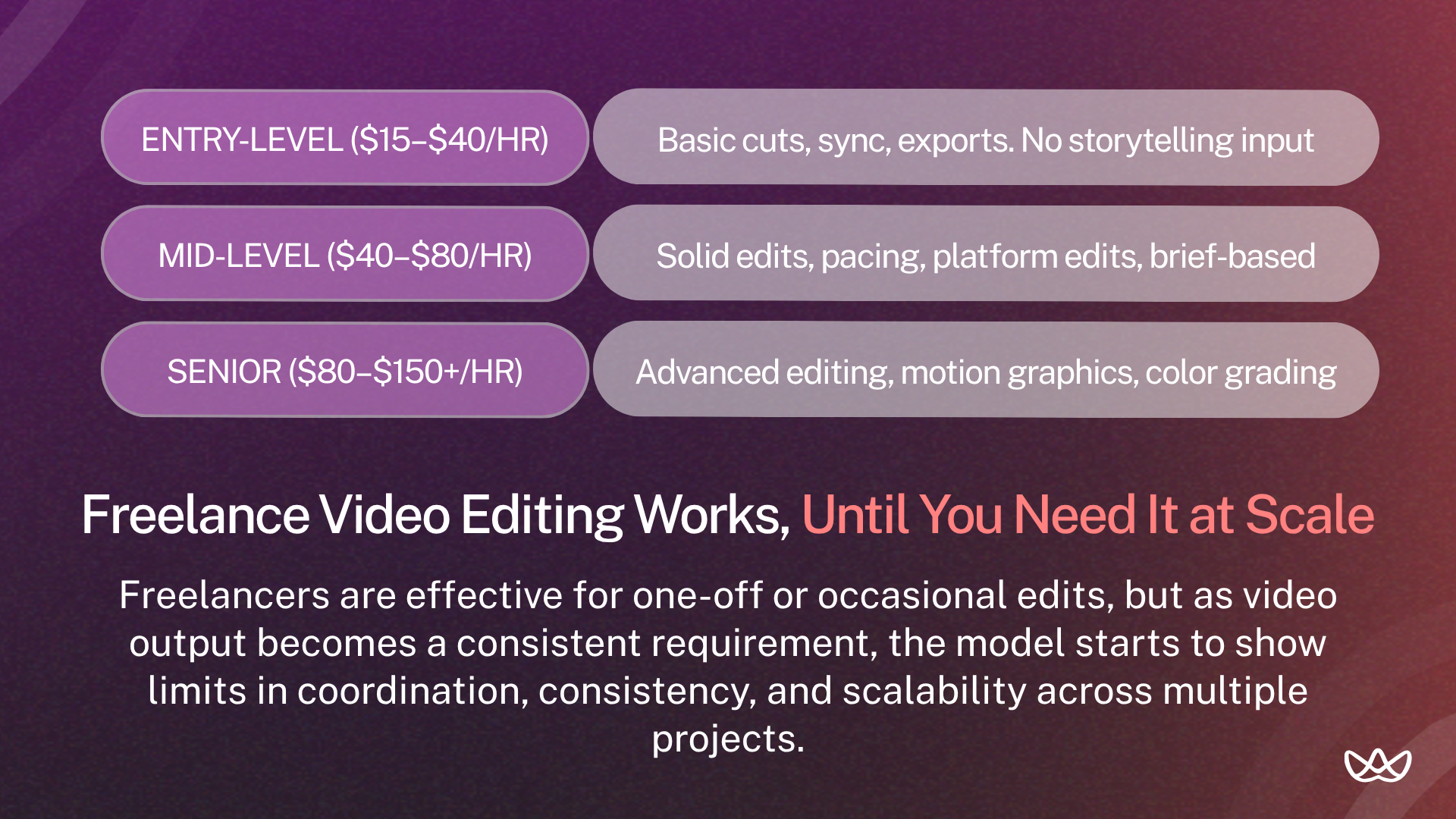
Freelance marketplaces remain the go-to for agencies that need quick, project-based video editing. The rate spread is wide, what matters is what you get at each tier, not the average.
Entry-Level Freelance ($15-$40/hr)
Entry-level editors on Upwork charge $15–$40/hr. At this tier, the editor can cut footage, sync audio, and export to spec. Pacing judgment, platform-native storytelling, and brand-specific decision-making are not part of the package.
This range works for internal videos, raw interview cuts, or anything where the brief is fully locked and the output is straightforward. For client-facing social content, quality inconsistency becomes a problem fast.
Mid-Level Freelance ($40-$80/hr)
This is the most common range for agencies doing recurring freelance work. While the platform median sits around $35/hr, editors with solid portfolios, verified reviews, and established platform history typically charge $40–$80/hr.
At this level, editors understand pacing and platform nuances, handle basic color correction, and can execute from a clear brief without much direction. The limitation is consistency across context. Execution is reliable, but every project still requires a complete brief, and there’s no retained understanding of the brand between assignments.
Senior/Specialist Freelance ($80-$150+/hr)
Senior freelancers and specialists with broadcast or agency backgrounds, motion graphics expertise, or advanced color grading skills typically charge $80–$150+/hr on Upwork. For product launches, brand campaigns, or any work where quality is non-negotiable, this tier is often the right fit.
The limitation is volume. A $120/hr editor is not a sustainable structure for an agency producing 15–20 social videos per client each month. At that point, the workflow model needs to change before the cost equation does.
In-House Video Editor Salaries (United States)
Hiring in-house changes the cost structure entirely. The cost is no longer tied to hours or projects. It becomes a fixed annual commitment that continues whether the queue has three requests or thirty.
Video editor salaries in the US average around $45k and can reach up to $133k+, with top production-heavy roles exceeding $150k.
Junior Editor Salary
Junior video editors in the US earn $45k–$55k/yr, with entry-level distribution typically clustering around the low $50ks. These editors usually have 1–3 years of experience, are proficient in Premiere Pro or Final Cut, and can execute straightforward edits from clear direction.
This level works best for execution-heavy tasks. Output is solid when direction is precise, but consistency depends heavily on how well the brief is structured.
Mid-Level Editor Salary
Mid-level video editors in the US typically earn $55k–$75k/yr, with the broader market average sitting around the low $70ks. Across the industry, median compensation lands in the high $60ks.
This is the most balanced in-house hire. They can manage full edits independently, but still rely on clear brand systems to maintain consistency at scale.
Senior Editor / Video Producer Salary
Senior video editors and video producers earn $76k–$133k/yr, with top-tier roles reaching into the $170k+ range. Positions that include motion graphics, production ownership, or creative direction sit at the higher end.
At this level, creative direction often becomes part of the role itself. The cost is higher, but one strong senior hire can replace multiple fragmented roles if fully utilized.
True Cost Reality:
Benefits, payroll taxes, 401(k), and paid leave add 20–30% on top of base salary. A $70k editor effectively costs $84k–$91k/yr before software, equipment, and management overhead.
Most teams underestimate this layer. The real constraint is rarely salary alone, but how consistently the role is actually utilized.
Offshore & Nearshore Video Editor Rates
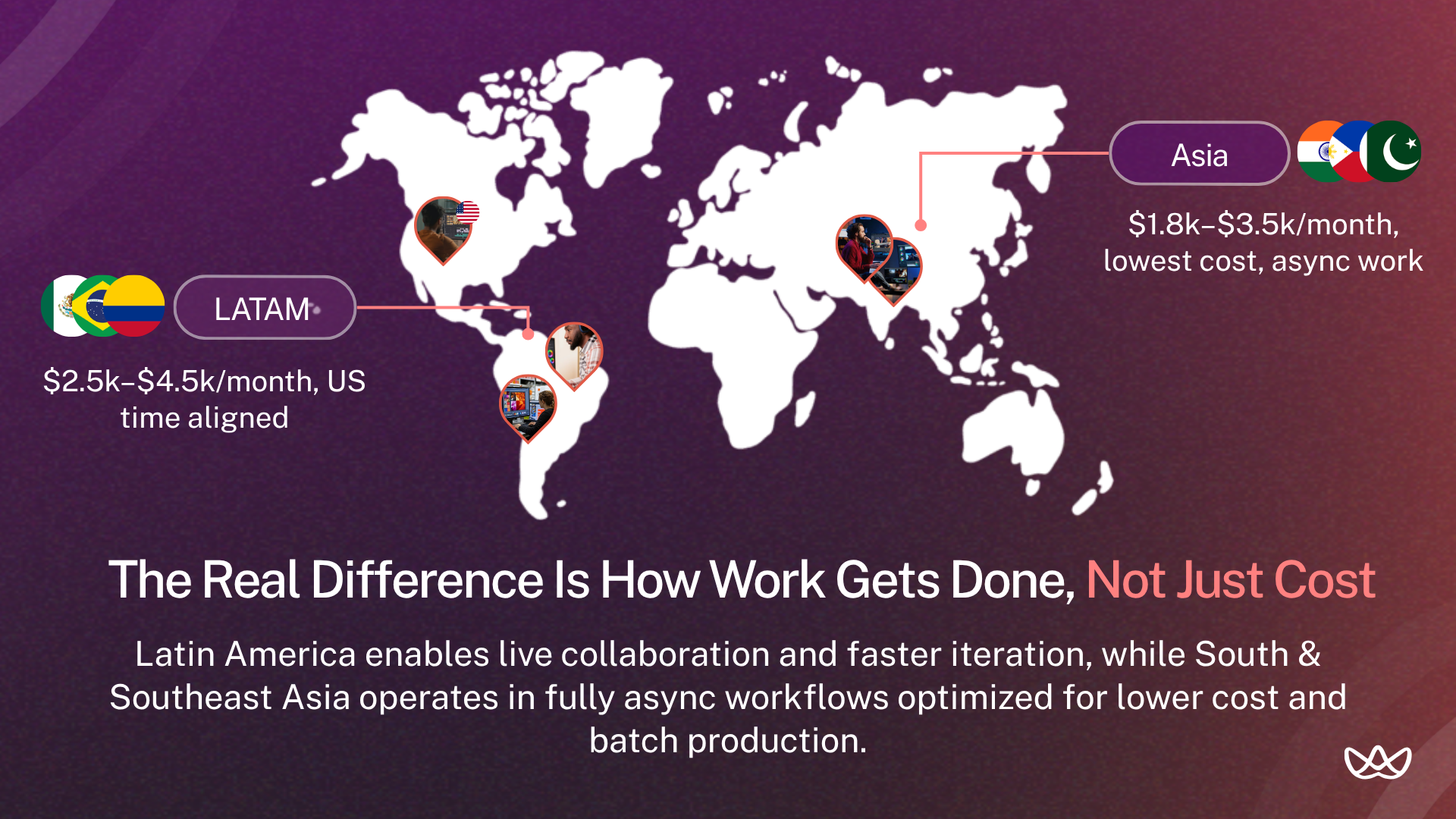
This is where the cost conversation becomes relevant for growing agencies that are already spending real money on video production.
Across nearshore markets, video editor costs average roughly $2.5k–$4.5k/month depending on region and experience
Latin America (Mexico, Colombia, Argentina)
Dedicated full-time video editors hired through nearshore partners in Latin America typically cost $2.5k-$4.5k/month all-in. This includes compensation, partner fees, HR, payroll, and local compliance, with no separate benefits or equipment overhead.
On freelance platforms, LatAm editors typically charge $15-$40/hr, which overlaps with US entry-to-mid-level rates. The real advantage shows up in the dedicated model, where consistency and workflow efficiency start compounding into actual cost savings.
Time zone alignment is the main operational driver. Colombia runs on EST, Mexico aligns with CST, and Argentina and Chile sit close to ET+1. This enables same-day feedback, real-time standups, and faster iteration cycles instead of delayed async loops.
For agencies cutting social content weekly and re-briefing a different editor every time, the option to hire a video editor from Latin America through a vetted nearshore partner changes the operational model entirely.
South & Southeast Asia
Dedicated video editors in South & Southeast Asia (primarily India, Pakistan, Bangladesh, and the Philippines) typically cost $1.8k-$3.5k/month full-time. Freelance rates range from $10-$30/hr.
The main advantage is cost efficiency at scale. For high-volume, repeatable work like batch social clips, YouTube content, or templated ad edits, the lower cost structure works well. The trade-off is the 10-13 hour time difference with US Eastern time.
This model works best when workflows are fully async with clearly defined specs. Teams that rely on live iteration or same-day feedback loops tend to struggle compared to nearshore setups.
Eastern Europe
Editors from Poland, Ukraine, Romania, and Serbia typically operate on a freelance or project basis, ranging from $25-$60/hr. The region has strong technical depth, especially in narrative, documentary, and long-form editing.
For US agencies building dedicated teams, the 6–9 hour time gap and stronger nearshore alternatives in Latin America make this a less common choice for ongoing production roles.
How Much Does YouTube Video Editing Cost?
YouTube editing is its own category with its own pricing logic. Retention-optimized cuts, chapter structure, thumbnail alignment, and platform-native pacing are different skills from standard video production, and the volume expectations are typically higher than any other format.
For short-form content - YouTube Shorts, Reels, TikTok cuts, freelance rates on Upwork run $15-$40/hr for basic edits. For long-form YouTube content with retention editing, custom graphics, and proper audio mixing, expect $50-$100/hr from an experienced freelancer, or $200-$600 per finished video on a fixed-price basis depending on length and complexity.
Retainer Models for Creators
Most YouTube-focused editors move to monthly retainers rather than per-video pricing once the channel is producing consistently. A typical retainer for 4-8 long-form videos per month runs $800–$2,500/month from a freelancer, depending on turnaround and complexity.
For agencies managing YouTube channels across multiple clients, the per-video model compounds fast. At 8 videos per client per month at $300 per video, that is $2,400/month in variable spend, with no retained brand knowledge, no consistency between editors, and no buffer when the freelancer is unavailable.
A dedicated offshore video editor in LatAm at $2,500-$3,000/month gives full-time capacity that builds client knowledge over time, not just capped output.
Factors That Change Video Editor Pricing
Not all video editing work is priced the same way. These variables typically move the rate up or down regardless of the engagement model.
- Experience and portfolio depth: Editors with broadcast backgrounds or recognizable brand work in their portfolio charge more. For high-stakes deliverables, that premium is usually justified.
- Software stack: After Effects, DaVinci Resolve color science, and Cinema 4D integration command higher rates than Premiere Pro generalist work. The tools on the brief determine which tier is actually required.
- Turnaround time: Rush delivery, anything under 48 hours - adds 25–50% to marketplace rates. That premium needs to be in the budget before the deadline appears.
- Motion graphics: An editor who animates lower-thirds, intros, and transitions is a different hire from a straight-cut editor. Motion graphics capability typically adds $15–$40/hr to freelance rates.
- Color grading: Basic color correction is standard at most tiers. Broadcast or commercial-grade color grading is a separate specialty. DaVinci Resolve-level work needs to be scoped and budgeted separately, not assumed.
- Client industry: Legal, financial, and healthcare content often requires familiarity with compliance review processes. That industry knowledge adds cost and should be screened for during hiring.
- Rights management: Music licensing, stock footage rights, and broadcast clearances are not included in most editors' base rates. Confirm the scope before the project starts, not after.
How to Choose the Right Video Editor Engagement
The engagement model should follow the work structure, not the rate card.
Volume of work. One video this quarter means a marketplace is the right tool. Weekly video production across multiple client accounts means the team needs capacity - a dedicated hire, not a rotating contractor.
Budget structure. Marketplace rates are flexible but variable and hard to forecast. In-house salaries are fixed and carry a benefits burden. Nearshore dedicated is fixed, predictable, and typically 40–55% below US in-house fully-loaded cost according to Floowi's 2025 LATAM hiring benchmarks.
Timeline to start. Marketplace hires can start in 24–48 hours. Nearshore dedicated hiring through a vetted partner takes 9–15 days. US in-house hiring typically runs 60–90 days before someone is seated and productive.
Brand knowledge needs. A freelancer delivers to spec. Without months of repeated work on the same accounts, a freelancer cannot build working knowledge of a client's preferred pacing, revision patterns, or creative voice. When brand consistency is tied to client retention, the engagement model has to support continuity.
The decision simplifies once the work is categorized correctly. Transactional, scope-defined output goes to freelancers. Recurring production with consistency requirements goes to a dedicated hire.
Hire a Pre-Vetted Video Editor from Latin America
For agencies producing video on a recurring basis and already spending more than $1,500/month on marketplace freelancers for that work, the numbers usually support making the shift to a dedicated nearshore hire.
Floowi places pre-vetted video editors from Latin America with US agencies and brands. Every candidate goes through portfolio review, technical assessment, English proficiency interviews, and culture-fit screening before a shortlist reaches the client. Time to hire runs 9–15 days. HR, payroll, and local compliance are handled on the Floowi side.
Start hiring with Floowi or book a free consultation to walk through the right setup for your production volume.
Frequently Asked Questions
How much should I pay a freelance video editor in 2026?
Entry-level freelancers on Upwork run $15-$30/hr. Mid-level editors with a solid portfolio and strong reviews charge $40-$80/hr. Senior and specialist editors with motion graphics, broadcast experience, or niche industry knowledge charge $80-$150+/hr. The Upwork median sits around $35/hr. The rate should match the complexity and stakes of the work, not just the lowest available number in the proposal list.
What is the average salary for a video editor in the US?
Video editor salaries in the US average around $45k and can reach up to $133k+, with top production-heavy roles exceeding $150k. Add 20-30% for employer-side benefits and taxes to estimate the fully-loaded annual cost.
Is it cheaper to hire a nearshore video editor?
Yes, significantly. Across nearshore markets, video editor costs average roughly $2.5k–$4.5k/month depending on region and experience.
The key advantage is operational alignment with US teams. Similar time zones enable real-time collaboration, faster feedback cycles, and easier daily communication. This reduces revision delays and makes it easier to run a predictable weekly production pipeline without async bottlenecks.
Is it cheaper to hire a South & Southeast Asia video editor?
Yes, and it offers the lowest cost base. Dedicated video editors in South & Southeast Asia (primarily India, Pakistan, Bangladesh, and the Philippines) typically cost $1.8k–$3.5k/month full-time. Freelance rates range from $10-$30/hr.
The main drawback is the 10-13 hour time difference with US teams. Work is largely async, which can slow iteration cycles and create delays in feedback loops. This model works best when briefs are highly structured and edits are batch-processed rather than iterated in real time.
How much do YouTube video editors charge?
Short-form editing runs $15–$40/hr from mid-level freelancers. Long-form YouTube editing with retention cuts, graphics, and audio typically runs $50–$100/hr or $200–$600 per video on a fixed-price basis. Monthly retainers for 4–8 long-form videos usually fall between $800 and $2,500 for freelancers, or the equivalent of a full-time dedicated editor for consistent production needs.
What is the difference between hiring a freelance vs. dedicated video editor?
A freelance editor works project to project and requires a fresh brief each time. It is fast to start and flexible on scope, but brand knowledge resets with every engagement. A dedicated editor, whether in-house or through a nearshore or offshore partner, works inside the team, builds familiarity with brand preferences over time, and reduces briefing and revision overhead. For agencies producing weekly content, the dedicated model usually delivers more consistency and predictable output.
What factors increase video editor rates?
Rush turnaround, motion graphics capability, advanced color grading, software specialization, broadcast or commercial experience, and niche industry knowledge all increase rates. Motion graphics is usually the biggest premium, with editors who animate as well as edit charging 30–50% more than straight-cut editors at the same experience level.




