






Most companies don't plan to outsource graphic design. They end up there after the same sequence of events: the team grows, content demands increase, and suddenly the design queue is the thing holding every campaign back. A full-time hire takes too long and costs too much. Freelancers are inconsistent.
According to Statista, graphic design is the most outsourced marketing content service worldwide, ahead of video and copywriting. Design execution doesn’t need to live inside your headcount to be reliable and on-brand.
Let's see how to outsource graphic design services effectively in 2026: when it makes sense, which model fits your situation, what it costs by region, and what separates a productive partnership from a frustrating one.
Graphic Design Outsourcing at a Glance
Here's an overview of the main outsourcing models to orient you before we get into the details.
When Should You Outsource Graphic Design?
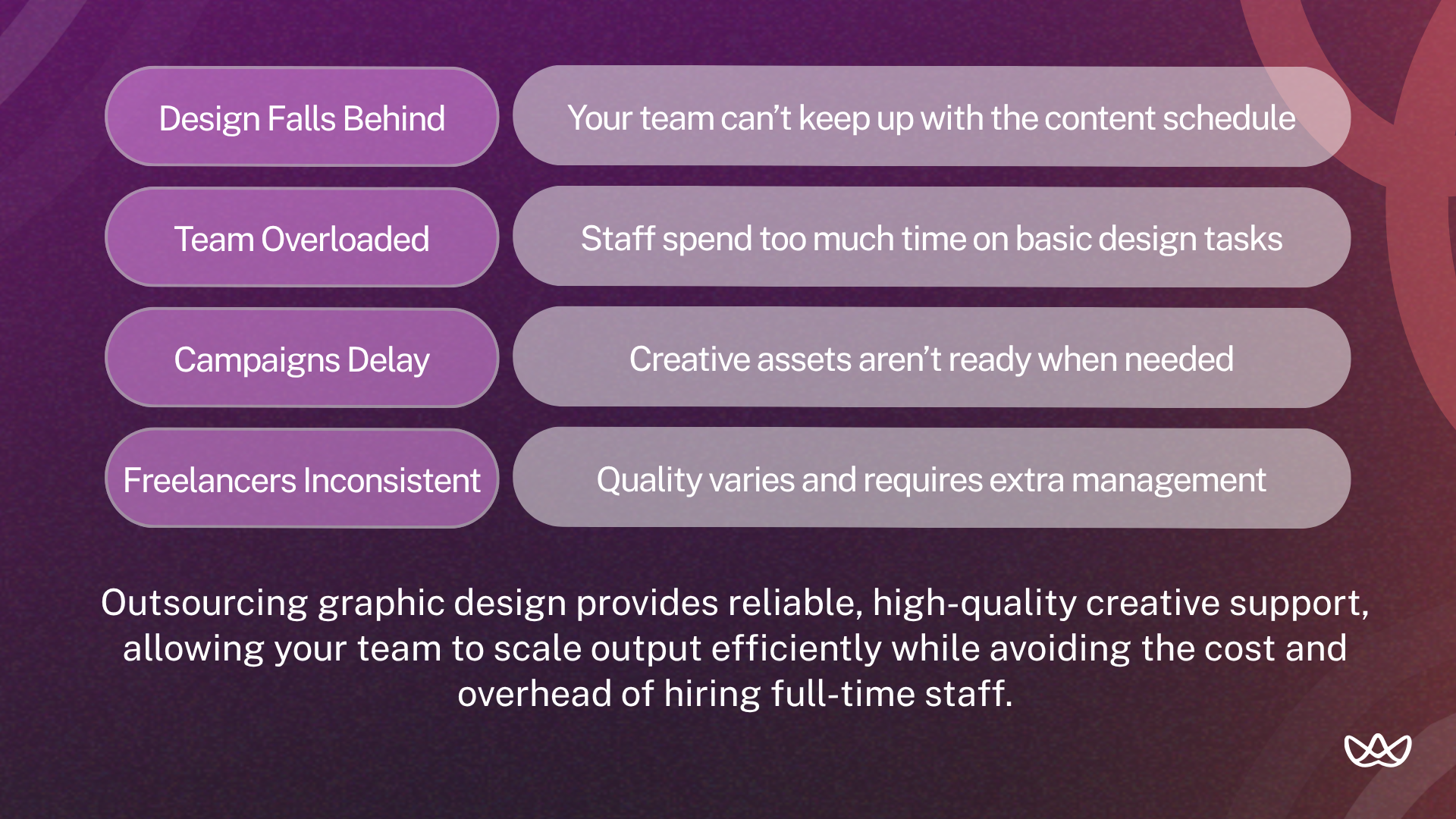
You should consider outsourcing graphic design when your team can’t keep up with content demand, deadlines are slipping, or campaigns are delayed due to unavailable design resources. Outsourcing becomes the most effective way to increase creative output without the overhead of hiring full-time staff.
Signs It's Time to Outsource
Most teams don't make a deliberate decision to outsource. The decision makes itself when the following start happening regularly.
- Your content calendar is set but design output consistently lags behind it.
- Your marketing manager is handling Canva edits because there's no one else.
- You're delaying campaign launches because assets aren't ready.
- You've tried freelancers but quality is inconsistent and briefing eats up more time than it saves.
These are signs that creative production has outpaced your current setup. At that point, adding outsourced design support isn't a cost decision. It's an operational one.
Your In-House Team vs Outsourced Support
An in-house designer gives you proximity, deep brand knowledge, and immediate availability for real-time collaboration. The tradeoff is cost and skill ceiling.
A single full-time graphic designer in the US earns $50k–$85k per year in base salary, and once you add benefits, software licenses, equipment, and recruiting costs, the actual total comes to $60k–$100k annually for one person covering one skill set.
Outsourced graphic design spreads that cost across only what you actually need. You get access to a broader range of skills, faster ramp-up, and the ability to scale output without a new hire cycle every time demand increases.
Cost vs Value: When Outsourcing Makes Financial Sense
Outsourcing is ideal when design is a support function rather than your core product, which is true for most agencies, marketing teams, and growth-stage companies.
A dedicated offshore graphic designer from LATAM typically costs $1.4k–$3k per month through a managed partner, less than a quarter of a US-based in-house hire. That cost covers recruiting, payroll administration, HR support, and the designer's compensation it's the total client cost, not just a salary figure. For regular social media content, ads, email graphics, and presentations, the output per dollar is far higher.
Outsourcing is less effective when volume is too low for a retainer, work demands constant in-person collaboration, or brand guidelines require deep institutional knowledge. In those cases, in-house remains the better option.
How to Outsource Graphic Design: Step by Step
Getting outsourced design right isn't complicated, but it does require doing a few things in the right order. Here's the process that works.
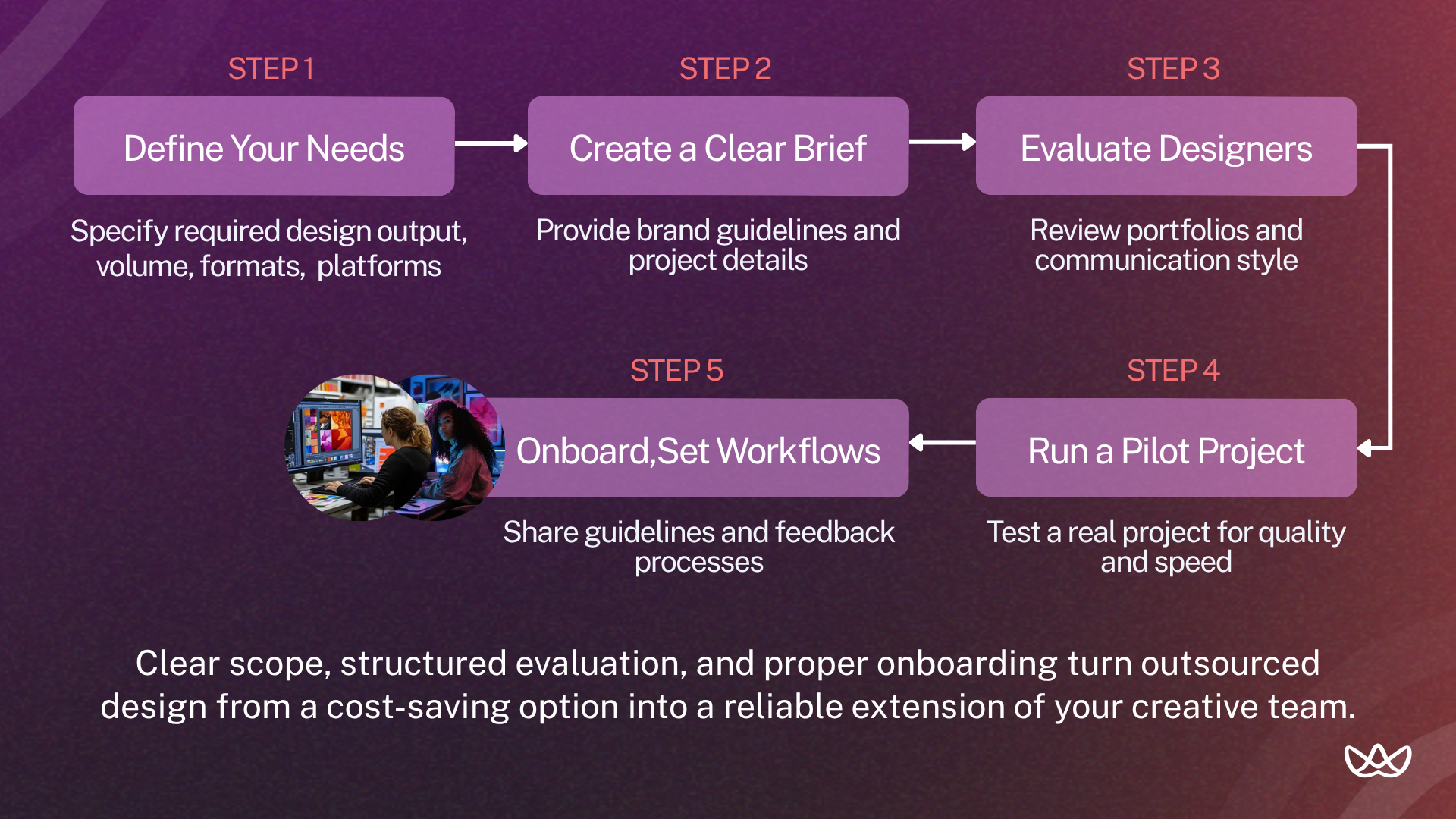
Step 1: Define Your Design Needs and Scope
Before contacting any provider, write down what you actually need. Not in general terms like "marketing design support." Specifically: how many social media posts per week, how many email headers per month, what ad formats, what platforms, and what level of creative direction you can provide.
This matters because different providers are built for different volumes and formats. A freelancer is fine for occasional logo work. A subscription service works for teams submitting 10–20 requests per month. A dedicated designer makes sense when you need someone embedded in your workflow full-time.
Get the scope on paper first. Every other decision flows from it.
Step 2: Create a Clear Creative Brief
A vague brief produces vague design. Before your first project with any outsourced designer, document your brand guidelines: logo usage, color palette, typography, tone, and any visual references that represent what you're going for.
A strong brief for an individual project includes the objective, format and dimensions, the platform it's being used on, the audience, any required copy or messaging, a reference image or two, and the deadline. It doesn't need to be long. It needs to be specific.
Teams that brief well consistently get better first drafts and fewer revision cycles, regardless of which outsourcing model they use.
Step 3: Evaluate and Vet Designers or Agencies
Portfolio review is just the first step. Focus on work that matches your actual needs, not only polished highlights. A designer who excels at editorial work may not perform as well on performance-driven ad creatives, so request relevant examples.
For agencies or managed partners, the process matters as much as the output. Revision flow, communication style, response times, and onboarding shape the day-to-day experience more than the portfolio alone.
Freelance marketplaces leave all the filtering to you. Partners like Floowi handle it upfront: portfolio reviews, technical tests, English interviews, and culture fit checks are already completed. Every candidate you see has passed these filters, saving time and reducing uncertainty compared to sourcing on platforms like Upwork.
For individual designers, response speed, clarity, and the quality of their questions during the process indicate how collaboration will go.
Step 4: Run a Pilot Project
Don't commit to a long-term engagement without testing first. Most subscription services offer a free trial or money-back guarantee. Use it with a real project, not a throwaway brief.
A good pilot is something representative of your regular work: a set of social media graphics for an upcoming campaign, an email header series, or a set of ad creatives in multiple formats. Evaluate not just the final output but the entire process: how they interpreted the brief, how fast the first draft came back, how they handled feedback, and how the final file quality compared to your standards.
This one step prevents the most common outsourcing mistake: committing to a model that looked good in a comparison table but doesn't fit how your team actually works.
Step 5: Onboard and Set Communication Workflows
Once you've selected a provider, invest time in onboarding properly. Share your brand guidelines, provide example assets you've used previously, explain how you prefer to give feedback, and establish the communication channel you'll use (Slack, email, a project dashboard).
- For dedicated designers, this onboarding period typically runs one to two weeks before the designer reaches full productivity on your brand.
- For subscription services, some re-briefing happens with each new request.
- For agencies, the onboarding is usually more structured and project-specific.
The teams that get the most out of outsourced design relationships treat onboarding as an investment rather than a formality.
Outsourcing Models Compared
Three main models cover the vast majority of outsourced design arrangements. Each has a different cost structure, output consistency, and operational fit depending on your volume and workflow.
Freelancers: Flexibility with Limited Scalability
Freelancers work best when your design needs are occasional, scope-defined, or highly specialized. A logo redesign, a pitch deck for a funding round, or a set of custom illustrations are all good freelancer use cases.
The challenge is consistency. A freelancer who produces excellent work for one project may be unavailable for the next, or may deliver at a different quality level when juggling multiple clients. Briefing overhead is also high: you re-brief fully on each project, and quality can vary depending on workload and communication clarity.
US-based freelancers charge $25–$200+ per hour in 2026 depending on experience and specialization, with mid-level designers typically billing $75-$150/hr. Entry-level freelancers start around $25–$45/hr.
Freelancers on global platforms like Upwork average $15-$150/hr, though quality varies significantly at lower price points.
Freelance rates include the designer's overhead, project management, and profit margin, so they run higher than employed-designer equivalents
Agencies: Structured but Expensive
Design agencies bring structure, strategic input, and breadth of service. They're appropriate when a project requires creative direction, brand strategy, multi-discipline output (design plus copywriting plus motion), or when the stakes are high enough to justify the premium.
Agency hourly rates run $100-$300+ per hour, and monthly retainers typically start at $3k-$6k for basic design support and scale to $15k+ for full-service creative partnerships. Per-project work for brand identity packages commonly ranges from $5k to $100k+ depending on scope and agency tier.
For most companies that need recurring execution work rather than strategic creative leadership, agency pricing is difficult to justify. Agencies earn their premium on complexity and strategy. For day-to-day marketing design, the overhead built into agency structures adds cost without adding proportional value.
Dedicated Offshore Designers: Scalable and Integrated
The dedicated offshore model falls between freelancers and agencies. When you hire an offshore graphic designer through a managed partner, you get a single designer focused solely on your projects, fully integrated into your tools and workflows, building brand knowledge over time. Costs reflect local labor markets rather than US rates or agency fees.
This approach works best for consistent, ongoing design needs. The designer functions like an in-house team member without the overhead: joining Slack, working in Figma, following brand guidelines, and operating in your time zone.
According to Floowi's 2025 LATAM Hiring Benchmarks, companies using this model see cost savings of 50–70% compared to equivalent US-based hires, with typical hiring timelines of 9-15 days.
Freelancer vs Agency vs Dedicated Designer
Here's how the three models stack up across the factors that matter most for day-to-day design operations.
Graphic Design Outsourcing Cost Breakdown
Cost varies widely across models and regions. Understanding what drives that variation helps you budget accurately and avoid overpaying for the wrong setup.
What Influences Pricing?
Four main factors drive variation in outsourced design costs: location, experience and specialization, pricing model (hourly, project, or retainer), and project complexity.
Location has the largest impact. A mid-level graphic designer in the US typically earns $25-$150/hour, with senior roles like art directors reaching $200/hour. In LATAM, rates start around $20/hour, creating a significant hourly difference. At the monthly level, the gap widens further when accounting for salary, benefits, and overhead in the US.
Specialization also affects rates. UI/UX designers, motion graphics experts, and brand strategists command higher fees than generalist designers, regardless of region.
Hourly vs Monthly Pricing Models
Hourly pricing works for short-term or undefined projects. You pay for time, which is predictable per hour but can grow if scope changes.
Monthly pricing through a retainer or dedicated designer fits teams with consistent design needs. You pay for capacity, which makes budgeting simpler and avoids the uncertainty of hourly billing over long engagements.
Project-based pricing suits clearly defined deliverables, like a logo, brand system, or a set of campaign creatives. It works well when scope is fixed but can become cumbersome if changes arise.
For teams producing weekly design output, a monthly model usually provides better value, lowering per-unit costs and eliminating repeated scope negotiations.
Graphic Design Rates by Region
The figures below represent typical rates for mid-level designers. Senior or specialized designers will sit at the upper end of each range.
Higher-end ranges reflect freelance specialists and agencies, while individual employed designers typically fall within lower structured ranges outlined in our hourly rate guide.
LATAM offers a strong cost-to-quality balance with high skill levels and US-friendly time zones. Eastern Europe and India provide affordable options with solid technical skills, while the US and UK are more expensive but deliver top-tier talent and immediate availability.
Monthly costs shown for LATAM reflect the total client cost through a managed partner, which includes recruiting, payroll administration, HR support, and the designer's compensation.
Why LATAM for Graphic Design Outsourcing?
For US companies, LATAM is a leading region for outsourced graphic design. Beyond cost, factors like time zone alignment, cultural compatibility, and bilingual talent make collaboration smoother and more efficient.
Timezone Alignment with US Teams
The single most underrated factor in outsourcing decisions is time zone overlap. A designer in Southeast Asia or South Asia working standard business hours operates on a 12–14 hour difference from US East Coast time.
LATAM provides 4-6 hours of real-time overlap with US teams. Mexico, Colombia, and Argentina all operate within one to three time zones of US business hours, making same-day feedback cycles practical rather than aspirational. This is the primary reason US agencies consistently choose LATAM for outsourced creative partnerships.
Cultural Compatibility and Communication
LATAM designers working with US brands are familiar with US consumer culture, design aesthetics, and marketing conventions. This cultural proximity reduces the brief-to-output gap that often appears when working with designers who have less direct exposure to the brand environments their work is designed for.
Communication tends to be more fluid too. Most design professionals in Mexico, Colombia, and Argentina who work with US clients are bilingual or close to it, and they operate within communication styles that align well with US agency and marketing team norms.
Bilingual Talent and Marketing Expertise
For companies targeting Spanish-speaking markets alongside English-speaking audiences, LATAM designers provide a direct capability advantage: fluency in both languages, understanding of both cultures, and the ability to adapt creative for bilingual campaigns without a separate brief or a separate designer.
Cost-Quality Balance Compared to Other Regions
LATAM may not have the lowest hourly rates. Parts of Asia, such as Southeast Asia, are cheaper on an hourly basis. What LATAM provides is the best cost-quality balance when you factor in time zone alignment, cultural fit, communication quality, and consistent output together.
The $1.4k–$3k/mo client cost through a managed partner reflects the total engagement cost, including recruiting, payroll, and HR support not a direct salary figure. Compared with $60k–$100k all-in for a US hire performing equivalent work, the difference is substantial and consistent.
Evaluation Checklist: Choosing the Right Outsourcing Partner
Before committing to any provider, work through these questions. If more than two answers point away from your shortlisted option, look further.
Do they understand your brand and creative direction? Review actual work in your category, not just impressive showcase pieces. A designer who handles your vertical well will require far less correction than one who is talented but unfamiliar with your context.
Do they provide consistent quality across projects? Ask for three to five examples of work done for the same client over time, not just their best single deliverables. Consistency across a body of work tells you more about reliability than a standout piece.
Are turnaround times aligned with your needs? If your team publishes content daily, a 48-hour turnaround is a bottleneck. Map your actual workflow cadence against the provider's delivery schedule before committing.
Do they integrate with your tools? A design partner who communicates through Slack, delivers files in Figma, and works within your existing project management system creates far less friction than one requiring you to adapt to their platform.
Is pricing transparent and scalable? Monthly costs that don't fluctuate make budget planning reliable. Be cautious of pricing models with add-on fees or revision limits that create cost surprises mid-project.
Do they offer dedicated resources or shared designers? Shared pools introduce variability in output quality and brand understanding. A dedicated designer builds brand knowledge that compounds into faster, more accurate work over time. Know which model you're paying for before signing.
Do they leverage AI design tools without compromising quality? The best design partners in 2026 use AI to accelerate production (faster iteration, smarter layout generation, AI-assisted asset resizing) while maintaining human judgment for brand decisions and final quality control. Ask specifically how AI is incorporated into their workflow.
Frequently Asked Questions
What are the best graphic design outsourcing companies?
The best option depends on your model preference and volume. For dedicated LATAM nearshore design, Floowi places vetted designers who integrate directly into your team. For unlimited subscription-based design, Kimp ($698–$848.50/mo) and Penji ($995/mo) cover most SMB needs.
For enterprise-scale creative production, Superside handles high-volume multi-discipline work. For one-off projects, DesignCrowd and 99designs offer contest-based options with multiple concept submissions.
How much does it cost to outsource graphic design?
Costs vary significantly by model and region. US-based freelancers charge $25–$150+ per hour. Design agency retainers run $3k–$15k+ per month. Subscription services start around $698–$995/month. Dedicated LATAM designers through a managed partner typically cost $1.4k–$3k/month as a total client cost this covers recruiting, payroll administration, and HR support in addition to the designer's work. For project-specific work, a logo design runs $300–$5k+ and a full brand identity system typically ranges from $3k–$20k depending on scope and who delivers it.
Is outsourcing graphic design better than hiring in-house?
For most companies where design is a support function rather than a core product, outsourcing delivers better cost efficiency and flexibility. A full-time US-based designer costs $60k–$100k annually all-in and covers one skill set. Outsourcing through a dedicated model provides access to comparable skills at 50–70% lower cost, with the ability to scale up or down without a new hire cycle. The exception is when design volume is very high, requires constant in-person creative collaboration, or when your brand is complex enough that deep institutional knowledge justifies the permanent hire.
What is the best country to outsource graphic design?
For US companies, LATAM consistently delivers the best cost-quality balance. Mexico, Colombia, and Argentina combine strong design talent with US time zone alignment (4–6 hours of overlap), bilingual communication, and cultural familiarity with US market conventions. Monthly client costs in LATAM run $1.4k–$3k through a managed partner, compared to $5k–$8k+ all-in for equivalent US hires. The Philippines and India offer lower hourly rates but carry a 12–14 hour time zone gap that makes real-time feedback cycles slow. Eastern Europe offers strong technical skills at mid-range costs, though the time difference from the US remains a practical constraint.
How do I ensure quality when outsourcing design?
Quality in outsourced design comes from three things: a clear brief, a structured feedback process, and the right model for your volume. Provide thorough brand guidelines from the start, include reference images in every brief, and establish a defined revision process before the first project begins. Run a pilot project before committing to any long-term agreement. For ongoing work, a dedicated designer who learns your brand over time will consistently outperform a rotating pool of designers who receive a new brief on every project.
Is Outsourcing Graphic Design Right for You in 2026?
The answer for most marketing teams and agencies is yes, with the right model and the right setup. Here's how to land on both.
When Outsourcing Is the Smartest Move
Outsourcing is ideal when design needs are consistent but don’t justify a full-time hire, when you need to scale creative output faster than hiring allows, or when delays in your current setup are slowing campaigns.
Agencies managing multiple clients, startups scaling marketing, and mid-size companies running ongoing campaigns often see faster output, broader skills, and lower costs than building in-house capacity.
Choosing the Right Model
For occasional, project-based work, a vetted freelancer or subscription service with a trial works well.
For ongoing support that integrates like an in-house hire, a dedicated LATAM designer delivers reliability and cost efficiency.
For enterprise-level volume across multiple channels and formats, platforms like Superside handle the scale.
For companies targeting both English and Spanish-speaking markets, a bilingual LATAM designer provides a direct capability advantage beyond cost savings. The ability to produce on-brand creative in both languages, for both audiences, without managing separate designers or separate briefs, is something other outsourcing regions don't offer with the same fluency and cultural understanding.
The most common mistake is choosing solely based on price. Test before committing, define scope clearly, and invest in proper onboarding to ensure the model fits your workflow.
Next Steps to Start Outsourcing Successfully
Start with scope clarity. Write down exactly what design output your team needs over a typical month. Then map that to the model that fits your volume and integration needs.
The most costly outsourcing decision is the one you delay because the current situation feels manageable. Every week that design capacity is stretched is a week your campaigns launch late and your team spends time on execution instead of strategy.
You can start hiring with Floowi today and book your free consultation to discuss your team’s needs and the best engagement model for your design workload.


