


.png)



A marketing assistant job description outlines the responsibilities, skills, qualifications, and expectations for an entry-level marketing professional who supports campaigns, content creation, and administrative marketing tasks. A well-written description helps you attract qualified candidates, set accurate expectations, and reduce costly mis-hires before a single interview takes place.
Most hiring issues start with poorly defined roles. Generic job listings attract the wrong candidates, extend hiring timelines, and often result in early turnover.
Let’s break down a complete template, salary benchmarks, key skills, and hiring insights to help you build an effective marketing assistant role.
What Does a Marketing Assistant Do?
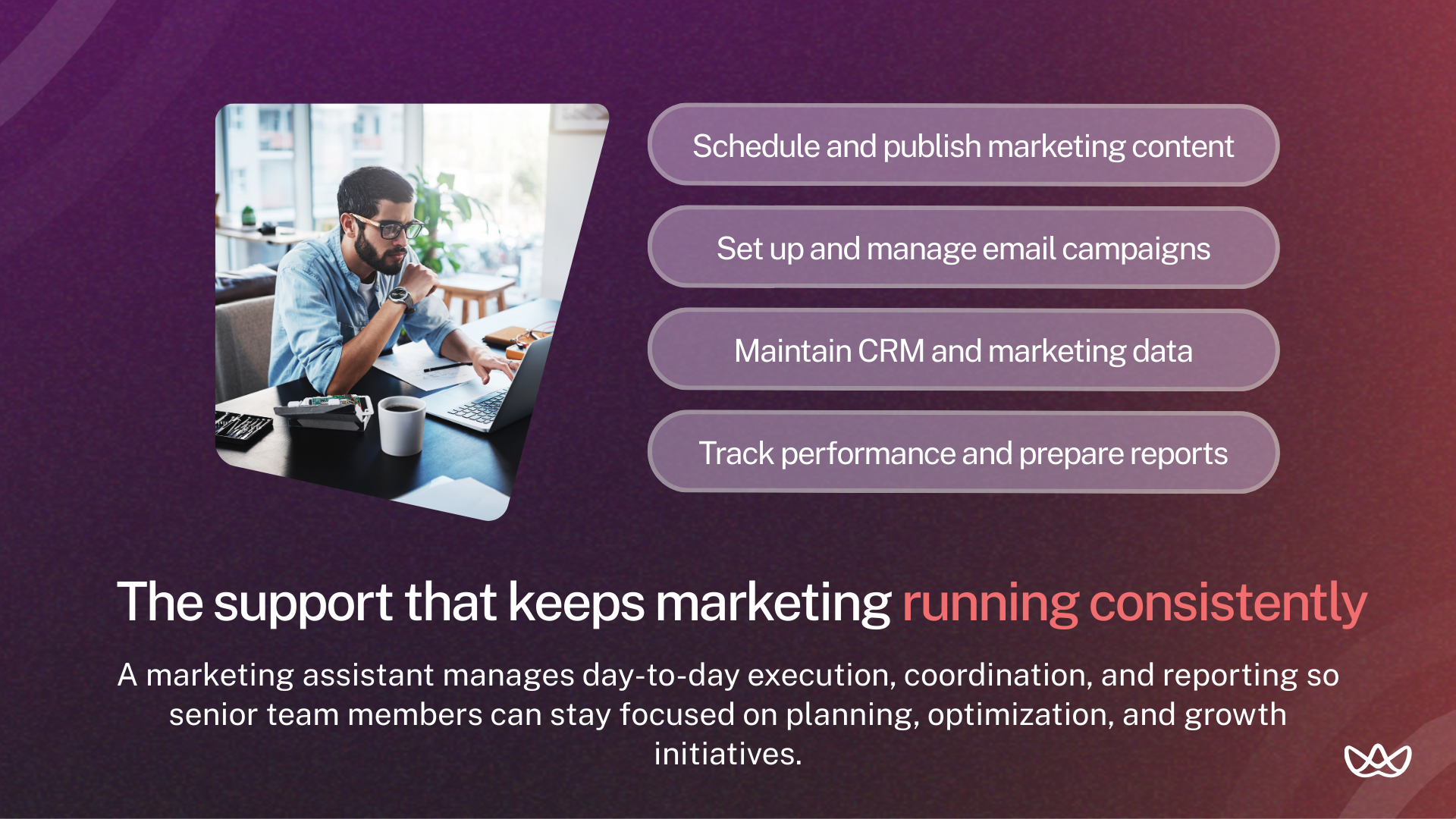
A marketing assistant is an entry-level or junior-level professional who supports a marketing team’s daily operations. Typical responsibilities include scheduling social media content, drafting copy, pulling performance reports, coordinating with vendors, and keeping campaign trackers up to date. While the role focuses on support, a strong marketing assistant can significantly improve how much a lean team accomplishes each week.
Marketing assistants primarily focus on execution and coordination. They rarely own strategy, but they implement it, and their accuracy and consistency directly influence campaign quality and delivery timelines.
Where Marketing Assistants Fit in a Team
In most organizations, a marketing assistant reports directly to a marketing manager, marketing coordinator, or sometimes a VP of Marketing in smaller companies. They work alongside content creators, designers, and paid media specialists to handle the operational side of campaigns.
In agencies, they often support multiple accounts simultaneously, which requires strong organizational discipline and clear communication habits.
For startups and growing agencies in particular, the marketing assistant is often the glue role - the person who makes sure no task falls through the cracks while senior team members focus on higher-level strategy.
Typical Daily Tasks
On any given day, a marketing assistant might schedule and publish social media posts, update a content calendar, coordinate with a designer on asset delivery, pull last week’s email campaign metrics from Mailchimp or HubSpot, draft a first-pass blog intro, or follow up with a vendor on event materials.
Responsibilities vary depending on the company and team size, but execution and organization remain constant.
Marketing Assistant Job Description Summary
The following summary provides a concise overview employers can use when posting the role on job boards or sharing internal hiring requirements.
We're looking for a detail-oriented Marketing Assistant to support our marketing team in executing campaigns, managing content schedules, and handling day-to-day administrative marketing tasks. The ideal candidate brings strong communication skills, a working knowledge of digital marketing tools, and the ability to juggle multiple priorities without losing accuracy. This role reports to the Marketing Manager and plays a direct part in keeping our marketing operations running efficiently.
Marketing Assistant Job Description Template
The following marketing assistant job description template can be adapted for job boards, internal hiring documentation, or recruitment platforms. Adjust the company details, salary range, and responsibilities based on your team structure and marketing priorities.
[Company Name] - Marketing Assistant
Location: [City, State/Remote/Hybrid]
Employment Type: Full-Time/Part-Time
Reporting To: [Marketing Manager/Director of Marketing]
Salary Range: $[X] – $[X] per year, depending on experience
About the Company
[Company Name] is a [brief description - e.g., B2B SaaS company / digital marketing agency / e-commerce brand] headquartered in [location]. We help [target clients/customers] achieve [core outcome]. Our marketing team is [X] people and growing, and we're looking for someone who can hit the ground running and grow with us.
Role Summary
As a Marketing Assistant, you'll support the marketing team in executing campaigns across email, social media, and content channels. You'll manage administrative coordination, track campaign performance, assist with market research, and help keep our marketing operations organized and on schedule. This is a hands-on role with real ownership from day one.
Key Responsibilities
- Schedule and publish content across social media platforms (LinkedIn, Instagram, Facebook, etc.) using tools like Buffer or Hootsuite
- Assist in drafting email campaigns, blog posts, and marketing copy under the direction of the content team
- Maintain and update the content calendar weekly
- Pull and compile performance reports from Google Analytics, HubSpot, or [your analytics tool]
- Coordinate with designers, copywriters, and external vendors to ensure assets are delivered on time
- Support event coordination and promotional material preparation
- Conduct market and competitor research and summarize findings
- Handle administrative tasks including scheduling, file organization, and meeting prep
- Update CRM records and maintain contact lists
Required Qualifications
- Bachelor's degree in Marketing, Communications, Business, or a related field (or equivalent work experience)
- 1–2 years of experience in a marketing support or administrative role (internships count)
- Proficiency in Microsoft Office or Google Workspace
- Familiarity with at least one email marketing platform (Mailchimp, Klaviyo, HubSpot, or similar)
- Strong written and verbal communication in English
- High attention to detail and ability to manage multiple tasks simultaneously
Preferred Qualifications
- Experience with social media scheduling tools (Buffer, Hootsuite, Later)
- Working knowledge of Google Analytics or basic SEO principles
- Familiarity with CRM platforms (HubSpot, Salesforce)
- Canva or Adobe Creative Suite experience
- Google Analytics Certification or HubSpot Content Marketing Certification
Salary & Benefits
- Salary: $[X]–$[X] per year
- Health, dental, and vision insurance
- Paid time off: [X] days annually
- Remote/hybrid flexibility: [specify]
- Professional development budget: $[X]/year
- Clear promotion path to Marketing Coordinator or Specialist within [X] months
Application Instructions
Submit your resume and a brief cover letter to [email] or apply via [platform link]. Applications without a cover letter will not be reviewed. We aim to respond to all applicants within [X] business days.
How to Write an Effective Marketing Assistant Job Description
Writing an effective marketing assistant job description starts with clarity. Candidates should understand what the role involves, how success will be measured, and how the position supports the broader marketing team. Clear expectations help attract applicants who fit both the work and the workflow.

Define Clear Objectives
Start with what you need this person to accomplish in their first 90 days. Focus on outcomes instead of general responsibilities so candidates understand what success looks like.
Examples include:
- Maintain a weekly content calendar with no missed publish dates
- Deliver a weekly performance report every Monday
- Track campaign metrics and update dashboards
- Coordinate marketing assets before launch deadlines
Use clear action verbs such as manage, coordinate, publish, analyze, draft, track, and execute to make responsibilities easy to understand and searchable on job boards.
Highlight Growth Opportunities
Entry-level candidates often want to understand where the role can lead. If the job description doesn’t address progression, strong applicants may look elsewhere.
Be specific about potential paths, such as moving into a Marketing Coordinator role within 12 to 18 months based on performance.
Be Transparent About Salary and Expectations
Job listings that include salary ranges tend to attract more qualified applicants. Transparency helps candidates assess fit early and reduces unnecessary interviews. If compensation or budget limits are fixed, state them clearly to avoid misalignment later in the process.
Optimize for SEO and Job Boards
Use standard job titles like Marketing Assistant instead of creative alternatives. Candidates search using common terms, and job platforms rely on keywords to surface listings.
Include relevant terms naturally, such as:
- Digital marketing
- Social media management
- Content calendar
- HubSpot
- Google Analytics
KPIs to Include in a Marketing Assistant Job Description
Including measurable KPIs sets expectations from the start and helps you evaluate performance once the person is hired. Relevant KPIs for this role include:
- Content calendar adherence
- Social media publishing accuracy
- Report delivery timelines
- CRM data accuracy
- Campaign asset coordination speed
Select two or three KPIs that align with your team’s current priorities.
What to Include in a Marketing Assistant Job Description
A strong marketing assistant job description should cover a few core details so candidates clearly understand the role before applying. In most cases, include:
- A clear job title
- A short 2–3 sentence role summary
- Defined responsibilities using action verbs
- Required skills and tools
- Preferred or nice-to-have qualifications
- Salary range
- Reporting structure
- Application instructions
When important details like compensation or reporting lines are missing, candidates often make assumptions, which can result in mismatched applications and longer hiring cycles.
Marketing Assistant Duties and Responsibilities
In most teams, marketing assistants take ownership of the coordination and follow-through required to keep campaigns moving once plans are approved.
1. Campaign Support and Execution
Marketing assistants keep campaigns moving. They track deadlines, coordinate asset delivery between teams, update project management tools (Asana, Trello, Monday.com), and make sure nothing slips.
When a campaign is running, they monitor its progress and flag issues to the marketing manager early. This operational support is what allows senior marketers to stay focused on strategy instead of logistics.
2. Content Creation and Social Media Management
Most marketing assistants handle some degree of content creation - drafting captions, writing first-pass blog intros, resizing graphics in Canva, or scheduling posts in Buffer or Hootsuite. The level of creative ownership varies by team. In smaller companies, a marketing assistant may own the entire social media calendar. In larger teams, they execute within a system that senior creatives have built. Either way, consistency and accuracy matter more than creativity at this level.
3. Market Research and Data Analysis
Marketing assistants pull competitive intel, track industry news, aggregate campaign metrics, and deliver summary reports to the team. They're usually not doing deep statistical analysis - but they are expected to know how to navigate Google Analytics, pull data from a CRM, and present findings in a clear, readable format.
The ability to turn raw data into a concise summary is one of the most undervalued skills at this level.
4. Administrative and Coordination Tasks
Scheduling meetings, managing shared drives, organizing brand assets, updating contact lists, preparing presentation decks, coordinating event logistics - these tasks are real, they take time, and they matter.
Don't bury them at the bottom of a job description as if they're incidental. A good marketing assistant treats administrative coordination as a core responsibility, not a distraction from "real" marketing work.
5. Vendor and Client Communication
In agency settings especially, marketing assistants often communicate directly with external vendors (printers, event venues, freelancers) or support client-facing teams by preparing reports or coordinating deliverable timelines. Clear, professional written communication is non-negotiable for these interactions.
Marketing Assistant vs. Marketing Coordinator vs. Marketing Intern
These roles often overlap in smaller teams, but they differ in responsibility level, experience, and involvement in marketing planning. The comparison below shows how each position typically fits within a marketing team structure.
Marketing Assistant Skills and Qualifications
Hiring managers look for candidates who bring working knowledge of common marketing tools along with strong communication and organizational skills, since the role depends on accuracy, coordination, and consistent execution.

Technical Skills (Digital Tools, Analytics, CRM)
Required tools vary by industry, but most employers expect working knowledge of several core platforms, such as:
- Google Analytics or GA4
- HubSpot or another CRM
- Mailchimp or similar email marketing platforms
- Canva or basic Adobe tools
- Social media scheduling tools
- Google Workspace or Microsoft Office
Candidates don’t need expertise in every tool. What matters is the ability to learn new systems quickly and work independently after onboarding.
Communication and Writing Skills
Marketing assistants write constantly - emails, captions, briefs, reports, first drafts. Strong writing doesn't mean literary talent; it means clarity, appropriate tone, and the ability to adjust for different audiences.
A marketing assistant who writes confusing emails or unclear status updates creates friction across the entire team. Communication is a hard skill in this role, not a soft one.
Organizational and Project Management Skills
Managing multiple campaign deadlines simultaneously while keeping assets organized and stakeholders informed is the operational core of this role.
Experience with project management tools like Asana, Trello, or Monday.com is increasingly expected. Even if you don't require prior tool experience, you should ask in interviews how candidates manage competing priorities - their answer reveals a lot.
Creativity and Brand Awareness
Marketing assistants don’t need advanced design skills, but they should understand brand voice and recognize what aligns with it. Candidates who can identify inconsistencies or suggest small improvements often contribute more quickly. Portfolios, even from internships or personal projects, help demonstrate applied creative thinking.
Soft Skills Employers Look For
Attention to detail remains one of the most important qualities for this position. Small mistakes, such as incorrect links, missed deadlines, or formatting errors, can create downstream issues across campaigns.
Beyond detail orientation, look for:
- Proactive communication
- Adaptability
- Willingness to ask clarifying questions
Required Skills by Industry
Skill expectations for marketing assistants often vary depending on industry priorities, tools, and campaign complexity. The following comparison shows how required skills and commonly used platforms differ across major industries.
Education, Training, and Experience Requirements
Education and experience expectations for marketing assistants vary by company, but employers often look at formal education along with relevant skills, certifications, and hands-on marketing experience.
Minimum Educational Background
Most job postings for marketing assistants require a bachelor's degree in marketing, communications, business, or a related field.
That said, many employers especially in digital-first companies, have shifted toward skills-based hiring. A candidate with a strong portfolio, relevant certifications, and demonstrable tool experience can compete effectively against degree holders, particularly at the entry level.
Certifications That Add Value
Google Analytics Certification, HubSpot Content Marketing Certification, HubSpot Inbound Certification, Google Ads Search Certification, and Meta Blueprint Certification are all recognized, free or low-cost credentials that show initiative and baseline tool competency.
They're not replacements for experience, but they do signal that a candidate takes the field seriously enough to learn outside of class or a previous job.
Entry-Level vs. Experienced Candidates
An entry-level marketing assistant (0-1 year experience) typically needs more onboarding time and closer supervision, but they're easier to develop and less expensive to hire.
A candidate with 1-3 years of experience, including relevant internships, can usually operate more independently and take on slightly broader responsibilities.
Be clear in your description of who you're targeting, and calibrate the salary range accordingly. Listing an entry-level scope with a mid-level experience requirement is one of the most common reasons strong candidates disengage.
Marketing Assistant Salary and Job Outlook in 2026
In the United States, marketing assistant salaries typically range between $44K and $55K per year as of early 2026. This equals roughly $21-$26 per hour, depending on experience, industry, and location.
Entry-level candidates in smaller markets often start around $40K-$44K, while roles in major metropolitan areas can reach $55K-$65K or more.
Remote and offshore hiring continues to influence compensation trends. Marketing assistant roles in LATAM commonly cost 50-70% less than US-based hires, making them the best option for agencies and startups managing operational budgets.
Average Salary by Country
Pay levels vary across markets based on local labor costs and demand.
LATAM compensation varies by country and seniority but often provides cost advantages alongside strong English proficiency and time-zone alignment across major hiring hubs in the region.
Entry-Level vs. Experienced Salary Range
Experience level plays a major role in compensation growth.
As assistants gain deeper platform knowledge and take on broader responsibilities, many transition into marketing coordinator or specialist roles, where compensation increases accordingly.
Factors That Influence Pay
Location often affects salary levels, with roles in larger cities generally paying more than those in smaller markets. Industry and company size also influence compensation, as larger organizations tend to follow structured pay ranges.
Tool experience can make a difference as well. Familiarity with CRM platforms, analytics tools, or marketing software may contribute to higher pay depending on the role’s scope.
Salary Comparison by Location
Marketing assistant salaries remain highest in the US, UK, and Australia, while remote offshore roles offer lower compensation ranges across similar experience levels.
Actual compensation may vary depending on experience level, industry requirements, and the scope of responsibilities assigned to the role.
Hiring Tips for Employers
When hiring for this role, look at how candidates manage details, deadlines, and follow-through, since these habits often determine how effectively they perform day to day.
Interview Questions to Ask
Move past general introductions and ask questions that show how candidates handle everyday marketing tasks. For example:
- Walk me through a project you managed with a tight deadline.
- Describe a time you caught an error before content went live.
- What tools have you used to manage a marketing calendar?
These questions give you the clearest sense of how someone approaches execution and communication.
How to Evaluate Marketing Portfolios
A marketing assistant portfolio doesn’t need to showcase advanced creative work. Instead, look for evidence of practical experience, such as:
- Writing samples like emails or captions
- Reports or tracking documents
- Social posts they scheduled or managed
- Examples of campaign coordination
Well-organized samples often indicate reliable working habits.
Red Flags to Watch For
Pay attention when candidates struggle to explain how they’ve used tools listed on their resume. Communication during the hiring process can also offer useful signals. Delayed responses, unclear messages, or difficulty explaining how they manage deadlines may point to coordination challenges later on.
Frequently Asked Questions
What skills do you need for a marketing assistant?
Strong written communication, organizational skills, and comfort with digital marketing tools are the foundation of this role. Most employers also expect familiarity with social media platforms, basic content creation, and tools such as analytics platforms, email software, or a CRM. Attention to detail matters throughout the work.
What do you need to be a marketing assistant?
Many employers look for a bachelor’s degree in marketing, communications, or a related field, along with some relevant experience, including internships. Certifications in areas like analytics or inbound marketing can help candidates strengthen their profile at the entry level.
Why should we hire you as a marketing assistant?
From an employer’s perspective, strong candidates usually explain how they’ve used specific tools, share examples of reliable execution, and connect their experience to the needs outlined in the role. Clear examples tend to matter more than general enthusiasm.
How much does a marketing assistant get paid?
In the US, marketing assistants typically earn between $44K and $55K per year. In the UK, salaries often fall around £24K–£29K, while roles in Australia range from roughly AU$48K–AU$68K, depending on experience. Remote offshore roles in LATAM generally fall below US salary levels while supporting similar day-to-day responsibilities.
What should be included in a marketing assistant job description?
A clear job title, role summary, responsibilities, required skills and tools, preferred qualifications, salary range, reporting structure, and application instructions. Leaving out compensation or reporting details often leads to mismatched applications.
How detailed should a marketing assistant job description be?
Detailed enough to set expectations, but still easy to scan. Many employers aim for 400–700 words for job board listings so candidates can quickly understand the role without reading through unnecessary detail.
What KPIs should be included in a marketing assistant job description?
Common KPIs include content calendar adherence, publishing accuracy, report delivery timelines, CRM data accuracy, and asset coordination turnaround time. Most teams select two or three metrics that reflect current priorities.
What are the main objectives of a marketing assistant role?
The role supports marketing execution by helping campaigns stay organized, maintaining accurate reporting, and handling coordination tasks that allow senior team members to focus on planning and strategy.
Can a marketing assistant work remotely?
Yes. Much of the work, including content scheduling, reporting, CRM updates, and email coordination, can be handled remotely. Clear communication and consistent availability usually matter more than location.
What is a good objective for a marketing assistant job description?
A strong objective explains the expected outcome of the role. For example: hiring a marketing assistant to support campaign execution across email, social, and content channels while maintaining consistent delivery timelines.
How long should a marketing assistant job description be?
For job boards, 400-700 words is often a practical range. Longer listings can work for internal documentation, but external postings generally perform better when they remain clear and easy to review.
Your Next Step
The marketing assistant role works best when expectations are clearly defined from the start. Employers gain more consistent support when responsibilities align with real workflow needs, and candidates perform better when they understand how execution and coordination fit into the broader marketing process.
As teams expand across channels and locations, this role continues to support the day-to-day work that keeps campaigns organized and moving forward.
Start hiring remote marketing assistants through Floowi to support your marketing operations. Book your free consultation today.


