





At some point, every growing agency or content brand runs into the same situation. Video production becomes weekly, the current freelance setup stops working, and the team needs a dedicated editor offshore. The focus moves from outsourcing itself to choosing the right region.
Two regions come up repeatedly: Latin America and the Philippines. Both have strong English proficiency. Both are significantly cheaper than US in-house. Both have mature pools of editors who work with Premiere Pro, After Effects, and DaVinci Resolve daily.
The real difference is operational, especially in how your team’s day runs with an editor 12 time zones away versus one working in your hours.
This comparison covers rates, time zones, language, creative ecosystem depth, and the operational trade-offs that do not show up in a rate card.
The Short Answer
For US-based brands, agencies, and creator businesses producing video on a weekly cadence, Latin America is the stronger operational fit. Time zone alignment with the US is 4–8 hours of daily overlap depending on the country. Editors in Colombia, Mexico, Argentina, and Chile are available for morning standups, same-day revision turnarounds, and real-time feedback loops. This mirrors the same collaboration model your team already uses with in-house staff. To hire a video editor from Latin America with full time zone alignment, Floowi places pre-vetted editors across Colombia, Mexico, Argentina, and Chile.
The Philippines is the better fit for high-volume, template-driven production workflows that run fully async. Rates are lower, the BPO talent pool is deep and mature, and teams that can batch their raw footage at end of day and receive polished cuts by morning can make this model work efficiently.
Side-by-Side Comparison
Rate Comparison (By Engagement Model)
There is a clear cost difference between the two regions, especially at the lower end. But for most teams, the bigger question is how those savings hold up once you factor in revisions, turnaround time, and management effort.
Freelance Hourly Rates
On international freelance platforms, LatAm editors typically charge $15–$40/hr. Philippines-based editors run $10–$30/hr. The $5–$10/hr gap at the lower end of each range is real, but it narrows significantly as you move toward mid-level and experienced editors in both regions.
The hourly rate is not the meaningful number for most agencies. A freelancer charging $25/hr who needs a full brief, runs two revision cycles, and is unavailable the following week does not cost $25/hr once account manager time is factored in.
Dedicated Full-Time Monthly Rates
This is the model that actually moves the needle for agencies with recurring production. Dedicated full-time editors placed through a nearshore or offshore partner typically cost:
Latin America: $2,500–$4,500/month all-in, covering compensation, partner fees, HR, payroll, and local compliance.
Philippines: $1,800-$3,500/month all-in, covering the same cost components.
The monthly gap between the two regions runs roughly $700-$1,000/month at comparable experience levels. Whether that gap justifies a 12–13 hour time zone difference is the operational question this guide is built to answer.
Agency Retainer Rates
Agency retainers, where a production agency handles the editing function under a service contract, run $3,000-$10,000+/month depending on volume and scope. This model applies to both regions and is typically used by brands without internal creative infrastructure. For most growing agencies, the dedicated offshore editor model is more cost-efficient than an agency retainer at comparable output volume.
Time Zone and Communication
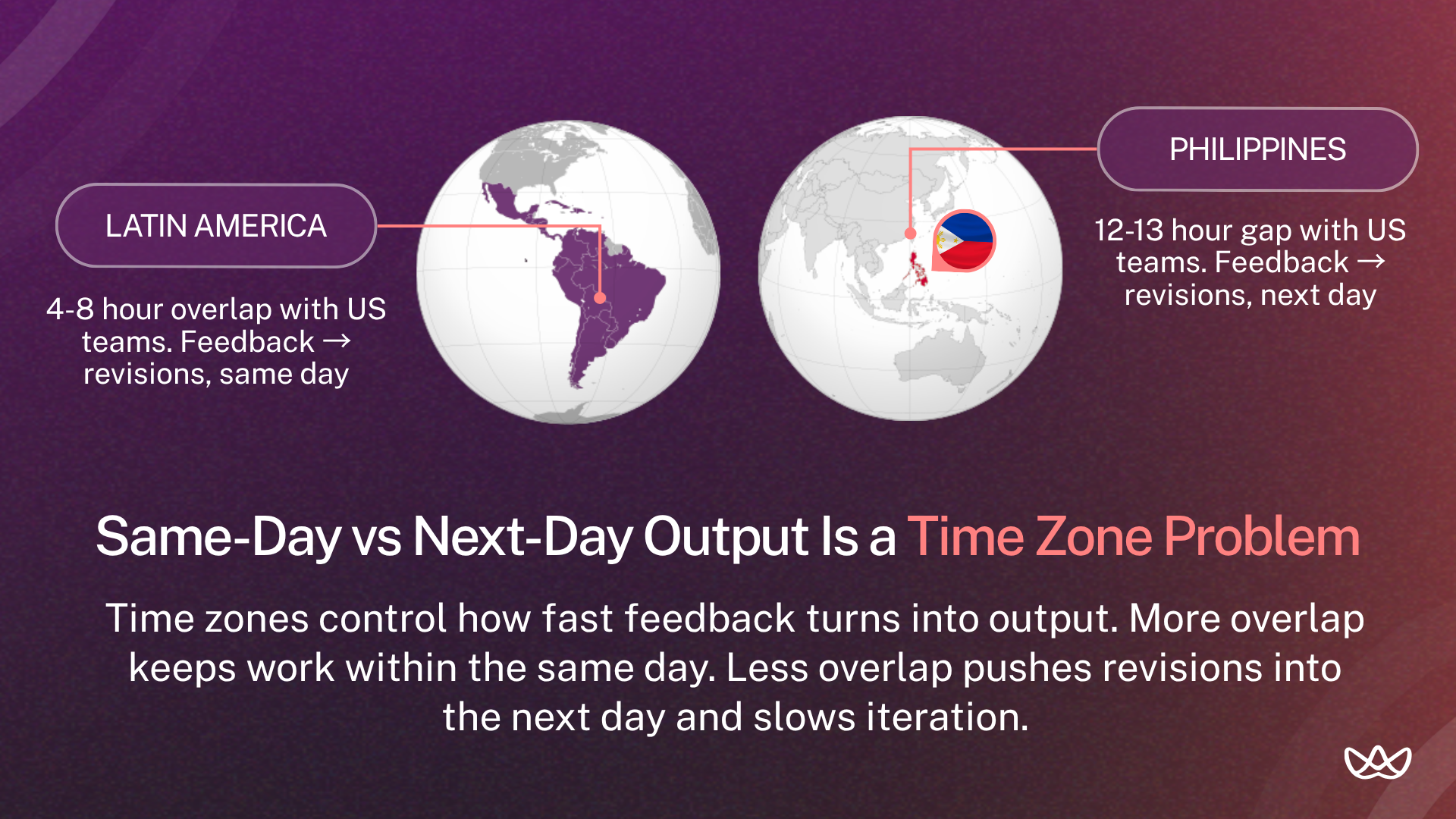
Time zone alignment directly affects how quickly feedback turns into output. It determines whether your editing workflow runs within the same day or shifts into a next-day cycle.
LatAm Hours Overlap
Colombia operates on Eastern Standard Time year-round. Mexico aligns with Central Standard Time. Argentina and Chile sit at ET+1. That puts 4-8 hours of direct daily overlap between a LatAm editor and any US-based team, regardless of whether the agency is in New York, Chicago, Austin, or Los Angeles.
In practical terms: the editor is in Slack by 9 AM your time. You can post a comment on a cut at 10 AM and get the revised version before your client call at 2 PM. That is the same feedback loop you would have with a US in-house hire.
Philippines Hours Overlap
The Philippines operates at UTC+8, which places it 12 to 13 hours ahead of US Eastern time depending on daylight saving. A standard US workday from 9 AM to 6 PM overlaps with the Philippines between roughly 10 PM and midnight local time.
Live standups are harder to schedule. Same-day revisions on morning feedback often require the editor to work late or start early. Real-time iteration, such as reviewing and editing together on a call, is rarely practical for most US-based teams.
What the Mismatch Actually Means for Your Workflow
Time zone differences mainly affect one thing: how many hours pass between feedback and the next usable version of the edit.
Daily standups: A 9 AM EST standup is 9 PM in Manila. LatAm editors attend in their morning. Philippines editors attend at end of their evening.
Same-day feedback: Client approves a video brief at noon EST. LatAm editor receives it, cuts a first draft, and can deliver before end of business the same day. Philippines editor receives it at midnight their time and delivers a cut the following morning.
Emergency edits: A client requests a change at 3 PM EST before a campaign launch. LatAm editor handles it in real time. Philippines editor handles it the following day.
For agencies running tight client timelines and same-day deliverable expectations, the time zone gap with the Philippines is a structural constraint, not a minor inconvenience. For teams with fully structured async workflows and batched footage delivery, the gap is manageable.
Language and Communication Style
Beyond time zones, communication quality affects how smoothly feedback turns into edits, especially when instructions are nuanced or iterative.
English Fluency
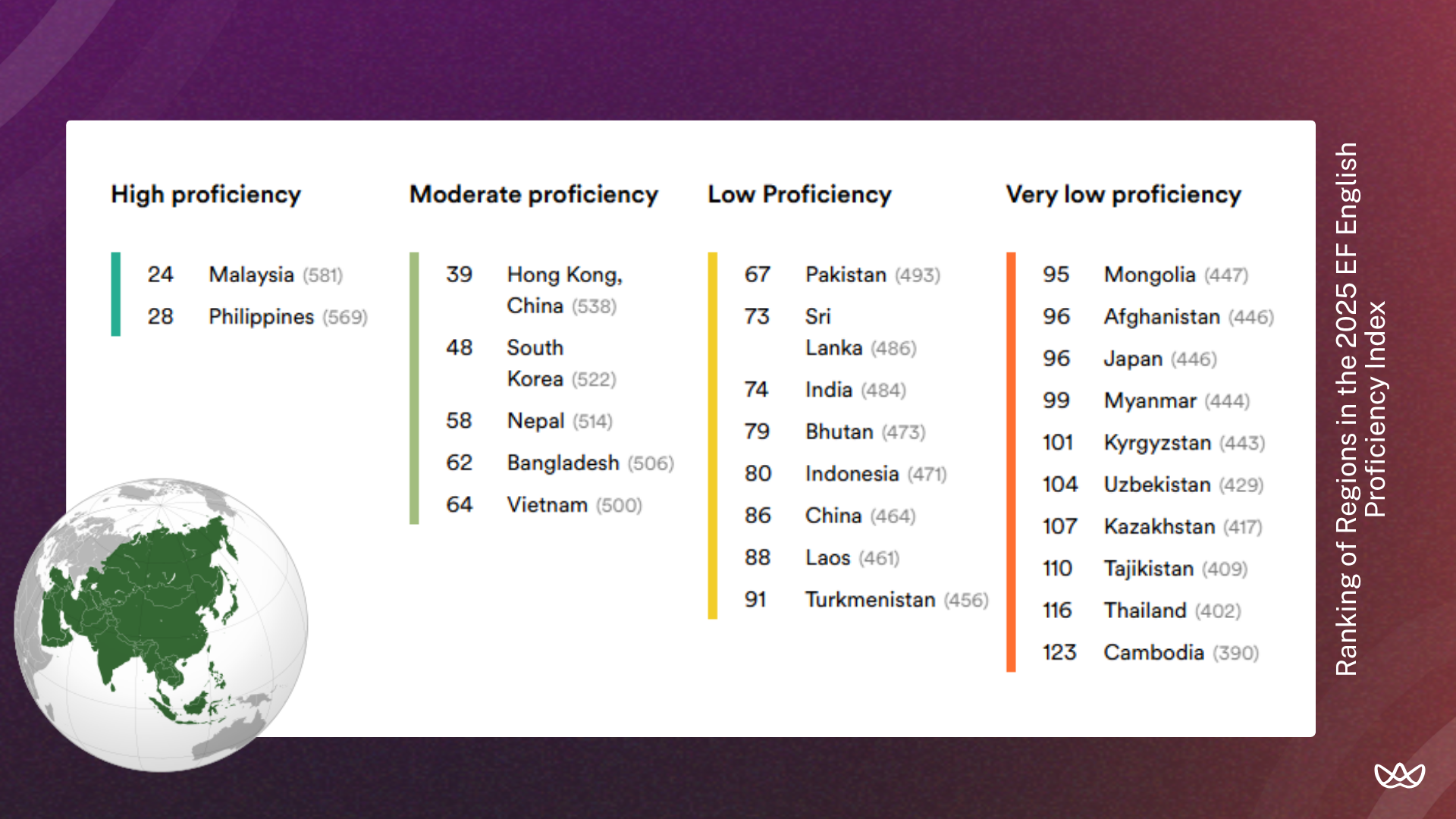
Both regions have high English proficiency, but through different pathways. In the Philippines, English is a co-official language and the medium of instruction throughout the education system. The country ranked #28 globally and #2 in Asia in the 2025 EF English Proficiency Index.
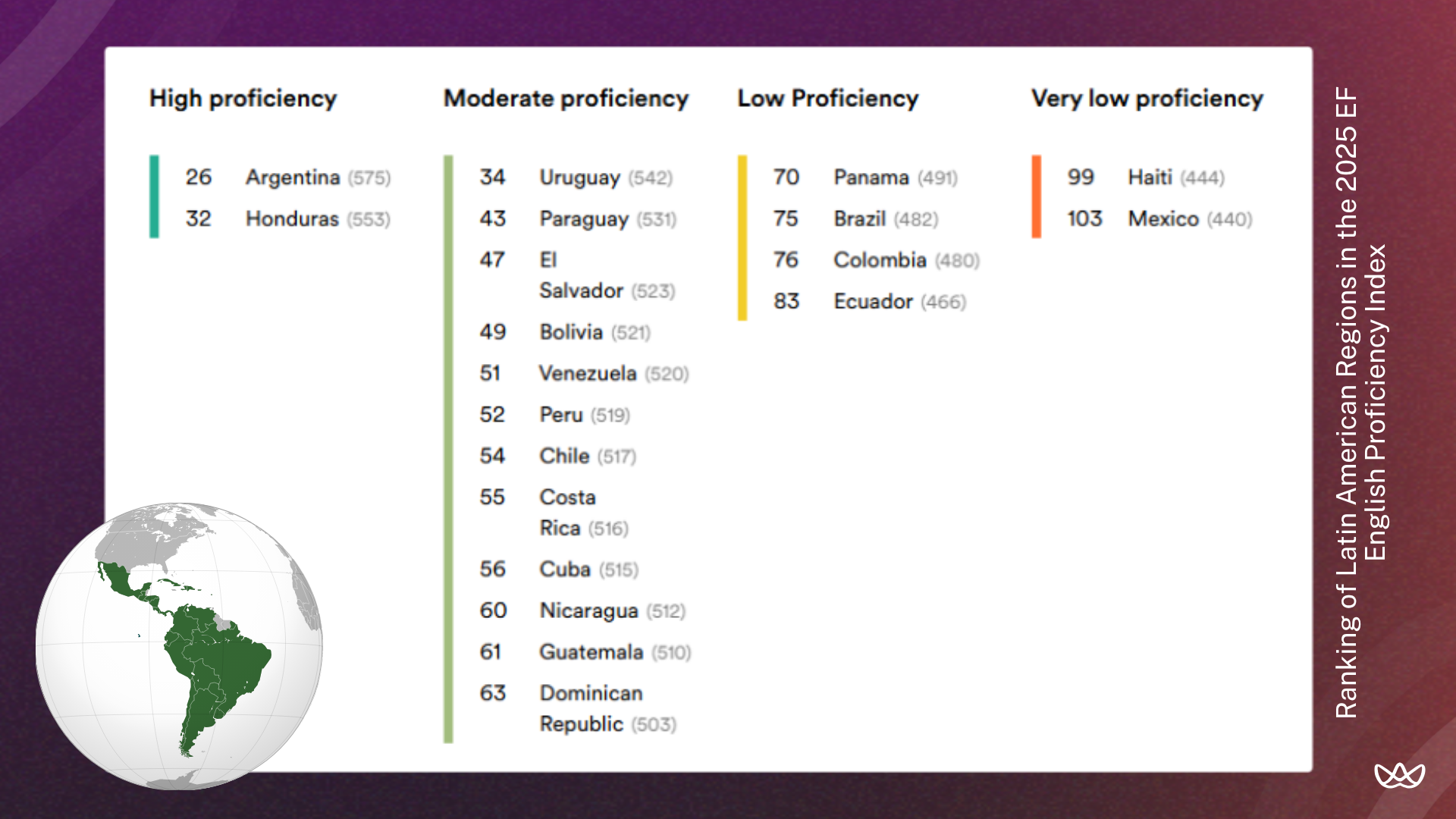
In Latin America, English is a second language. Proficiency varies by country: Argentina ranks second-highest in the region for English proficiency, with Colombia, Chile, and Mexico all producing strong bilingual professionals at the skilled-worker level. Editors hired through a vetted nearshore partner go through English proficiency screening before placement, so the question is not whether the editor speaks English, but how comfortably the communication flows day to day.
In both regions, editors are fully capable of handling Slack communication, interpreting briefs, asking clarifying questions, and joining calls. Differences tend to appear in more nuanced situations, such as detailed feedback discussions, client-facing presentations, or brand voice alignment.
Spanish as a Second Advantage for US Hispanic-Market Brands
For brands targeting US Hispanic audiences, DTC brands running bilingual ad creatives, or agencies serving clients in Latin American markets, LatAm editors bring a second language advantage the Philippines cannot match. A bilingual editor in Medellín or Mexico City who understands both the US content landscape and the Spanish-language audience is a resource that simply does not exist in a Manila BPO.
Cultural Literacy with US Media and Humor
Cultural fit is harder to measure but easy to feel in the output. LatAm editors grow up consuming the same media landscape US audiences do - Netflix originals, YouTube content formats, US advertising conventions, social media humor, and platform-native trends. The reference pool is shared.
Filipino editors also have strong cultural alignment with US business practices, shaped by decades of US-facing BPO work and a media landscape heavily influenced by American content. The difference is that LatAm editors are more likely to intuitively understand what a US DTC brand's creative voice should sound like from day one, without extensive calibration. US marketing agencies working with designers in Buenos Aires have reported creative concepts that align with Western market sensibilities from the first draft, reducing revision cycles significantly.
Creative Ecosystem Maturity
Where editors are trained and how creative industries evolve locally has a direct impact on the kind of work they produce, especially in pacing, storytelling, and adaptability.
Latin America
Mexico City, Bogotá, and Buenos Aires are the strongest creative hubs in the region for video production talent. Mexico City has long hosted multinational media and advertising operations and produces editors with agency-level experience at scale.
Bogotá reflects Colombia’s broader shift toward a knowledge and services-driven economy. According to the OECD Latin American Economic Outlook 2025, the country is actively investing in infrastructure, digital industries, SME growth, and innovation-led sectors, which strengthens its creative and production ecosystem over time.
Buenos Aires continues to combine a strong advertising culture with high English proficiency and consistent exposure to international client work.
Overall, creative output in the region is shaped by brand video, advertising, social content, and digital-first formats, which closely match the needs of US agencies and DTC brands.
Philippines
The Philippines IT-BPM industry is one of the most mature outsourcing ecosystems for English-speaking creative support roles, projected to reach nearly 1.9 million jobs and around $40 billion in export revenue.
A key shift in recent years is movement toward higher-value work. Filipino professionals are increasingly handling analytics, coordination, transformation support, and AI-assisted workflows, making the ecosystem more structured and capability-driven.
For video editing, this creates a workforce that is consistent, process-oriented, and experienced with global clients. It works well for high-volume, repeatable production pipelines.
However, the ecosystem still leans more toward structured execution than advertising-led, brand-first creative work compared to Latin America.
Quality and Retention Considerations
Quality in video editing depends more on structure than geography. A dedicated editor working consistently with the same team and receiving clear feedback will outperform rotating freelancers over time.
Retention improves when editors are embedded into stable workflows with ownership and context, rather than treated as interchangeable resources.
In reality, the engagement model has a stronger impact on output than the region itself. Choosing the right setup first, then matching it with the right region, leads to more consistent results than focusing on cost alone.
Who Should Choose Latin America
This setup works best when video production is part of a weekly operating rhythm and feedback needs to move quickly between teams.
US-Based YouTubers
Creators posting 2–4 times per week need a production partner in their operating hours. Same-day feedback on rough cuts, real-time discussion of pacing and structure, and quick-turnaround revisions before a publishing window closes all require time zone alignment. A LatAm editor handles all of this without async friction.
DTC and E-Commerce Brands
Ad creative for Meta and TikTok iterates fast. A new hook needs to be cut, tested, and ready within a day or two of the brief. Brands producing 4–8 new creatives per week cannot afford a 24-hour turnaround window just on the feedback loop. LatAm editors working in EST or CST eliminate that lag and give creative teams the live iteration capability they need to stay competitive.
Agencies Serving Hispanic and English-Speaking Markets
Bilingual editors in LatAm are uniquely positioned for agencies running campaigns across both English and Spanish-language audiences. The cultural and language fluency in both directions is a production asset that the Philippines cannot offer at the same level.
SaaS Marketing Teams in Eastern and Central Time Zones
SaaS companies in ET and CST can run their video production function, product demos, testimonials, webinar cuts, and ad creatives with a LatAm editor who is online during the same core hours. No async gaps. No next-morning delivery as the default. The editing function operates like an internal resource.
Who Might Still Choose the Philippines
This model fits better when production is structured in batches and work is designed to run independently of real-time collaboration.
Very High-Volume, Commodity Editing Workflows
Brands processing hundreds of short-form clips per month, batch editing, template-driven social content, and large-scale YouTube channel management can leverage the Philippines' cost floor and deep supply of trained editors. When the brief is fully locked, the specs are standardized, and the feedback is batched, the async workflow becomes an asset rather than a constraint.
Brands With No Synchronous Communication Need
Some production pipelines are intentionally built around async delivery. Raw footage drops at end of US business day, notes are written in a brief document, and the editor delivers a cut the following morning. For teams operating this way consistently, the Philippines fits well.
Enterprise BPO Contracts at Scale
Large enterprises outsourcing video production as part of a broader BPO setup are already aligned with the Philippines’ infrastructure. In these cases, creative production sits alongside other managed services, making consolidation within the same ecosystem more efficient than introducing a separate nearshore setup.
Hire a Latin American Video Editor with Floowi
For US agencies and brands that produce video on a recurring basis and need an editor who operates in their time zone, communicates in real time, and builds brand knowledge over months, not just delivers to spec per brief, the case for Latin America is clear.
Floowi sources and places bilingual, full-time video editors from Colombia, Mexico, Argentina, and Chile with US teams. Every candidate goes through portfolio review, technical assessment, English proficiency interviews, and cultural fit screening before a shortlist reaches the client. Placement runs 9–15 days. HR, payroll, and local compliance are handled by Floowi.
Hire video editors from Latin America through Floowi, or book a free call to find the right country and experience tier for your production volume.
Frequently Asked Questions
Is Latin America cheaper than the Philippines for video editing?
No. The Philippines typically has a lower cost floor, with dedicated full-time editors averaging $1.8k–$3.5k/month compared to $2.5k–$4.5k/month in Latin America. LatAm editors cost more, but many US agencies consider the $700–$1k monthly gap worth it for stronger time zone alignment, faster collaboration, and same-day turnaround potential.
Can I hire a video editor in Latin America who speaks English?
Yes. English proficiency at the professional working level is standard among LatAm editors placed through vetted nearshore partners. Argentina ranks second in the region for English proficiency per EF Index data 2025. Colombia, Mexico, and Chile all produce strong bilingual candidates. Nearshore partners like Floowi screen for English proficiency during the interview process before any candidate reaches the client.
Why is time zone important when outsourcing video editing?
Video editing for recurring client deliverables involves iteration, feedback, revisions, approvals, and sometimes same-day turnarounds. A 12-hour time zone gap forces every round of feedback into a 24-hour cycle. A 0–2 hour time zone gap keeps the feedback loop inside the same business day. For agencies managing client timelines, that difference shows up in project velocity and client satisfaction.
Which country in Latin America is best for hiring video editors?
Colombia (EST-aligned), Mexico (CST-aligned), Argentina (ET+1), and Chile (ET+1) are the four strongest countries for hiring dedicated video editors. Colombia and Mexico are the most common choices for US agencies because of full time zone overlap during standard business hours. Argentina and Chile offer equally strong talent with one hour of offset. Country choice often comes down to the specific candidate shortlist and cultural fit rather than a fixed rule.
What about hiring from both regions?
It is a workable model for agencies with a large enough production volume. LatAm editors handle client-facing, time-sensitive, brand-critical work during US business hours. Philippines editors handle high-volume, template-driven, overnight batch production. The overhead of managing two offshore teams only makes sense once production volume justifies the split, typically at 5 or more video deliverables per day across multiple clients.
How does Floowi source Latin American video editors?
Floowi sources from Colombia, Mexico, Argentina, and Chile through a combination of direct candidate pipelines and referral networks built across LatAm creative industries. Every candidate goes through portfolio review against the client's content type, a technical skills assessment on the required tools, an English proficiency interview, and a cultural fit evaluation before a shortlist is presented. The process runs 9–15 days from initial call to hire start.