

.png)




To hire a marketing assistant, you need to define your needs, evaluate skills, choose the right hiring model (in-house, freelance, or virtual), and set clear KPIs. The process works best when you know exactly what execution tasks need ownership, what tools the role requires, and which hiring model fits your budget and team structure.
Marketing rarely struggles because of strategy, but execution often starts consuming leadership time as campaign updates, content scheduling, and reporting pull focus away from growth work.
Let’s look at what the role involves, what it costs across hiring models, how to evaluate candidates properly, and how to run an efficient hiring process.
What Does a Marketing Assistant Do?
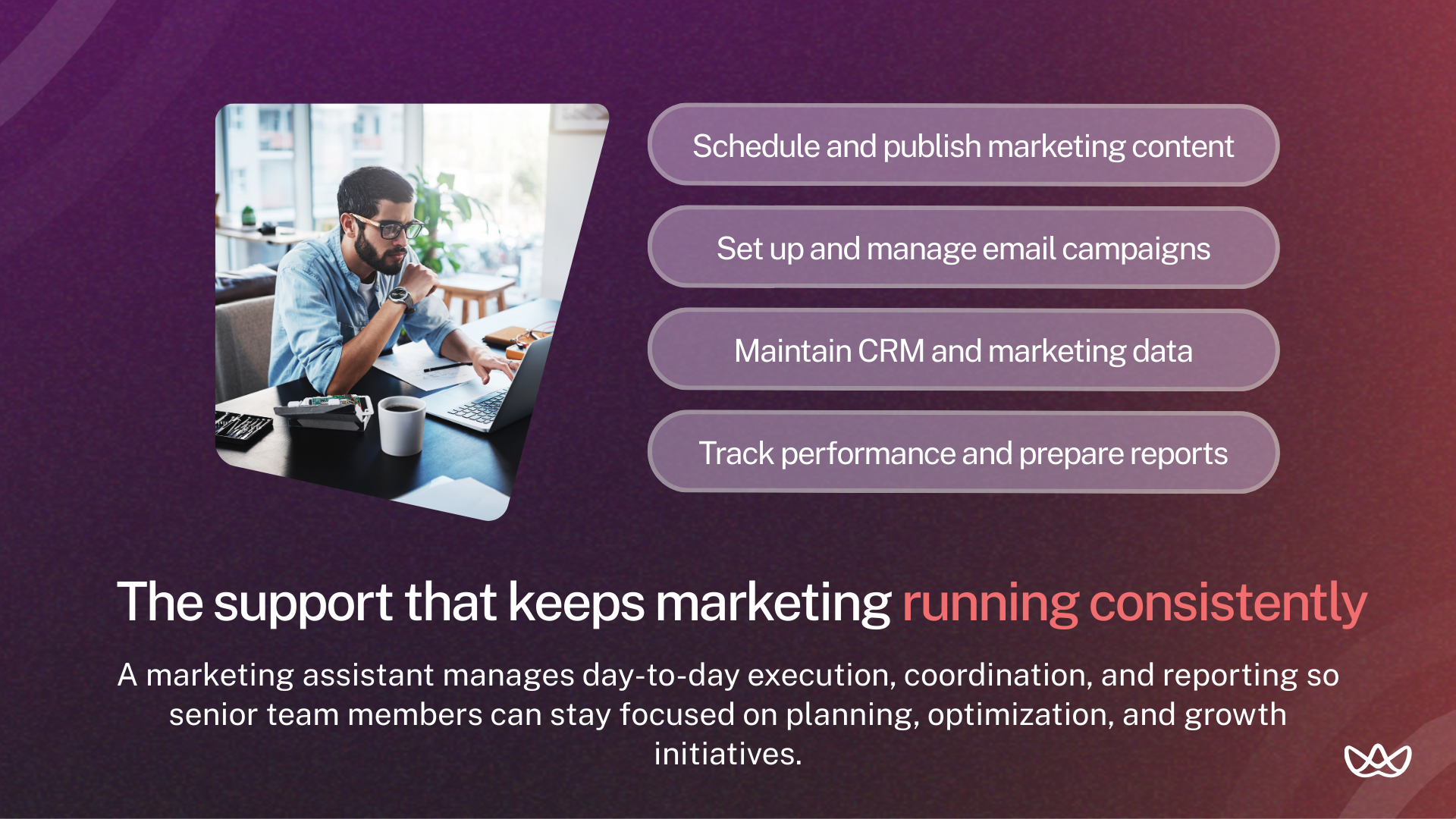
A marketing assistant handles the execution layer of your marketing operations - scheduling and publishing social content, drafting and sending email campaigns, maintaining CRM records, pulling performance reports, coordinating with designers, and proofreading materials before they go live.
The role doesn't own strategy or budgets. It keeps daily marketing work running so your senior team can focus on decisions that actually move the business forward.
Common Responsibilities
Most assistants support both operational and marketing execution tasks. This typically includes:
- Content Scheduling: Managing editorial calendars and publishing content across social platforms.
- Email Marketing: Setting up newsletters, maintaining subscriber lists, and monitoring campaign performance.
- Basic Design: Creating social graphics or presentation assets using tools like Canva or Adobe Express.
- Reporting: Pulling data from analytics platforms or CRM dashboards to track campaign results.
Marketing Assistant vs Other Marketing Roles
A marketing assistant works from direction set by others and handles recurring, defined tasks. A coordinator takes partial campaign ownership and makes decisions within a defined scope - typically after two or more years of experience. A specialist goes deeper in one channel with far more autonomy.
If you need reliable execution within a defined workflow, a marketing assistant is the right hire. If you need someone to own a channel or manage cross-functional campaigns, the role and the salary expectation are different.
Why Hire a Marketing Assistant?
A marketing assistant helps close the gap between planning and execution. As marketing activity grows, routine but necessary tasks begin consuming time that senior team members should spend on strategy, optimization, and revenue initiatives.
Hiring dedicated execution support ensures campaigns run consistently, deadlines stay on track, and marketing operations scale without immediately expanding senior roles.
Benefits for Small and Mid-Sized Businesses
Marketing execution often becomes the first operational constraint as teams grow. Founders and marketing leads gradually take on scheduling, reporting, and CRM updates simply to keep campaigns moving, which pulls attention away from strategy and performance.
A marketing assistant helps rebalance that workload. Once execution has a dedicated owner, senior team members commonly regain 10 to 15 hours each week.
Signs You Need One on Your Team
You need a marketing assistant when your marketing lead spends a significant portion of their week on scheduling, formatting, or reporting tasks.
Other signs include inconsistent content publishing, outdated CRM data, or campaigns running late because coordination tasks keep getting deprioritized.
Best Ways to Hire a Marketing Assistant in 2026
There are three common ways to hire a marketing assistant today: working with a specialized recruitment partner, hiring through freelance marketplaces, or bringing someone in-house.
1. Specialized Recruitment Partner (Recommended)
Working with a specialized partner such as Floowi offers one of the fastest and most cost-efficient paths for companies that need execution-ready talent without running a lengthy hiring process. These partners source pre-vetted marketing professionals from Latin America who already have hands-on execution experience and work within U.S. time zones.
According to the Floowi 2025 LATAM Hiring Benchmarks, companies hiring in LATAM typically reduce total employment costs by 50 to 70 percent compared to equivalent U.S.-based roles, while maintaining strong collaboration overlap.
Hiring timelines often range from 9 to 15 days, significantly faster than traditional recruitment cycles. Ongoing operational support also reduces internal management effort from the start.
2. Freelance Marketplaces
Platforms like Upwork and Fiverr provide access to a large global talent pool and flexible engagement options. This approach works well for short-term projects or temporary workload increases.
The main consideration is management time. Teams handle vetting, onboarding, briefing, and quality control themselves. For ongoing marketing execution, this can lead to inconsistency or additional coordination work over time.
3. In-House Hiring
Hiring locally allows for full team integration and long-term stability. Communication tends to be straightforward, and assistants become deeply embedded in internal workflows.
However, in-house hiring involves higher fixed costs, including salary, benefits, payroll taxes, and recruitment expenses. The process also takes longer, often 30 to 45 days or more. This model works best when building a permanent local marketing team and when internal resources are available to manage a full hiring cycle.
How Much Does It Cost to Hire a Marketing Assistant?
Costs largely depend on where and how you hire. In the U.S., a marketing assistant typically earns between $40k and $57k per year.
Freelance marketing assistants usually charge $18 to $40 per hour, while virtual assistants hired through nearshore partners often range between $1.2k and $2.5k per month.
Hidden Costs to Consider
Salary is only part of the total hiring cost. For U.S.-based in-house roles, benefits and payroll taxes typically add 25 to 35 percent on top of base compensation. Recruiting time, onboarding, equipment, and software licenses also add up over time.
Nearshore hiring models through recruitment partners often include HR and management support within the monthly engagement, which reduces administrative effort and makes overall costs easier to manage.
Full-Time vs Freelance vs Virtual Assistant
Choosing the right hiring model depends on the level of ongoing support you need and how much management time your team can realistically dedicate.
Full-time hires offer you stability, freelancers work well for short-term needs, while virtual assistants often provide consistent support at a lower overall cost.
Is Hiring a Marketing Assistant Worth the Investment?
For most growing teams, the return from hiring a marketing assistant becomes clear through smoother execution rather than dramatic results.
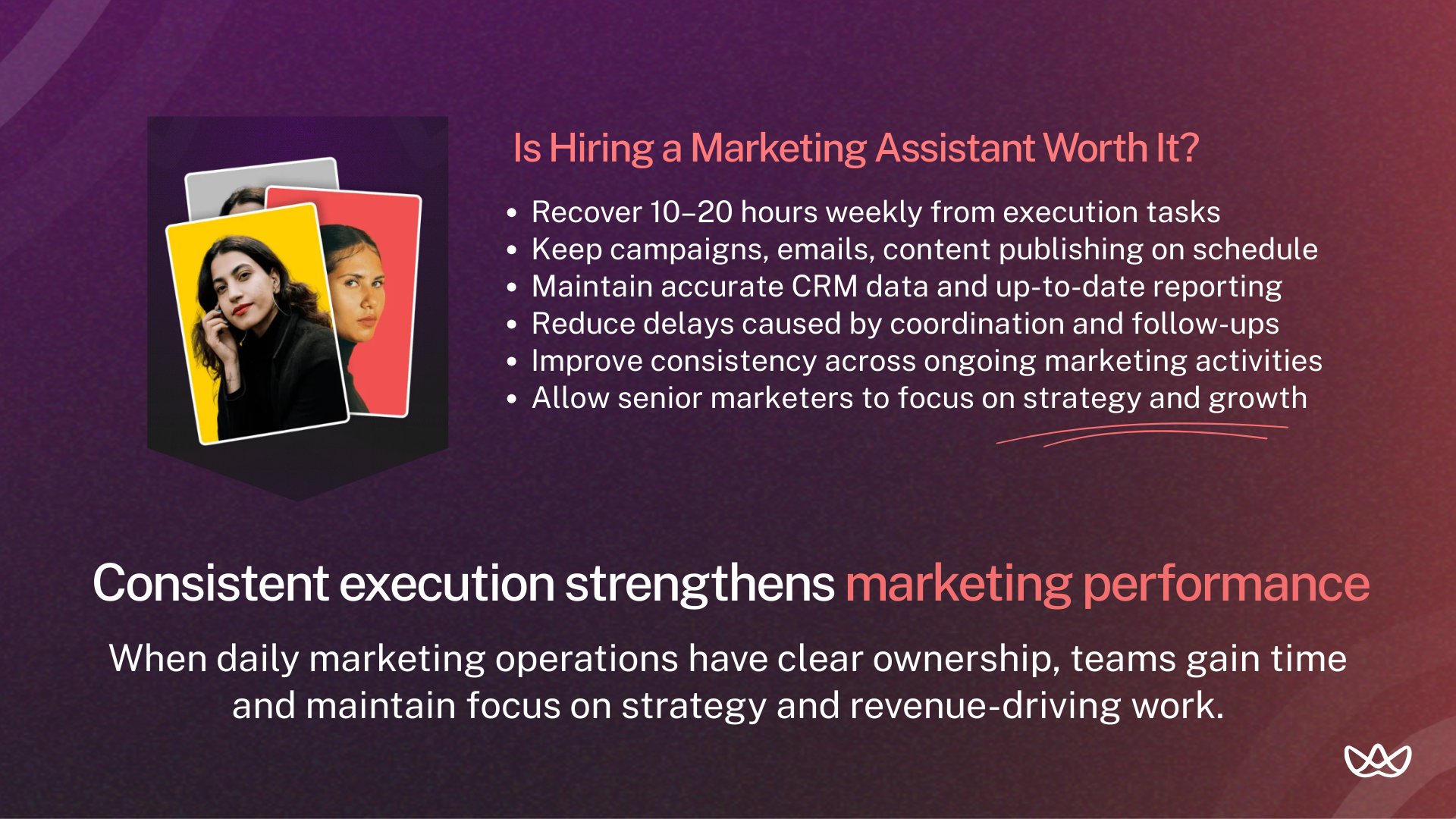
When routine marketing work has a dedicated owner, campaigns move consistently, reporting stays current, and senior marketers regain time to focus on strategy and revenue-focused initiatives.
1. Time Recovered
Marketing managers who take on execution tasks often spend 10 to 20 hours per week on work a capable assistant can handle. Delegating those responsibilities allows senior team members to redirect time toward planning, optimization, and growth activities.
2. Revenue Leverage
Consistent execution directly supports pipeline health. Email campaigns go out on schedule, social channels stay active, and CRM data remains organized. A marketing assistant helps maintain this operational rhythm, which keeps campaigns running and leads engaged.
3. Cost vs Revenue Impact
At roughly $45k per year in the U.S., a marketing assistant who helps keep even one additional deal moving through the pipeline each month can easily justify the investment. At nearshore LATAM rates, the overall cost-to-value balance often becomes even more favorable.
Skills to Look For When Hiring a Marketing Assistant
The strongest marketing assistants bring together tool familiarity, strong communication, and dependable execution habits.
Since the role supports ongoing marketing operations, the goal is not deep specialization but someone who can step into existing workflows and contribute with minimal supervision.
1. Technical Skills
Focus on hands-on experience with the tools your team already uses. This often includes CRM platforms like HubSpot or Salesforce, email tools such as Mailchimp or Klaviyo, reporting platforms like Google Analytics or Meta Ads Manager, and design tools like Canva for content formatting. Experience with WordPress or Webflow is valuable when content publishing is part of the role.
2. Soft Skills
Strong written communication is one of the most important qualities to assess. Marketing assistants frequently draft captions, format emails, and prepare internal updates, so messages need to be accurate and aligned with your brand voice.
Organization and deadline awareness are equally important, as much of the role involves managing multiple recurring tasks at once.
3. Industry-Relevant Knowledge
Foundational digital marketing knowledge often matters more than specialization. An assistant who understands campaign objectives and basic performance metrics can execute tasks independently, reducing the need for constant direction and speeding up onboarding.
Essential Skills Checklist by Role Type
Skill expectations vary slightly depending on how the assistant works within your team. In-house roles rely more on direct collaboration, while remote and nearshore assistants typically need stronger autonomy and comfort working asynchronously across distributed teams.
Writing a Marketing Assistant Job Description
A strong job description outlines the execution scope, required tools, and reporting structure upfront. When expectations stay vague, teams often attract mismatched candidates and extend the hiring timeline. Being specific about responsibilities and day-to-day tasks helps set the right expectations from the start.
Example Job Description Template
Job Title: Marketing Assistant
About the Role: Supporting day-to-day marketing execution across digital channels, reporting directly to the marketing lead to keep campaigns on schedule and CRM data accurate.
Responsibilities:
- Schedule and publish social media content across platforms
- Draft, format, and send email campaigns in Mailchimp
- Maintain and update CRM records in HubSpot
- Pull weekly performance reports from Google Analytics and Meta Ads Manager
- Coordinate assets with the design team and track deadlines
- Proofread and format marketing materials before distribution
Requirements:
- Familiarity with HubSpot, Mailchimp, Canva, and Google Analytics
- Strong written communication and attention to detail
- 0–2 years of relevant experience (internship, freelance, or full-time)
The Hiring Process Step-by-Step
Hiring a marketing assistant does not need to be complex when expectations and evaluation steps are defined early.
- Define Your Needs: List the specific tasks, tools, channels, and hours per week the role needs to cover before writing anything.
- Build the Ideal Candidate Profile: Document must-have skills, preferred tools, experience level, and communication requirements. This becomes your evaluation framework.
- Write a Clear Job Description: Specific, task-level descriptions attract stronger candidates than generic listings.
- Review Resumes & Portfolios: Look for direct tool experience and evidence of real execution work such as campaign examples, email screenshots, or analytics reports.
- Conduct Structured Interviews: Use the same questions across all candidates and focus on how they handled real execution scenarios rather than theoretical marketing discussions.
- Test Skills (Optional): A short skills task helps validate capability. Formatting an email template or drafting three social captions is usually sufficient.
- Make the Offer: Move reasonably quickly. Qualified candidates often evaluate multiple opportunities at the same time.
How to Interview a Marketing Assistant
Interviewing a marketing assistant should focus on how candidates actually execute work day to day. Instead of testing marketing knowledge, concentrate on how they organize tasks, use tools, handle deadlines, and catch mistakes before campaigns go live.
Top Interview Questions
These questions help you understand how candidates operate inside real marketing workflows:
- Walk me through how you manage a content calendar across multiple platforms.
- How do you prioritize tasks when multiple campaigns have overlapping deadlines?
- What tools have you used to track campaign performance, and what metrics did you report on?
- Tell me about a time you caught an error before something went live.
Red Flags to Avoid
As candidates talk through their previous roles, notice how specifically they explain the work they handled themselves. Strong marketing assistants can describe tasks and workflows in concrete terms.
Interview Evaluation Scorecard Example
You can use a simple scoring framework to compare candidates, especially when multiple interviewers are involved or several applicants reach the final stage.
Should You Hire In-House or Virtual?
The right choice depends on how your team collaborates, your budget structure, and how integrated the role needs to be within daily operations.
In-house gives full team integration and real-time collaboration at higher cost and a slower hiring timeline. It fits when your workflows require co-location or when culture integration is a meaningful priority.
Virtual covers the same execution scope at significantly lower cost, with LATAM nearshore professionals available in US time zones. Remote workflows require clear documentation and async communication practices, but for execution-focused roles, these are manageable requirements.
Decision framework: If your monthly marketing budget is below $30,000, the cost difference of a nearshore hire often frees meaningful budget for channels and tools. If your team is five or more people, the infrastructure to manage a remote assistant is likely already in place.
Should You Hire a Marketing Assistant or Outsource Marketing?
If you have marketing strategy in place and need reliable daily output, a marketing assistant is the right call. An agency addresses a different problem - strategy, creative direction, and multi-channel execution for businesses without in-house marketing leadership.
In terms of cost, a U.S.-based marketing assistant usually falls within the $40k to $57k per year range, while agency retainers with comparable execution involvement often range from $3k to $8k per month. For recurring operational work, having a dedicated assistant can provide continuity since the role focuses solely on internal workflows.
Many early and mid-stage companies start with a marketing assistant to support execution and engage agencies later for specific strategic or specialized needs.
Your Next Step
Hiring a marketing assistant remains relevant as AI becomes part of everyday marketing workflows.
While AI can speed up drafting, reporting, and research, campaigns still need someone to manage timelines, coordinate tasks, and ensure execution stays on track. The role increasingly focuses on ownership and workflow management rather than manual work alone.
With clearly defined responsibilities, a marketing assistant helps keep marketing operations running consistently without pulling senior team members back into daily execution.
Start building your team with a vetted marketing assistant from Floowi, aligned to your workflows and time zone. Book your free consultation today.
Frequently Asked Questions
When is the right time to hire a marketing assistant?
The right time usually comes when execution tasks start taking noticeable time away from strategy or growth work. If campaigns are delayed because leadership or senior marketers handle scheduling, reporting, or coordination themselves, additional execution support becomes useful.
Should I hire a marketing assistant or a marketing coordinator?
Hire a marketing assistant when workflows already exist and you need someone to handle execution reliably. A coordinator is better suited when the role involves campaign ownership, cross-team coordination, or decision-making responsibility.
How many hours per week do I need a marketing assistant?
Many companies start with 20 to 40 hours per week. Once activities like social publishing, email campaigns, reporting, and CRM updates become consistent, the role often grows into full-time support.
What tasks should I delegate first?
Begin with recurring tasks such as social media scheduling, email formatting, CRM updates, content uploads, and report preparation. These are structured activities that free up immediate time without affecting strategic oversight.
How long does it take to onboard a marketing assistant?
Most assistants become productive within two to four weeks, especially when workflows, brand guidelines, and templates are documented in advance.
How do I protect company data when hiring remotely?
Limit access to only the tools required for the role, use role-based permissions, and outline data handling expectations in employment agreements or internal policies.
What KPIs should I set for a marketing assistant?
Useful KPIs include on-time publishing, email accuracy, CRM data completeness, report delivery timelines, and the number of errors caught before campaigns go live.
How quickly can I see results after hiring?
You’ll usually notice operational improvements first, such as more consistent publishing and organized reporting, often within the first few weeks.
How long does it take to hire a marketing assistant?
Timelines depend on the hiring model. In-house hiring may take several weeks, while working with a specialized recruitment partner can shorten the process considerably.
Can I hire a marketing assistant part-time?
Yes. Many teams begin with part-time support when marketing activity is still growing, then expand hours as execution needs become more consistent.


