






Most SaaS marketing teams weren't built for how growth actually works in 2026. The org chart still looks like 2019: a VP at the top, functional heads underneath, specialists reporting up through channel silos. It made sense when campaigns lived inside one channel and reporting rolled up quarterly.
Now campaigns cross five channels in a week, attribution runs in real time, and the teams that keep up have shifted to a smaller strategic core supported by distributed specialist pods.
Let’s see how modern SaaS and tech companies are restructuring, what breaks in traditional org charts under 2026 conditions, and how to design a team that scales without adding a management layer every quarter.
Quick Answer: How Modern Marketing Teams Are Structured in 2026
Modern SaaS marketing teams are moving away from execution-heavy departments toward a lean strategic core supported by specialized operators, embedded marketing operations, and flexible execution resources like nearshore pods. Per Semrush analysis of 8,000 content marketing job listings, demand has shifted toward execution-heavy and senior ownership roles, with AI now a baseline expectation: 34% of senior listings and 19% of non-senior listings mention AI. Employers also expect content marketers to own analytics, SEO, storytelling, and measurable outcomes. The dominant structure at 15 to 30 marketers is a pod model: two to three cross-functional teams owning segments or motions end to end, with shared services (content, design, ops) underneath.
Legacy Structure vs. Modern Marketing Structure
Marketing teams still perform the same core functions, but they're organized differently. Instead of large channel-based departments, companies now rely on cross-functional pods supported by shared services and centralized operations.
Why Traditional Marketing Org Charts Break in 2026
The traditional structure was built for a slower marketing environment. Fewer channels. Longer sales cycles. Attribution as a quarterly exercise. All of that changed, but most org charts didn't.
Start with overloaded generalists. A single marketing manager owning content, SEO, email, and events might have worked in 2019. In 2026, each of those channels has become deep enough that no one person can operate all four at the level buyers now expect. The generalist becomes a bottleneck, and everything downstream slows.
Then there's fragmented ownership. When paid media, content, and lifecycle marketing all report separately to a VP, no single person owns the customer journey. Campaigns launch without lifecycle follow-through. Content gets written without demand distribution. Leads come in with no clear handoff. Coordination overhead consumes 20 to 30% of productive time.
Disconnected systems are next. Marketing platforms, CRM, product analytics, and revenue tools evolved separately for most companies. Without a MOps layer to hold them together, every dashboard tells a slightly different story, forecasting becomes political, and the CMO can't answer basic questions about pipeline contribution without a two-day data pull.
The last one is coordination cost. Every campaign needs alignment across 4 to 6 stakeholders. Every quarterly review turns into a status meeting instead of a decision meeting. Most teams stall structurally around 10 to 12 marketers because specialists scale linearly with coordination cost. Without a pod structure to cap that cost at the pod boundary, adding people reduces output per marketer.
The Core Pillars of the 2026 SaaS & Tech Marketing Structure
Modern marketing organizations rest on four pillars. Each handles a distinct problem, and each is structured differently from the legacy version of the same function.
Marketing Operations (MarTech) & RevOps Integration
Marketing Operations used to be a hire you added at Series B or later, often as an analyst inside demand gen. In 2026 it's the second or third hire on almost every serious marketing team. Without a working MOps layer, every other pillar operates on unreliable data.
MOps owns campaign tracking, lifecycle stage definitions, marketing automation, lead routing, and attribution. It has a dotted-line relationship into RevOps, which owns the CRM, shared data standards, and the reporting architecture spanning sales, marketing, and customer success. Per Stripe's SaaS organizational structure guide, RevOps becomes foundational once multiple go-to-market teams exist, which for most SaaS companies is around $5M ARR.
Teams that get this right hire a marketing analytics manager or dedicated MOps lead before adding a second demand gen specialist. Teams that don't spend the next 18 months trying to reverse-engineer attribution from broken tracking.
Lifecycle Marketing & Product-Led Growth (PLG) Hubs
Lifecycle used to be an afterthought owned by whoever ran email. In modern SaaS structures, especially product-led ones, it's a dedicated hub owning onboarding, activation, expansion, and retention communication. The email marketing specialist role now sits at the intersection of marketing, product, and customer success, with direct ownership of activation metrics and expansion revenue contribution.
In PLG companies, this pillar owns the growth loop: what happens after signup, how users hit their aha moment, when they get pushed toward paid tiers, and how the product itself becomes the primary distribution channel. Mature PLG motions typically allocate 15 to 20% of marketing headcount to lifecycle and product marketing combined, up from 5 to 8% under the legacy model.
Demand Generation & Performance Pods
Demand gen has moved from channel-siloed specialists to cross-functional pods organized around segments, motions, or business outcomes. A typical pod at a $10M to $30M ARR SaaS company includes a demand gen lead, a paid media specialist, a content writer, and a designer, with the pod owning a specific segment (mid-market, enterprise) or motion (inbound, ABM) end to end.
The advantage is speed and accountability. Instead of a demand gen manager negotiating with a separate paid media specialist, content team, and designer for every campaign, the pod runs the whole loop internally. Experiments launch faster, results attribute cleanly, and the pod lead is accountable for a specific revenue number rather than a channel metric.
Pods are typically led by a growth marketing manager. Growth marketers in a pod model need cross-channel fluency and comfort with revenue-level accountability, not just channel expertise.
Content Orchestration & Brand Management
Content teams have changed more than any other pillar in the past two years. The old model scaled volume by hiring writers. The new model combines a small orchestration team (a content marketing strategist, an editor, a designer) with AI-assisted production and specialized nearshore execution for volume work.
The strategic content lead owns editorial direction, brand voice, quality standards, and distribution strategy. The execution layer, which used to be five or six full-time writers, is now a mix of AI-assisted drafts, contracted specialists, and a lean production team.
Companies operating this way produce more finished content per month than teams twice their size, with better brand consistency because the orchestration layer enforces standards.
Scaling Phases: Marketing Team Roadmaps by Business Maturity
Team structure has to match business stage. A Series C structure at a seed-stage company creates unused overhead. A Series A structure at $30M ARR creates bottlenecks that cost pipeline.
Phase 1: Founder-Led Marketing ($0–$1M ARR)
At this stage the team is the founder plus one generalist. The generalist is a full-stack marketer executing across content, paid, email, and basic analytics. Everything reports directly to the CEO or founder. The priority is finding one or two repeatable channels and proving unit economics, not building infrastructure.
The mistake most seed-stage companies make is trying to hire a senior VP of Marketing before they have a channel that works. A $200k senior leader with no channel to optimize is expensive dead weight. Treat this phase as channel discovery, not organization building. Floowi's startup-focused hiring model is oriented around this: get an operational marketer working the channels before committing to a senior full-time hire.
Phase 2: Specialized Team Formation ($1M–$10M ARR)
Once one or two channels are working, the team grows to 4 to 8 marketers with defined specializations. A typical structure: Head of Marketing, one demand gen manager, one content marketer, one MOps lead, and a marketing coordinator or two. Design and paid media often stay outsourced until volume justifies full-time hires.
This is the phase where MOps becomes essential. Without a working data layer here, the transition to Phase 3 gets blocked. Companies that skip the MOps hire spend the next two years reconstructing clean data from broken systems.
Phase 3: Mature Growth Infrastructure ($10M+ ARR)
.png)
At 15 to 30 marketers, the pod structure takes over. Two to three cross-functional demand pods each own a segment or motion, with content, brand, and MOps operating as shared services. RevOps becomes a dedicated function reporting into either the CRO or CEO, not into marketing. Product marketing gets its own headcount, typically 2 to 4 people covering positioning, launches, and enablement.
Past $50M ARR, additional layers appear: centralized COEs for paid and SEO, dedicated ABM teams for enterprise motion, and a mature RevOps team with sub-functions for systems, analytics, and forecasting. Teams at this stage run 25 to 30 marketers, though teams leaning into AI-assisted workflows often deliver equivalent output at 20 to 25.
What Stage Is Your Marketing Team?
Use the following framework to place your team on the maturity curve. Score each dimension from 1 (early) to 5 (mature), then total.
Role specialization. 1 = generalists doing everything. 3 = defined channel owners. 5 = pods with segment ownership plus shared services.
MOps maturity. 1 = no dedicated MOps, spreadsheet reporting. 3 = MOps lead in place, working attribution. 5 = MOps and RevOps integrated, real-time dashboards, trusted data.
Data visibility. 1 = campaign results take days to compile. 3 = weekly reporting reliable. 5 = leadership sees pipeline in real time, forecast trusted.
AI adoption. 1 = no AI in production workflows. 3 = AI used for drafts, briefs, or basic automation. 5 = AI embedded across content, ops, and analytics with guardrails.
Cross-functional alignment. 1 = marketing runs independent of sales and CS. 3 = shared MQL definitions, monthly syncs. 5 = shared pipeline goals, integrated RevOps.Execution capacity. 1 = constant backlog, missed campaigns. 3 = keeping up but no room for experiments. 5 = experimenting weekly, campaigns launch on time.
Scalability. 1 = adding headcount slows things down. 3 = new hires ramp in reasonable time. 5 = pods can be added or expanded without redesigning.
Score interpretation:
- 7–14 (Phase 1, founder-led): Focus on channel discovery. Don't hire a senior leader yet. Invest in one operational marketer plus contracted specialists.
- 15–24 (Phase 2, specialized formation): Prioritize the MOps hire and one channel specialist for whatever's working. Skip pod structure for now.
- 25–30 (early Phase 3): Introduce pods, invest in RevOps, and consider nearshore execution to expand capacity without proportional headcount growth.
- 31–35 (mature Phase 3): Focus on structural refinement, brand governance, and specialization inside pods.
The Blended Team Framework: High-Leverage Strategic Core + Nearshore Pods
Most SaaS marketing teams that scale well past $10M ARR end up in a blended structure: a small strategic core in-house, supported by specialized nearshore pods for execution.
The strategic core owns strategy, brand direction, senior specialization (product marketing, MOps, growth leadership), and cross-functional coordination. It stays small on purpose. Every extra in-house hire adds coordination cost, compensation load, and management overhead.
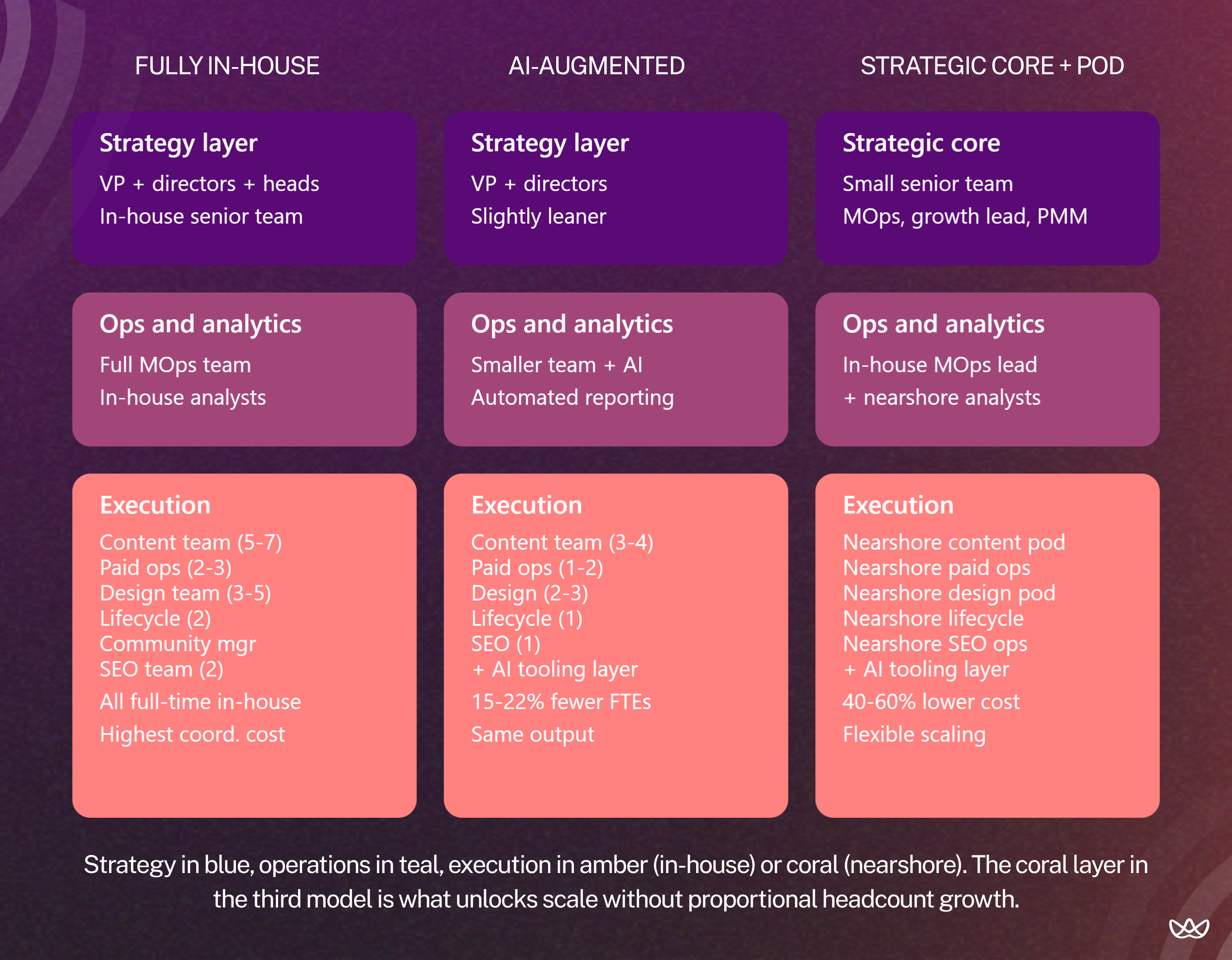
The nearshore pod handles execution: content production, paid campaign operations, design output, lifecycle builds, technical SEO, and analytics reporting. Pods scale up during launches and down during quieter periods without full-time hiring friction. Per Floowi's 2025 LATAM Hiring Benchmarks, typical placements complete in 9 to 15 business days.
The choice depends on cost, speed, and collaboration. Cost per hire drops 40 to 60% for equivalent skill levels. Time zone overlap with the US (LATAM operates within 0 to 3 hours of US business hours) removes the async lag offshore models from Asia or Eastern Europe introduce. English fluency is strong: per the EF English Proficiency Index 2025, Argentina ranks 26th globally with a "high" band score, and other LATAM markets have professional marketing populations operating at business-level English.
2026 Marketing Team Sourcing Framework
Floowi's marketing and strategy talent pool is built around this framework: pre-vetted specialists across content, demand gen, paid media, design, and analytics that plug into an existing strategic core.
Avoid the Pitfalls: Common Structural Failures in Modern Teams
Even teams that adopt the right structure on paper hit predictable failure modes. Watching for these signals is more valuable than debating org chart layouts in the abstract.
Excessive coordination overhead. If your team's calendar is more than 40% meetings, the structure isn't working. Pods are supposed to reduce coordination cost by moving decisions inside the pod. If meetings keep growing, either the pods are miswired or people don't trust the decision authority the structure implies.
Poor system integration. When paid team numbers don't reconcile with the CRM, attribution changes depending on which dashboard you open, or sales quotes different pipeline than marketing, the MOps and RevOps foundation isn't strong enough. Fix this before adding headcount.
Unclear ownership. Every important outcome (pipeline, activation, expansion revenue, brand quality) should have a single accountable owner. If more than two people are "responsible" for a metric, no one is.
Inadequate data visibility. If leadership can't answer "how are we tracking against pipeline this month" in under 5 minutes without a special data pull, the reporting infrastructure has broken down. This almost always traces to under-investment in MOps.
Over-reliance on generalists. A growth marketer expected to run paid, SEO, email, and lifecycle at scale in 2026 is being set up to fail. Specialize the pods; keep only senior leadership generalist.
Structural rigidity. Marketing team structure should be adjusted every 6 to 12 months. Teams treating the org chart as fixed accumulate structural debt that forces a much more disruptive redesign later.
Build Your Specialized Marketing Pod with Floowi
Modern SaaS and tech companies build marketing teams the way they build product teams: a small strategic core supported by specialized execution capacity that scales with the work. Floowi is built for this model.
Pre-vetted LATAM marketing specialists across content, demand gen, paid media, lifecycle, analytics, and design plug into your existing structure. No sourcing overhead. No 45-day recruiting cycles. Typical placement runs 9 to 15 business days, with candidates screened for English fluency, tool proficiency, US workflow familiarity, and role-specific portfolio evidence.
Engagements support pod expansion as your marketing operation grows, without the extra coordination cost of full-time in-house hires for every specialization.
If the strategic core is in place but execution capacity is limited, see how the process works or schedule a meeting to talk through the pod structure your team needs next.
Frequently Asked Questions
How are marketing teams structured?
Modern SaaS marketing teams follow one of three models: functional (channel-based teams, typical under 15 marketers), pod-based (cross-functional teams owning segments, common at 15 to 30), or hybrid (pods plus centralized COEs, standard past 30). The right structure depends on ARR, go-to-market motion, and product complexity.
How big should a marketing team be?
B2B SaaS teams typically operate with 4 to 8 marketers at $1 to $5M ARR, 8 to 15 at $5 to $20M, and 15 to 30 at $20 to $50M. Teams using AI-assisted workflows increasingly hit these output ranges with leaner headcount by shifting execution to tools and pod-based distributed talent.
What does a successful marketing team look like?
A successful 2026 marketing team has a lean strategic core, a working MOps and RevOps layer, cross-functional pods owning specific outcomes, and flexible execution via AI tools and specialized pods. Meetings under 40% of time. Attribution trusted. Pipeline contribution measurable.
What is a marketing org chart?
A marketing org chart shows reporting lines, functional ownership, and how marketing coordinates with sales, product, and customer success. In 2026, the best org charts are pod-based with shared services underneath, not the traditional VP-with-functional-heads pyramid.
When should I hire a marketing operations person? Hire dedicated MOps as your second or third marketing hire, usually between $1M and $3M ARR. Skipping this hire until later almost always causes 12 to 18 months of data cleanup when the team eventually tries to scale.
How do I decide between hiring specialists versus generalists?
Hire generalists in Phase 1 (under $1M ARR) when channels aren't proven. Add specialists in Phase 2, once one or two channels reliably deliver pipeline. Past 10 marketers, generalists become bottlenecks; specialization inside pods is the correct pattern.



.png)


