






If you're planning your marketing team in 2026, you've probably heard two different stories. One says AI will replace marketers. The other says companies are still struggling to hire for key roles.
The hiring data suggests the reality is somewhere in between. Some marketing roles are declining, while others are growing. Rather than replacing marketing teams, AI is changing the work marketers do and the skills companies look for when hiring.
Will AI Replace Your Marketing Team?
No, but it is reshaping who you should hire and for what. AI is automating meaningful chunks of execution work in content production, reporting, campaign operations, and creative iteration. At the same time, hiring for senior ownership roles, AI-fluent execution specialists, and analytics-driven positions has grown sharply. According to Semrush's analysis of 8,000 content marketing job listings, senior leadership titles like Head of Content Marketing grew 376% since 2023, VP of Content grew 308%, and execution-level Content Producer listings grew 1,261%. Meanwhile, mid-level generalist titles like Content Marketing Manager dropped 73% and Content Marketing Specialist dropped 74%. Companies are restructuring their teams, not eliminating them.
Marketing Workflows in 2026
AI is having the biggest impact on repetitive, process-driven work. But most marketing functions still need people to make decisions, set direction, and connect work across channels.
What the 2026 Hiring Data Actually Shows
Set aside the AI speculation for a moment. The workforce data tells a specific story.
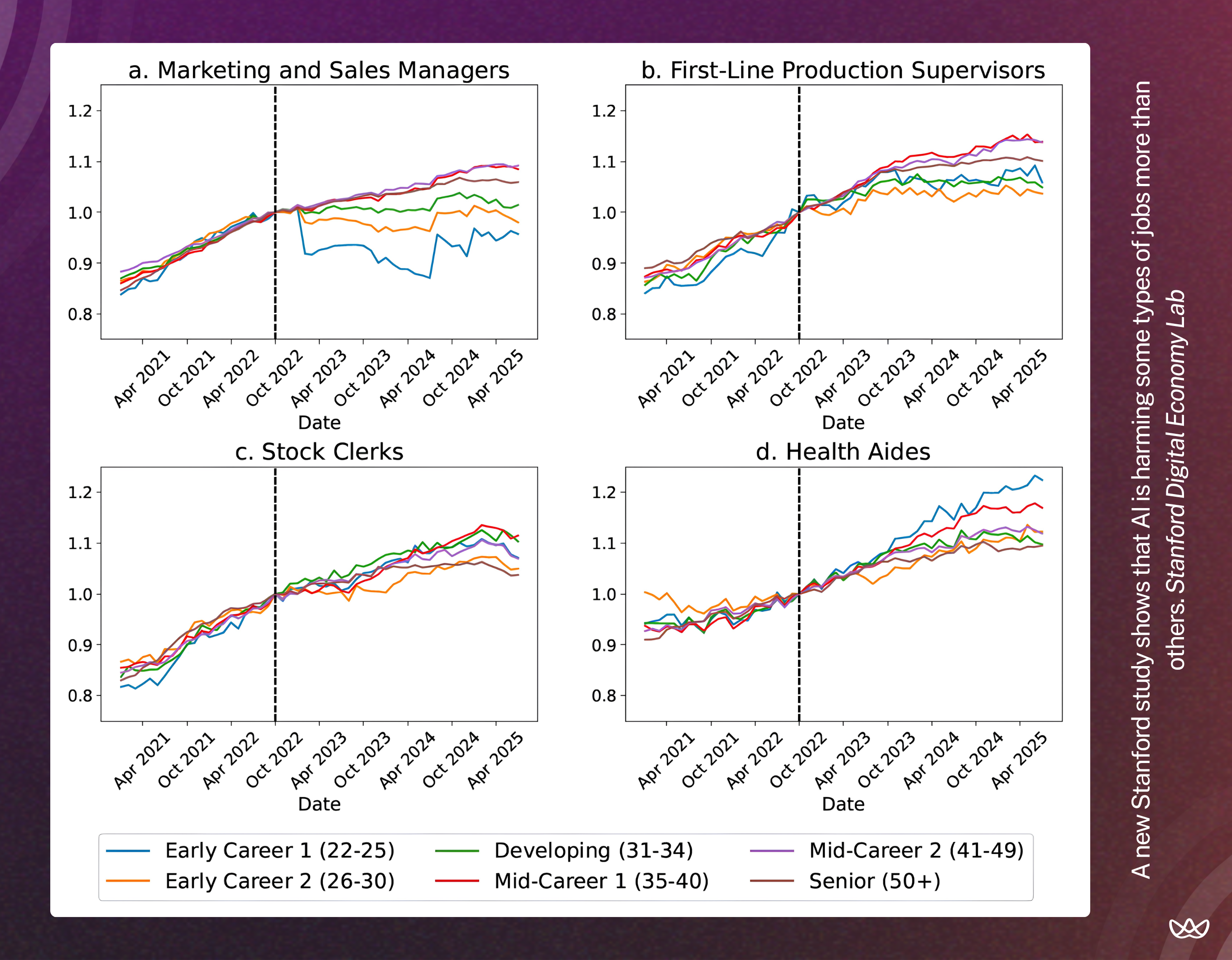
Stanford Digital Economy Lab and Anthropic have both published research tracking employment shifts by AI exposure. The Stanford "Canaries in the Coal Mine" study found that early-career workers aged 22 to 25 in the most AI-exposed occupations experienced a 16% relative decline in employment since generative AI became widely adopted, even after controlling for firm-level shocks. Anthropic's Economic Index labor market report confirms similar patterns.
What matters more for marketing specifically is what happens by seniority. According to Time's coverage of the Stanford analysis, workers aged 30 and over in the same high-exposure categories saw employment grow between 6% and 12% from late 2022 to May 2025. Older marketers with judgment, cross-functional experience, and the ability to direct AI tools are being retained and hired at rates that indicate demand, not decline.
The best marketing-specific evidence comes from Semrush's 8,000-listing study. Since 2023:
- Content Producer listings grew 1,261%
- Content Creator listings grew 410%
- Head of Content Marketing grew 376%
- VP of Content grew 308%
- Content Marketing Manager (mid-level generalist) fell 73%
- Content Marketing Specialist fell 74%
- Median senior salary reached $161,500 (up 54%)
- Median non-senior salary reached $80,000 (up 29%)
The pattern is polarization, not elimination. Companies are pulling headcount away from the middle and pushing it toward two poles: senior strategic ownership and hands-on execution. The generalist middle layer is what's shrinking.
Are Companies Actually Reducing Marketing Headcount?
Some are. Many are changing what they hire for.
The difference matters. Reducing headcount means hiring fewer marketers overall. Changing hiring priorities means replacing some roles with others as AI takes over more execution work.
The data shows both trends. In Wynter's survey of 100 B2B SaaS marketing leaders, 47% said they had eliminated, reduced, or stopped backfilling marketing roles because of AI over the past year. But only 7% reported visible team reductions. Most changes happened through attrition or unfilled roles rather than layoffs.
The Semrush hiring data we discussed above tells the other side of the story. Demand for senior leadership and execution-focused roles increased sharply, while mid-level generalist roles declined. Median salaries also rose across senior and non-senior positions. Together, these findings suggest that many companies are changing the mix of roles they hire for rather than reducing marketing hiring across the board.
The biggest changes are happening in execution-heavy and generalist roles. Companies are still hiring for positions that require strategy, analytics, cross-functional ownership, and the ability to work effectively with AI.
What AI Actually Automates in Modern Marketing Operations
The easiest way to understand AI's impact is to look at the work it helps marketers do faster.
Content drafting is one of the biggest changes. Many teams now use AI to create first drafts of blog posts, emails, ad copy, and social content. That doesn't remove the need for content marketers. It shifts more of their time toward editing, positioning, brand voice, and quality control.
Reporting is another area where AI is saving time. Automated dashboards and AI-generated summaries reduce the effort required to collect and organize data. Marketers still need to interpret results, identify trends, and decide what to do next.
Campaign operations have also become more automated. Many advertising platforms now handle tasks like bid management, scheduling, and budget pacing. Strategy, audience selection, testing, and budget decisions still rely on people.
Creative work is changing in a similar way. AI can generate multiple versions of copy and creative ideas in minutes, while marketers decide the concept, direction, and final output.
Workflow automation is also becoming part of day-to-day marketing. Teams increasingly use AI to automate repetitive tasks, connect tools, and reduce manual work, allowing marketers to spend more time on planning and execution.
The New Responsibilities Driving Marketing Hiring
AI is changing the type of work many marketing teams expect people to do. Instead of focusing only on execution, more roles now combine strategy, analysis, automation, and oversight.
One area is reviewing and improving AI-generated work. As more teams use AI for content creation, marketers are spending more time editing, maintaining brand voice, and making final decisions before work is published.
Another is managing workflows and automation. Marketing teams are increasingly using AI alongside existing tools, creating demand for people who can build processes, connect systems, and improve how work moves across teams.
Data interpretation is also becoming more important. AI can summarize performance data, but marketers still need to identify patterns, explain results, and recommend what to do next.
Finally, companies continue to hire for senior leadership roles that own strategy across marketing functions. At the same time, many execution roles now include AI as part of the day-to-day workflow rather than treating it as a separate skill.
Across these areas, the common theme is that AI is handling more of the repetitive work, while marketers are spending more time on planning, decision-making, and coordination.
What Floowi Is Seeing Across Marketing Hiring
Our conversations with clients reflect many of the same patterns that we discussed above.
One change is the move from generalist to specialized roles. Clients who once asked for a marketing manager or digital marketing specialist are now more likely to look for a technical SEO strategist, Klaviyo email specialist, growth marketer, or content marketer with experience across multiple formats.
We're also seeing more demand for senior-level candidates. Many clients are looking for marketers who can own strategy, make decisions independently, and work across teams rather than focus on execution alone.
AI familiarity has also become part of the conversation. Clients increasingly ask whether candidates have experience using tools like ChatGPT, Claude, or relevant AI tools as part of their workflow. In many cases, it's viewed as a practical skill alongside technical expertise rather than a separate qualification.
Taken together, these requests suggest that hiring priorities are changing. Companies are placing greater emphasis on specialized skills, strategic ownership, and the ability to work effectively with AI.
If you're figuring out what your marketing team should look like in the AI era, get a free AI consultation. We'll help you identify the roles you need, then use our simple three-step process to help you hire vetted AI-ready talent in Latin America.
Structural Comparison: AI Leaders vs. AI Laggards
Companies are at different stages of adopting AI in marketing, and that often shows up in how they organize work.
Teams that have integrated AI into their workflows usually define where AI is used, who reviews the output, and where human decisions are required. AI becomes part of an established process rather than a standalone tool.
Teams that are still experimenting tend to use AI on an individual basis. Different people use different tools and workflows, with fewer shared standards for quality or consistency.
The biggest difference isn't whether AI is available. It's whether the team has clear processes for using it alongside human expertise.

Team Structure Comparison Framework
How Marketing Leaders Should Build Teams in 2026
If you're hiring in 2026, start with the work that needs to get done instead of the job title.
Ask yourself three questions.
Can AI handle part of this work? If it can, you may not need another full-time hire. You may need someone who can review the output and make the final decisions.
What does this role own? Roles that involve planning, analysis, decision-making, or cross-functional coordination continue to be important as AI becomes part of everyday marketing.
Can this person work effectively with AI? Experience with AI tools is becoming a practical skill for many marketing roles. Look for candidates who know how to use them as part of their workflow.
Every team will look different, but many companies are hiring for specialized roles instead of broad generalist positions. The goal isn't to build a bigger team. It's to build a team with the skills your business needs.
If you're hiring in Latin America, you can also access experienced marketing specialists while keeping strong time zone overlap with the US.
Your Next Step
The teams adapting well are building with specialization, ownership, and AI in mind. That means hiring people who can make decisions, work across functions, and use AI to improve execution instead of expecting AI to replace the team.
If you're planning your next marketing hire, start hiring or schedule a free AI consultation to identify the roles your team needs and hire vetted AI-ready marketing talent in Latin America.
Frequently Asked Questions
Will AI replace marketing jobs?
Probably not in the way many people expect. AI can already handle parts of content creation, reporting, and campaign management, but you'll still need people to make decisions, interpret data, and own strategy. The bigger change is in how marketing work is divided, not whether marketers are needed.
What marketing roles should you hire for in the AI era?
If you're hiring today, look for specialists who can combine their expertise with AI. Roles in strategy, analytics, SEO, lifecycle marketing, marketing operations, and content production continue to be in demand, while broad generalist roles are becoming less common.
Should you reduce your marketing team because of AI?
Not automatically. Before removing a role, ask whether AI can replace the work or simply help someone do it faster. In many cases, companies are changing what they hire for rather than reducing marketing teams altogether.
Is marketing still a good career?
Yes. If you're building skills in strategy, analytics, automation, SEO, or AI-assisted workflows, you'll continue to find opportunities as marketing teams evolve.
What will marketing teams look like over the next few years?
Every company will be different, but many teams are becoming more specialized. Instead of hiring one person to do everything, companies are building smaller teams with specialists who use AI as part of their daily work.



.png)


