






For U.S. companies hiring marketing talent in LATAM, the main options fall into three categories. Nearshore LATAM specialists like Floowi and Terminal focus on pre-vetted, time zone-aligned hires from Latin America. Freelance marketplaces like Upwork, Fiverr, and Toptal offer flexible access to global talent at varying price and quality tiers. Offshore staffing platforms like Remote or OnlineJobs.ph tap into lower-cost markets, though the 12+ hour time difference with the Philippines typically limits real-time collaboration.
Comparison Table: 7 Best Options to Hire Nearshore Marketing Talent in LATAM in 2026
The seven options below differ in talent region, hiring model, and how long it takes to get someone working. The table makes the structural choices visible at a glance.
Why U.S. Companies Are Looking for Nearshore Marketing Talent in LATAM
Hiring marketing talent in LATAM sounds simple until you start comparing options. Upwork sends 70 applications in a day for a single posting. Toptal demands a $500 deposit before showing you a candidate. OnlineJobs.ph is cheap but expects you to run the entire vetting process yourself. Floowi screens for marketing roles specifically but only places in Latin America. Each platform was built for a different buyer with different priorities, and the wrong choice burns weeks before you realize the model itself was the problem.
The seven options below are the ones US marketing teams actually use to build LATAM teams in 2026. For each one, you'll see how it works, what it costs, and the type of team it fits best, with the data you need to skip the wrong-tool-for-the-job mistakes that consume most first hiring cycles.

The shift toward LATAM nearshore hiring for marketing roles has accelerated because the operational fit is different from offshore models that came before it.
Time zone overlap is the most concrete advantage. A marketing professional in Bogotá, Mexico City, or Buenos Aires works within 0–4 hours of U.S. business hours. That means daily standups happen in real time. Campaign reviews don't wait for an overnight handoff. Client feedback gets actioned the same day. By comparison, the Philippines runs 12–14 hours behind U.S. East Coast time, which forces every revision into an asynchronous cycle.
English proficiency in LATAM marketing populations is now strong enough for client-facing work in major cities. According to the EF English Proficiency Index 2025, Argentina ranks 26th globally in the "high" band, the strongest in Latin America. Bilingual professionals in Bogotá, Medellín, Mexico City, and Buenos Aires routinely produce English-language copy, manage U.S. client relationships, and participate in English-language Slack workflows without friction.
Cost savings remain substantial. Per Floowi's 2025 LATAM Hiring Benchmarks, U.S. companies hiring LATAM marketing talent through a managed partner save 50–70% compared to U.S.-based equivalents. A U.S. marketing manager costing $80k–$130k per year is comparable to a $40k–$55k LATAM hire delivering similar work.
Cultural fit is the underrated factor. Marketing professionals across Mexico, Colombia, and Argentina who work with U.S. companies understand U.S. consumer brands, advertising conventions, and digital marketing tools. They don't need to be taught the context that distant offshore hires often need explained from scratch.
What to Look for When Hiring Nearshore Marketing Talent in LATAM
Not all nearshore hiring options are the same, even within LATAM. A few important factors make a big difference when choosing the right one.
Specialization fit. A platform built for general freelance work won't screen for marketing competence specifically. A nearshore staffing partner focused on marketing pre-filters for tool proficiency, campaign experience, and English fluency before you see a profile. The further the platform is from marketing specifically, the more screening work falls on you.
Vetting depth. Some options vet candidates before you see them (Floowi, Toptal). Others surface every applicant and leave the filtering entirely to you (Upwork, OnlineJobs.ph). Both models work, but they require different amounts of internal hiring capacity.
Time zone alignment. This is binary in practice. LATAM gives you full or near-full overlap with U.S. business hours. The Philippines, India, and Eastern Europe do not. For client-facing marketing roles where same-day communication matters, this single factor often determines success.
Contract flexibility. Some providers require multi-month or annual commitments. Others let you stop at any time with short notice. For marketing teams whose needs fluctuate with campaign cycles, lock-in periods carry real cost.
Replacement policy. What happens when the first hire doesn't work out? A good provider replaces the candidate quickly at no extra cost. A platform-based marketplace leaves you to restart the entire hiring cycle.
Onboarding support. Marketing roles need brand guidelines, tool access, and clear performance expectations from day one. Providers that help with structured onboarding deliver productive hires meaningfully faster than direct-hire platforms where onboarding is entirely your responsibility.
The 7 Best Options to Hire Nearshore Marketing Talent in LATAM in 2026
The seven options below cluster into two groups: nearshore LATAM specialists (where U.S. agencies typically start) and offshore staffing providers from other regions (often considered for cost reasons). Each comes with strengths and limitations worth understanding before committing.
Nearshore LATAM Specialists
1. Floowi
Floowi is a nearshore staffing partner specialized in marketing, creative, and design roles from Latin America. Unlike generalist platforms, Floowi pre-vets candidates for specific marketing functions and manages the full onboarding process, clients typically receive 3–4 screened profiles within days instead of filtering hundreds of applications.
The typical time to hire is 10 to 15 business days. If you are looking for a marketing specialist, graphic designer, video editor, or social media manager who works U.S. hours and is already vetted for your type of role, this is one of the more efficient options available in the LATAM market.
Floowi's marketing and strategy talent catalog covers the specific roles agencies and growing companies hire for most: marketing managers, SEO specialists, paid media specialists, content marketing managers, email marketing specialists, social media managers, growth marketing managers, and copywriters.
Best for: companies across tech, e-commerce, SaaS, professional services, and marketing agencies that need recurring marketing talent without long-term contracts.
Main advantage: specialized vetting for marketing roles, 15-day placement, no lock-in.
Main limitation: focused on LATAM talent; not the right fit if you need a global or Asia-based team.
2. Upwork
Upwork is the largest open freelance marketplace, with roughly 18 million freelancers and 5 million active clients globally. You post a job, freelancers submit proposals, and you screen them yourself. There is no vetting before profiles reach you, which means quality varies widely across applicants on every posting.
For clients in 2026, fees include a marketplace fee of up to 7.99% on payments (reduced to 3% for U.S. ACH transactions) plus a contract initiation fee of $0.99–$14.99 per new contract. Business Plus plans add 8–10% in fees. Freelancers also pay 0–15% on their earnings, which most price into the rates they quote.
The honest tradeoff: Upwork's scale is unmatched, but you absorb the entire screening burden. For a marketing manager role, expect 30–80 proposals within 48 hours, with quality ranging from $5/hour applicants in low-cost regions to $250+/hour specialists from the U.S. Filtering is a real time investment.
Best for: companies with internal hiring capacity that can run their own screening process and want maximum optionality on freelance talent.
Main advantage: scale and breadth; access to any skill at any price point.
Main limitation: no pre-vetting, high screening overhead, time-zone alignment varies by individual.
3. Fiverr
Fiverr is structured around defined gigs rather than ongoing employment. Freelancers list packaged services at fixed prices, and clients buy them like products. The model works well for one-off marketing deliverables: a logo, a landing page copy edit, a batch of social posts, a video edit.
Fiverr charges buyers a 5.5% service fee on all transactions, plus a $2.50 small order fee on gigs under $75. Freelancers pay a 20% commission on earnings, which is among the highest in the freelance marketplace category. Fiverr Pro Advanced is available at $129/month for businesses that want vetted freelancers and team management features.
For ongoing marketing roles, the per-project structure introduces friction. Each new task is a separate transaction. The platform isn't built for the continuity that recurring marketing operations require.
Best for: one-off marketing deliverables with defined scope and tight timelines.
Main advantage: fast turnaround on discrete tasks, predictable upfront pricing per gig.
Main limitation: not designed for ongoing roles, high freelancer fees often passed through in pricing.
4. Toptal
Toptal accepts roughly the top 3% of applicants, per its own published screening overview. The vetting process includes a live interview and test project, which produces a higher-quality pool than open marketplaces. For senior specialized marketing talent (performance marketing leads, growth specialists, CMO-level strategists), Toptal is a credible option.
The cost reflects the curation. Client rates run roughly $60–$200+ per hour, with an undisclosed markup embedded in the quoted figure. Toptal requires a $500 refundable deposit to start a search, plus a $79/month platform fee that continues until you cancel. Matching is fast: clients typically see candidates within 24–48 hours of the deposit.
The model fits short-to-medium-term project engagements where senior expertise matters more than headcount cost. For ongoing full-time marketing team building at scale, the hourly rate structure and the markup compound quickly.
Best for: companies needing senior specialized marketing expertise on project or part-time engagements.
Main advantage: rigorous vetting, fast matching, top-tier talent quality.
Main limitation: premium pricing, $500 deposit + $79/month platform fee, less suited to recurring full-time hires.
Offshore Staffing: Other Regions
The three options below are not LATAM-based. They're included because U.S. companies frequently compare nearshore LATAM against offshore Philippines as part of the same hiring decision. Each is worth understanding to see why time zone alignment specifically pushes most U.S. marketing teams toward LATAM rather than Asia.
5. Outsource Access
Outsource Access is a Philippines-based virtual assistant and offshore staffing provider focused on solopreneurs, small businesses, and SMBs. The model covers virtual assistance, customer service, project management, and some marketing functions.
Pricing is flexible but typically runs in the range of $5–$12/hour for marketing-adjacent roles, which translates to roughly $800-$1.9k per month for full-time placements.
The main limitation is time zone alignment. The Philippines runs 12–14 hours ahead of U.S. East Coast time. For marketing roles that require real-time campaign management, client communication, or same-day creative iteration, the offset pushes most work into asynchronous cycles. Strong English fluency helps, but the operational gap is still noticeable.
Best for: small businesses and solopreneurs comfortable with asynchronous workflows and prioritizing cost over time zone alignment.
Main advantage: lower hourly rates than LATAM, established VA management infrastructure.
Main limitation: 12+ hour time zone offset from U.S. business hours.
6. OnlineJobs.ph
OnlineJobs.ph is the largest direct-hire marketplace for Filipino virtual assistants, with over 2 million active workers. Employers pay $69–$99/month for platform access and post jobs directly to the worker pool. There is no commission on wages. Once you hire, you pay the worker directly through Wise, PayPal, or bank transfer.
The model is the cheapest path to Philippines-based marketing support, with full-time roles available at $400-$1k/month for general VAs and $700–$2k+/month for marketing specialists. The trade-off is that you run the entire hiring process yourself: posting, screening, interviewing, contract setup, payroll. There's no pre-vetting and no replacement guarantee.
Filipino workers typically expect a "13th month" bonus paid in December, an additional month's salary as an annual bonus that's standard practice in the country. Budgeting for this is not optional; skipping it materially hurts retention.
Best for: companies with internal hiring capacity comfortable running their own screening process and managing direct employment relationships.
Main advantage: lowest cost path to Philippines-based talent, no commission, monthly subscription only.
Main limitation: no pre-vetting, no managed onboarding, full hiring process responsibility on the employer.
7. Staff Domain
Staff Domain is an Australian-led offshore staffing partner operating from delivery centers in Manila, Cebu, Clark, and Alabang in the Philippines, plus Randburg in South Africa. The model is offshore staffing rather than traditional BPO: Staff Domain handles recruitment, employer-of-record compliance, equipment, and infrastructure, while the staff work exclusively for your company and report to you directly.
Pricing is all-inclusive and quoted per role rather than per hour. The "Pod Pilot" program offers a 5-person team on a 90-day trial with 60-day cancellation, which lowers the commitment barrier. Standard engagements are subscription-based with no fixed lock-in beyond the 60-day notice period.
The strength of the model is structural: dedicated staff, full employment infrastructure, established governance frameworks. The limitation for U.S. marketing teams is the same as other Philippines-based providers. The 12+ hour time zone offset doesn't go away regardless of how well the operational model is structured.
Best for: companies building larger offshore teams (5+ roles) that can absorb the time zone offset and want full employment infrastructure handled by the provider.
Main advantage: dedicated staff with full compliance handling, structured governance model, established delivery centers.
Main limitation: Philippines/South Africa base means 12+ hour offset from U.S. East Coast time.
Key Factors When Evaluating Nearshore Hiring Options
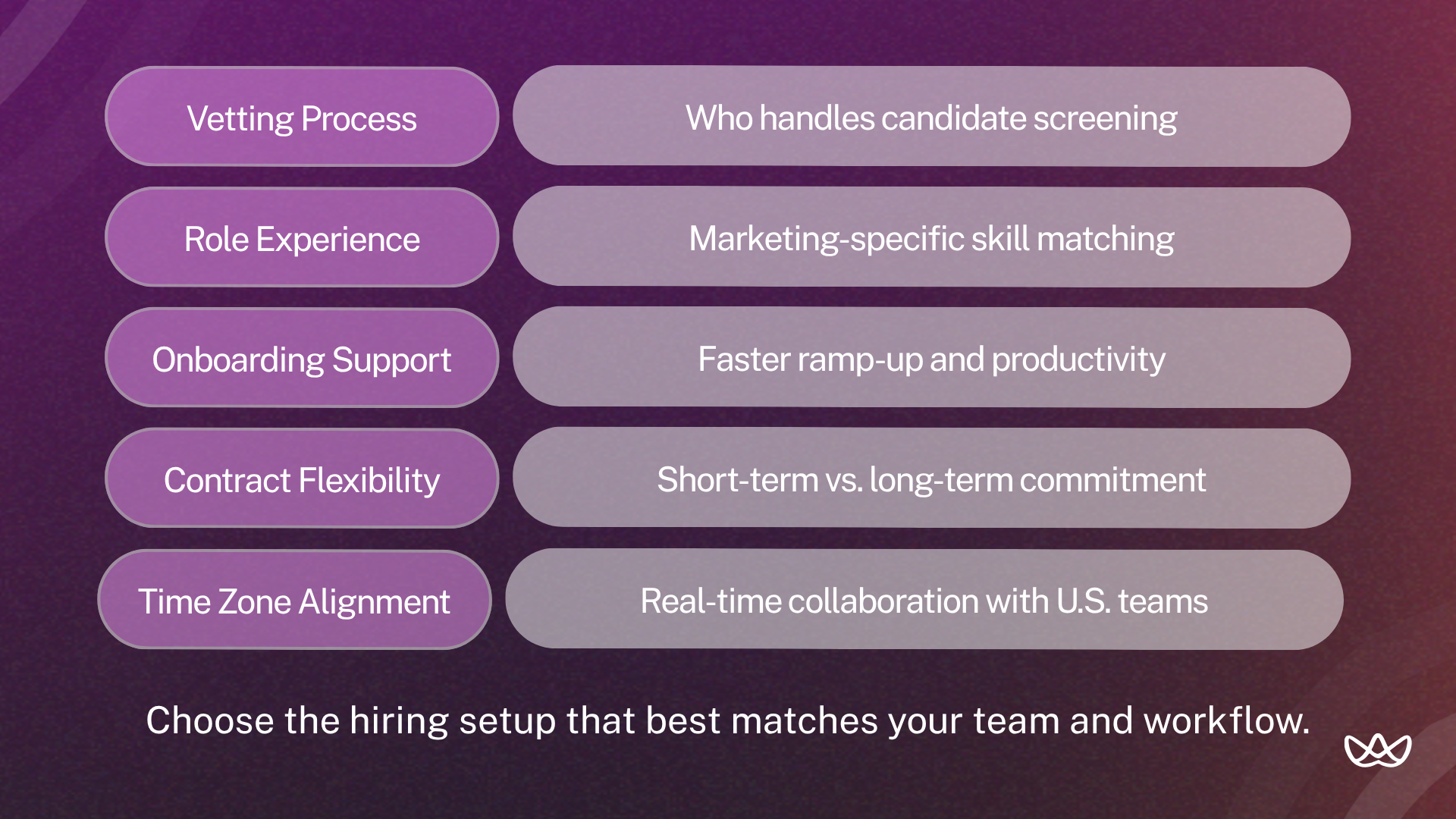
Once you've narrowed the field to two or three options, the comparison gets specific. Six operational factors decide which provider actually fits your team.
Vetting process: who screens candidates and how
The most consequential question is who does the filtering. Pre-vetted providers (Floowi, Toptal) screen candidates before profiles reach you, which means every person you interview has already passed a baseline of skill and English proficiency.
Open marketplaces (Upwork, OnlineJobs.ph) leave the entire vetting process to you, including the basic question of whether the applicant can actually do the work they claim. The former costs more per hire; the latter costs more in internal screening time.
Experience with specific marketing roles (performance, content, design, video)
General staffing platforms place anyone for anything. Marketing-specialized platforms maintain candidate pools organized by marketing function: paid media specialists with verified Google Ads experience, content writers with portfolio evidence, designers with relevant work samples.
If your role is specific (a Klaviyo email specialist, a TikTok ad buyer, a brand designer for SaaS), specialization in the platform itself meaningfully changes hit rates on the first batch of candidates.
Onboarding support and ramp-up time
Marketing roles need brand guidelines, tool access, performance expectations, and a clear first 30-day plan to reach productivity. Providers that help structure onboarding deliver effective hires in two weeks. Direct-hire platforms where onboarding is entirely your responsibility often see four to six weeks before the hire is fully productive, even with strong candidates.
Contract flexibility: no long-term lock-in
Marketing budgets fluctuate with campaign cycles, product launches, and seasonal demand. Lock-in clauses create real cost when needs change. Look for month-to-month arrangements, 60-day notice periods, or pilot programs that don't require multi-year commitments.
Floowi, Staff Domain (post-pilot), and most freelance marketplaces support this. Some EOR and BPO arrangements don't.
Replacement policy if the hire does not work out
Even with good vetting, some hires don't work. A clear replacement policy (typically a new candidate within 2–4 weeks at no extra cost) is the difference between a manageable setback and restarting the entire hiring cycle. Managed nearshore partners typically offer this. Open marketplaces don't.
Time zone alignment with U.S. business hours
This is binary in practice. LATAM nearshore options give you 4–8 hours of overlap with U.S. business hours, which makes real-time collaboration possible. Philippines, India, and Eastern Europe-based providers force asynchronous workflows because of the 12+ hour offset. For marketing roles that require same-day campaign adjustments or client communication, this single factor often determines success more than any other.
Frequently Asked Questions
What are the best options to hire nearshore marketing talent in LATAM?
The most efficient option for marketing-specific roles is a nearshore staffing partner like Floowi, which pre-vets candidates for marketing functions and places within 10–15 business days. Toptal is appropriate for senior specialized roles on project engagements. Upwork is the broadest option for companies with internal screening capacity. Philippines-based providers (Outsource Access, OnlineJobs.ph, Staff Domain) are typically considered when cost is prioritized over time zone alignment.
Why hire marketing talent from LATAM instead of other regions?
The combination of time zone alignment, English proficiency in major cities, cultural familiarity with U.S. markets, and 50–70% cost savings versus U.S.-based hires consistently makes LATAM one of the strongest fits for U.S. marketing teams. Asian outsourcing regions often offer lower hourly rates, but the time zone gap can make real-time collaboration harder for marketing roles that depend on fast communication and same-day execution. For companies looking to build a vetted nearshore marketing team in LATAM, Floowi is one of the more specialized options available.
What marketing roles can be filled with nearshore talent from LATAM?
The most commonly placed roles include marketing managers, SEO specialists, paid media specialists, content marketing managers, email marketing specialists, social media managers, growth marketing managers, community managers, copywriters, media buyers, marketing automation specialists, and UX/UI designers focused on marketing applications. Each role has established LATAM talent pools with verified tool proficiency and English fluency.
How long does it take to hire a LATAM marketing professional through one of these options?
Time-to-hire varies meaningfully by model. Pre-vetted nearshore partners like Floowi place candidates in 10–15 business days. Toptal matches within 24-48 hours after the deposit. Upwork and Fiverr can produce hires within 1–7 days but require internal screening that adds days to the effective timeline. Direct-hire job boards like OnlineJobs.ph can take 2–6 weeks because the entire vetting process sits with the employer.
Is nearshore hiring more expensive than offshore hiring from Asia?
Yes, on a pure hourly basis. Philippines-based providers operate at $5–$15/hour for marketing-adjacent roles. LATAM nearshore options run $15–$30/hour for equivalent roles. The trade-off is time zone alignment: LATAM gives you 4-8 hours of overlap with U.S. business hours, while Philippines forces a 12+ hour offset. For marketing roles requiring real-time collaboration, the operational difference often makes the cost gap worth it.
What is the difference between a freelance marketplace and a nearshore staffing partner?
A freelance marketplace (Upwork, Fiverr) provides a self-service platform where you post jobs and screen applicants yourself, with the platform taking transaction fees. A nearshore staffing partner (Floowi) pre-vets candidates for specific roles, presents you with a short list, handles compliance and payroll, and supports onboarding. The marketplace is cheaper per hire if you have internal screening capacity. The staffing partner is faster and more reliable for marketing-specific roles where vetting depth matters.
Which of these 7 options is best for a SaaS or tech company hiring a marketing team?
For a SaaS or tech company building a marketing team, the strongest fit is typically Floowi for specialized marketing roles requiring U.S. time zone alignment and bilingual capability. Toptal is appropriate for senior specialized hires on project engagements. The Philippines-based options (Outsource Access, OnlineJobs.ph, Staff Domain) are usually less effective because marketing in SaaS depends on real-time campaign management, customer communication, and tight collaboration with product and sales teams that the time zone offset complicates.
Your Next Step
The right option depends on three things: how specialized the role is, how much internal screening capacity you have, and whether time zone alignment is a hard requirement.
For specialized marketing roles requiring U.S. time zone alignment, a nearshore staffing partner like Floowi removes most of the screening burden and places vetted candidates within 10–15 business days.
For senior project-based work where premium pricing is acceptable, Toptal delivers quality through rigorous vetting. For companies with strong internal hiring capacity who want maximum optionality, Upwork provides scale. The Philippines-based options remain on the table when cost takes priority over operational fit, but the 12+ hour time zone offset is the structural limitation that affects every hire built on that model.
The financial case for LATAM nearshore hiring is well-supported. For verified pricing and engagement details that fit your specific role requirements, see Floowi's pricing for transparent cost data and the engagement model that matches your team size and timeline.



.png)


