






Hiring a remote video editor in LATAM in 2026 typically costs between $2.5k and $4.5k per month through a managed nearshore arrangement. These figures represent total client cost, including recruitment, payroll administration, and HR support, while still reflecting meaningful savings versus equivalent US-based hires. The most common formats LATAM editors handle are short-form social, YouTube long-form, ad creatives, podcast clips, and corporate video. Typical time-to-hire through a pre-vetted nearshore partner is 10–15 business days.
Why U.S. Companies Are Hiring Video Editors in LATAM in 2026
A lot of agencies hiring video editors in 2026 are dealing with the same issue: they need more short-form content, but hiring locally is expensive, and low-cost freelancers often require too much oversight.
US-based editors can cost anywhere from $70k–$100k annually, which is difficult for smaller agencies or lean content teams to justify. On the other hand, very cheap freelance options often lead to inconsistent quality and extra revision work.
For many teams, hiring in LATAM has become a more workable approach. Editors in cities like Mexico City, Bogotá, and Buenos Aires are commonly being hired for monthly rates around $2.5k–$4.5k , with the added advantage of overlapping work hours with US teams. That overlap tends to make communication, revisions, and turnaround times easier to manage.
Let’s look at the current pricing, what to evaluate during hiring, and the process agencies are using to build reliable remote editing teams in 2026.
Three operational factors are driving more U.S. companies to hire video editors in LATAM, and that trend continued through the first half of 2026.
First, agencies now produce much more short-form content than they did a few years ago. Weekly Reels, YouTube Shorts, podcast clips, and ad creatives have become part of standard client deliverables. Many teams struggle to keep up with that volume using only one in-house editor, while low-cost freelance setups often create consistency and revision issues.
Second, time zone overlap makes collaboration easier. A video editor in Colombia or Mexico can usually work within U.S. business hours, which helps teams move through feedback and revisions faster. Compared to working across larger time gaps, the workflow tends to be more efficient for agencies publishing content on a weekly schedule.
Third, cost still plays a major role. A US in-house video editor averages $70.7k per year on Glassdoor's May 2026 data, while senior editors average $100.2k. In comparison, companies can typically hire a LATAM editor through a managed nearshore arrangement for around $30k–$54k annually. For many agencies, that difference creates more flexibility without sacrificing day-to-day collaboration.
What Does a Remote LATAM Video Editor Actually Cost in Mid-2026
.png)
LATAM video editing rates have stabilized after the salary increases that ran through 2024–2025. Editors working in dedicated remote roles through nearshore partners typically cost between $2.5k and $4.5k per month all-in, depending on experience level, technical specialization, and content complexity.
These figures represent client cost through a managed nearshore arrangement, which includes the editor's compensation along with recruitment, payroll administration, and HR support. The structure is comparable to what you'd budget for an in-house hire, just with the geographic arbitrage built in. For verified rate benchmarks segmented by experience and engagement type, see Floowi's video editor hourly rate guide.
Hourly equivalents are useful for comparing project-based work: LATAM mid-level editors price at $15–$25 per hour for ongoing engagements, against US freelance rates of $35–$75 per hour and US in-house equivalents of $34–$48 per hour.
Comparative Table
The cost advantage is usually strongest at the mid-level hiring range, where most agencies build their day-to-day editing capacity
What to Look for in a Remote Video Editor Before Hiring
Most hiring mistakes happen because companies evaluate portfolios without evaluating how the editor actually works day to day. Before making a hire, you should understand how the candidate handles tools, communication, revisions, turnaround times, and the specific type of content your team produces.
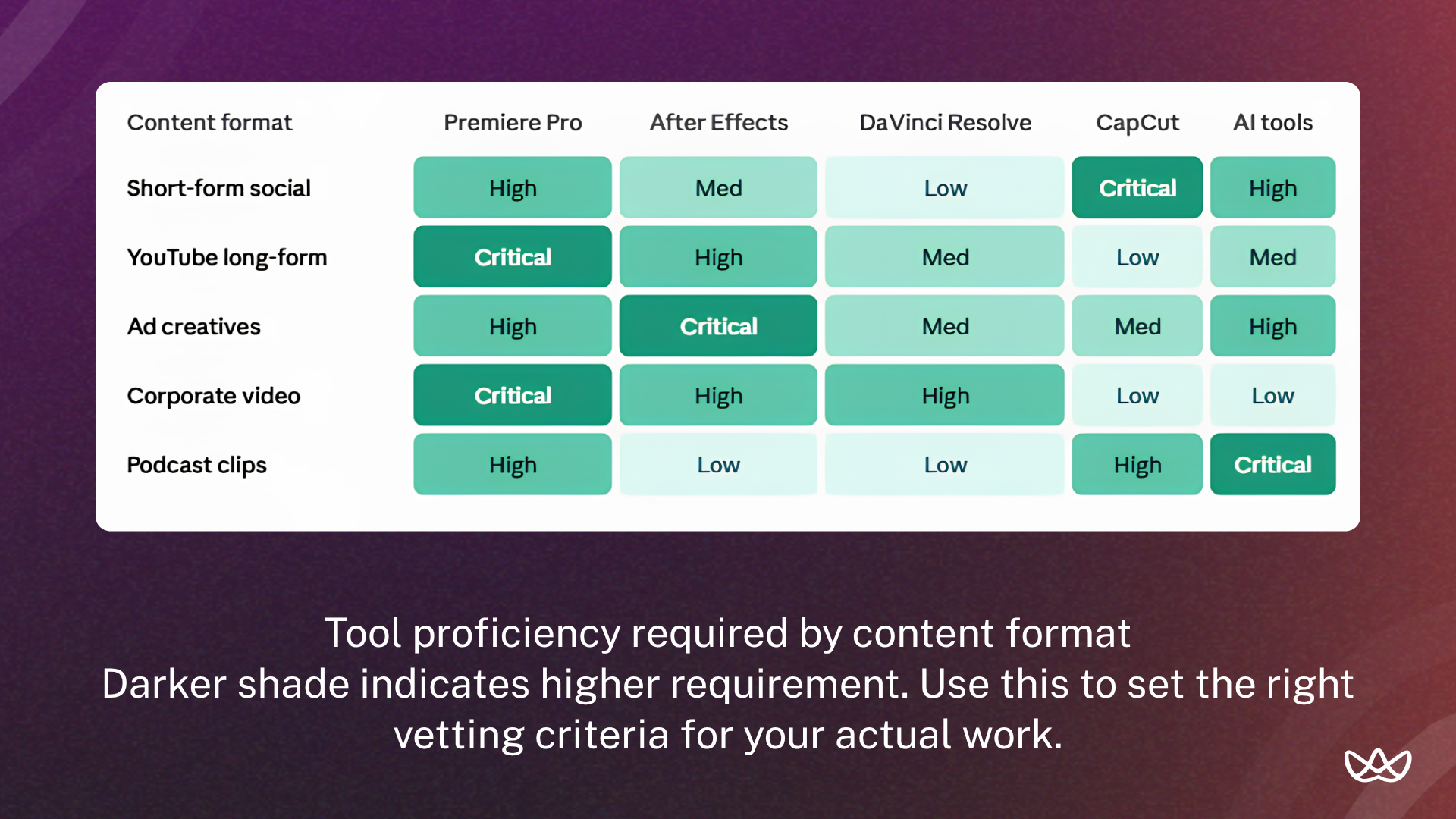
Proficiency in the tools your team uses (Premiere Pro, After Effects, DaVinci Resolve, CapCut)
Tool fluency varies more than candidates' resumes suggest. A Premiere Pro editor isn't automatically comfortable in DaVinci Resolve, and a YouTube long-form editor may not have CapCut's vertical-first workflow down. Ask candidates to walk through their actual project file structure, naming conventions, and proxy workflow. Real proficiency shows up in those details. Surface-level familiarity doesn't.
For 2026 specifically, AI-assisted editing tools (Runway, Descript, Adobe Firefly integrations) are increasingly relevant. Editors who use them well move faster on rough cuts and repetitive tasks. Editors who treat them with caution often produce more consistent finished work. Neither approach is wrong, but knowing where a candidate sits affects how you brief them.
Experience with your content format (short-form social, YouTube, ads, corporate video)
Format-specific experience matters more than years of total editing. A senior corporate video editor often struggles with the pacing demands of TikTok or Reels. A short-form social specialist may not have the patience for a 20-minute YouTube long-form structure. Match the candidate's portfolio to the type of work that fills 80% of your output, not 20%.
English communication level for async feedback loops
Video editing communication is heavily written: brief documents, feedback notes in Frame.io or Loom, Slack threads, async revision requests. Test written English specifically. Spoken English fluency in a call doesn't always translate to clear written interpretation of complex briefs. For client-facing roles or any role with significant copy-on-screen work, written English at B2/C1 level should be a baseline requirement.
Turnaround time on a standard edit
Define what "standard" means for your work and ask the candidate to commit to a realistic timeline. A 30-second Reel from raw footage typically runs 4–8 hours for a mid-level editor. A YouTube long-form (10–15 minutes) typically runs 1–3 days depending on complexity. Editors who quote dramatically faster timelines are often cutting corners on quality. Editors who quote dramatically slower timelines may not have the production cadence required for weekly social work.
Availability within U.S. business hours
For LATAM specifically, this is usually a non-issue. Colombia (UTC-5), Mexico (UTC-6 CST), Argentina (UTC-3), and Chile (UTC-3) all overlap meaningfully with US business hours. Confirm specifically: which hours will the editor be reachable? Will they attend a weekly standup at 10 AM EST? Are they comfortable with same-day revision requests during US working hours? Get these answers explicitly, not implicitly.
Revision process: how many rounds, how they handle direction changes
Revision tolerance is one of the most underrated qualification signals. An editor who pushes back constructively on bad direction is often more valuable than one who accepts every change without question.
Ask candidates to describe their typical revision workflow, how they handle direction changes mid-edit, and what their cap is on revision rounds. The answers reveal whether you're hiring an executor or a collaborator.
Where to Find Pre-Vetted Remote Video Editors in LATAM
Where you hire from affects both the quality of candidates you see and the amount of screening work your team has to handle internally. Most companies hiring remote video editors in LATAM usually choose between three main options depending on speed, budget, and how involved they want to be in the hiring process
Nearshore staffing partners like Floowi pre-vet candidates specifically for video editor roles before profiles reach you. The vetting covers tool proficiency, portfolio review, English communication, and US workflow familiarity. The typical engagement starts with two to three screened candidates within 10–15 business days. This is the most operationally efficient model for ongoing roles that need consistent output.
Curated freelance networks like Toptal accept roughly the top 3% of applicants and produce high-quality matches for project-based work. Pricing runs $60–$200+ per hour with a $500 refundable deposit plus a $79/month platform fee. The model fits short-to-medium engagements where premium quality matters more than headcount cost.
Open freelance marketplaces like Upwork and Fiverr surface large candidate pools without pre-vetting. Upwork posts can pull 30–80 applications in 48 hours for a video editor role, with rates from $5 to $250+ per hour and quality varying just as widely. The model works when you have internal capacity to run your own screening process. It doesn't work when speed of placement and consistency of output matter more than optionality.
For agencies and growing companies publishing video content every week, nearshore staffing can make the hiring process more manageable. Instead of spending time filtering large numbers of applicants, teams work with candidates who have already been screened for editing ability, communication, and familiarity with U.S.-based workflows.
How to Onboard a Remote LATAM Video Editor Into Your Team
The first few weeks usually determine how quickly a new editor adapts to your workflow. A structured onboarding process helps reduce revision friction, communication gaps, and inconsistent output early in the engagement.
- Set up tools and asset access: Give the editor access to your media storage, brand assets, project folders, templates, and editing workflows from day one. Document where files live and how projects should be organized so they can work independently faster.
- Share recent reference projects: Provide a few recent edits that reflect the pacing, style, and quality level you expect. Walking through real examples gives editors a clearer understanding of your standards than written instructions alone.
- Define the feedback process early: Decide where feedback will happen, whether through Frame.io, Loom, Slack, or written notes. Clarify turnaround expectations, approval flow, and who signs off on final edits.
- Use clear success criteria for early projects: For the first few assignments, define expectations around pacing, formatting, visual style, music, and delivery requirements before editing begins. Clear direction usually reduces unnecessary revision cycles.
- Schedule a review after the first month: A short review after the first 30 days helps both sides adjust workflows, communication habits, and expectations before they become long-term issues.
Frequently Asked Questions
How much does it cost to hire a remote video editor in LATAM in 2026?
Remote video editors in LATAM typically cost between $2.5k and $4.5k per month through a managed nearshore arrangement. These figures represent total client cost, including recruitment, payroll administration, and HR support, not just the editor's direct compensation. Compared to US-based equivalents at $5.5k–$11k monthly, the savings are still substantial while offering stronger time-zone alignment and operational consistency. Floowi's video editor hourly rate guide has the verified regional breakdown.
What tools should a remote LATAM video editor know?
Adobe Premiere Pro is the standard baseline. After Effects is required for motion graphics work, lower thirds, and any complex animation. DaVinci Resolve is increasingly common for color grading and is the preferred tool in some agencies for full editing workflows. CapCut has become essential for vertical short-form content given its mobile-native templates and AI features. For 2026, working knowledge of AI-assisted tools like Runway, Descript, and Adobe Firefly is increasingly relevant for editors handling high-volume short-form work.
How long does it take to hire a remote video editor in LATAM?
Through a managed nearshore partner like Floowi, the typical timeline is 10–15 business days from intake to first candidate interview. Through freelance marketplaces, you can hire faster (1–7 days) but absorb the entire screening burden yourself. Through curated networks like Toptal, matching happens in 24-48 hours after the deposit, but you typically pay premium hourly rates for that speed.
What content formats do LATAM video editors specialize in?
LATAM video editors cover the full range: short-form social (Reels, TikTok, YouTube Shorts), YouTube long-form, podcast clips, ad creatives, corporate video, training and educational content, and webinar editing. Mexico and Argentina have particularly deep talent pools in commercial and brand video work. Colombia has a strong concentration in social-first content and short-form. For agency work specifically, short-form social and ad creatives are the most common deliverables LATAM editors are hired for.
How do I evaluate a remote video editor before committing to a hire?
Three steps. First, review the candidate's portfolio focusing specifically on work that matches your format and brand level (not just their most impressive showcase pieces). Second, run a paid trial edit using real raw footage from your team, with the same brief structure you'd use ongoing. Pay them for it. The output tells you more in 24 hours than any reference call. Third, interview them about a specific edit they're proud of and one that didn't go well. The answers reveal craft awareness, self-direction, and communication ability in a way portfolio review alone cannot.
Is a LATAM video editor as good as a U.S.-based one?
For the volume of editing work most agencies and growing companies need (short-form social, ad creatives, YouTube long-form, corporate video), yes. The mid-level talent pool in Mexico, Colombia, and Argentina includes editors with formal training, agency experience, and tool proficiency comparable to US mid-level editors. For specialized work (high-end commercial post-production, broadcast editing, feature film) the US still has a deeper senior talent concentration. For everyday content production, the quality gap is operationally negligible and the cost difference is substantial.
What is the difference between hiring a freelance video editor and a dedicated remote editor?
A freelance video editor handles project-based work, charges per project or per hour, and typically juggles multiple clients simultaneously. Briefing happens on each project, brand knowledge resets between engagements, and availability varies. A dedicated remote editor works exclusively on your projects in a full-time or sustained part-time capacity, builds brand knowledge over time, integrates into your team's tools and workflows, and produces increasingly accurate output as the engagement matures. For one-off projects, freelance is fine. For ongoing weekly output where consistency matters, dedicated is meaningfully more productive.
Your Next Step
Hiring the right remote video editor in 2026 depends less on finding the cheapest option and more on finding a workflow that fits your content volume, turnaround expectations, and communication style. For many agencies and growing companies producing video content every week, LATAM-based editors remain a practical option because of the time zone overlap, consistent availability, and lower overall cost compared to equivalent U.S. hires.
Different hiring models work for different needs. Freelance marketplaces can work well for one-off projects, while curated premium networks usually make more sense for highly specialized work. For teams looking for ongoing editing support, many companies prefer working with dedicated editors through nearshore staffing partners because the screening and operational setup are already handled.
If you're looking to hire a LATAM-based video editor, Floowi specializes in pre-vetted nearshore talent matched to your workflow, content style, and production needs. You can schedule a free consultation to explore whether it's the right fit.