






Most tech companies do not have a marketing problem. They have a marketing capacity problem. The channels that drive growth in a competitive SaaS market, SEO, paid acquisition, demand generation, marketing ops, email automation, and AI-driven personalization, each require a depth of expertise that a two or three person internal team cannot cover simultaneously.
Hiring separately for each function is expensive and slow, and the specialized skills the market demands are increasingly scarce. That constraint is pushing a measurable number of tech companies toward outsourced marketing, and the data behind that shift tells a more interesting story than simple cost-cutting.
Let’s examine five statistics that explain how tech companies are actually using marketing outsourcing in 2026, what they are prioritizing when they choose external partners, and what the numbers suggest about building a marketing function that scales alongside product growth.
Why Tech Companies Are Increasingly Outsourcing Marketing
Hiring dynamics have changed in ways that make outsourcing far more attractive than it was five years ago. Tech companies are increasingly outsourcing marketing to cut costs by 30% to 50% while gaining access to specialized skills in AI-driven marketing, automation, and data analytics. This shift also allows firms to launch campaigns faster and avoid long hiring cycles for in-house roles.
A startup that needs a growth marketer with hands-on HubSpot experience, paid search depth, and a working knowledge of product-led growth often cannot afford to spend months recruiting for a single position. When the cost of leaving that function understaffed shows up as missed pipeline and slower execution, outsourced teams that can begin producing results within weeks become a far more practical option.
The Rise of Specialized Marketing Partners in SaaS and Technology
The outsourcing model that characterized the 2010s, which centered on offshore content production and cost arbitrage, has been largely replaced by something more useful.
The demand now runs toward specialized partners that understand SaaS conversion economics, B2B pipeline mechanics, and AI-integrated marketing workflows. That shift in what buyers expect has reshaped what the best outsourced marketing partners offer, and it has raised the bar considerably for what a good engagement actually looks like.
How Outsourced Marketing Supports Faster Growth
The clearest operational argument for outsourced marketing is execution speed. An internal team carries hiring lead time, onboarding overhead, and the productivity ramp that every new hire requires before contributing at full capacity.
An outsourced team with documented processes, configured tooling, and a track record in your category can run the first campaigns within two weeks of an engagement starting. When you are trying to build pipeline in a competitive quarter, that difference is not marginal.
Key Marketing Outsourcing Statistics for Tech Companies
The five statistics below recent industry research. Each one directly addresses a decision that tech companies face when building or restructuring a marketing function, and each one has implications that go beyond the headline number.
1. The Marketing Outsourcing Market Continues Rapid Growth
The marketing outsourcing market is not a niche segment that has found a moment. It is growing faster than many of the marketing categories it supports, which reflects sustained demand across company sizes and industries rather than a short-term trend.
Global Marketing Outsourcing Market Size and Growth Outlook
The global marketing technology outsourcing market was valued at $44.09B in 2023 and is expected to grow at a 10.2% CAGR from 2024 to 2030, according to Grand View Research. That growth rate outpaces many traditional marketing services categories. What it signals is that companies are directing incremental budget toward external marketing delivery rather than building internally, and that pattern is accelerating rather than plateauing.
Projected CAGR Through 2030
Zoom into the digital marketing subsegment and the numbers are even stronger. The digital marketing BPO segment generated $9.54B in 2025 and is projected to reach $21.43B by 2033, growing at a 10.7% CAGR. North America led regional revenue in 2025, which reflects the density of tech companies and SaaS businesses that have already normalized outsourced marketing as a standard operating model. The U.S. market alone is valued at $8.8B today and is projected to reach $23.5B by 2034. That near-tripling over a decade is not speculation. It reflects commitments already being made by the buyers driving this market.
Growth of Marketing Technology Outsourcing
The fastest-growing subcategory within marketing outsourcing is not content production or paid media management. It is marketing technology: customer data platforms, analytics infrastructure, CRM configuration, and AI-driven automation. The increasing complexity of marketing technology stacks, with businesses adopting multiple tools for customer engagement, analytics, CRM, and digital advertising, is creating demand for specialized expertise that most internal teams cannot maintain at full depth.
For a tech company running between 10 and 20 martech tools simultaneously, the expertise gap in managing those tools is not an abstract problem. It shows up as underused software, broken attribution, and campaigns that cannot be properly measured.
2. Tech Companies Prioritize Expertise Over Cost Savings
The reason companies outsource marketing has changed more sharply over the past five years than almost any other metric in this space. Cost is no longer the primary driver, and for tech companies specifically, access to capability has replaced budget reduction as the central motivation. This matters because it changes how you should evaluate potential partners.
Access to Specialized Marketing Talent
According to Deloitte's 2024 Global Outsourcing Survey, cost reduction dropped from 70% as the primary outsourcing driver in 2020 to just 34% in 2024. That shift is significant because it happened during a period when operating costs were rising across nearly every industry. Companies are not outsourcing less because of cost pressure. They are outsourcing more to gain access to specialized expertise, move faster, and fill capability gaps that are difficult to solve through traditional hiring.
A 2024 survey of 3,000 marketers found that 50% outsourced marketing work due to skill gaps, while only 14% did so primarily to reduce costs. The biggest limitation companies face when building internal marketing teams is often not budget. It is finding people with the right mix of technical, analytical, and execution skills.
Faster Execution and Scalability
The skill gap problem connects directly to a speed problem. Marketing Week's 2025 Annual Survey found that 63% of brands outsourced marketing work to an agency or third-party provider in the past year, up sharply from 46% the year before. Speed to market ranked among the top three drivers alongside talent access and cost optimization.
For a tech company entering a new vertical or launching a product update, the difference between a two-week campaign launch and a ten-week hiring process has direct pipeline consequences. A month of delayed demand generation activity is not recovered by eventually making the right hire.
Demand for AI and Automation Expertise
There is a specific skill dimension within the talent gap that deserves attention on its own. Gartner's survey of 418 marketing leaders confirmed that approximately 73% of marketing teams now use generative AI. Most of those teams are using it for individual productivity, writing faster or researching quicker, rather than at the infrastructure level. Configuring AI workflow automation, building prompt libraries for campaign execution, fine-tuning models for content personalization, and integrating AI outputs into CRM pipelines require skills that most internal marketing hires do not yet carry. Outsourced teams that have built and deployed these workflows across multiple clients bring them immediately, without the experimentation period that internal adoption requires.
3. Outsourced Marketing Helps Reduce Operational Costs
Cost savings are no longer the primary reason companies outsource marketing, but they remain a consequential one. For startups managing runway and for growth-stage companies trying to extend spend efficiency, the financial case is real and the numbers are specific enough to model.
Average Cost Savings for Tech Companies
Companies report average cost savings of 15 to 30% through outsourcing compared to equivalent in-house staffing. In more optimized offshore models, labor savings can be significantly higher depending on geography, role specialization, and team structure. Nearshore models, which maintain time zone alignment with U.S. teams instead of operating across an eight- to twelve-hour gap, typically offer a balance between cost efficiency and day-to-day collaboration.
For marketing organizations, those savings compound across multi-person engagements without many of the communication and coordination challenges that fully offshore arrangements can create. A three-person nearshore team covering demand generation, content, and marketing operations can often deliver the same output as four U.S.-based hires at a substantially lower cost.
Lower Hiring and Training Expenses
The salary comparison undersells the full financial case because it ignores the costs that sit outside the payroll line. A full-time U.S.-based senior demand generation manager carries a base salary between $110K and $150K, plus benefits, employer taxes, recruiting fees, and the three- to four-month onboarding period before that hire reaches full productivity.
According to SHRM benchmarking data, the average cost per hire in the U.S. is nearly $4,700 before accounting for ramp time and lost productivity. An outsourced team with existing tooling, documented playbooks, and a track record in your category starts generating output in the first month.
Flexible Engagement Models
One of the structural advantages that outsourced marketing provides over internal headcount is the ability to scale scope without scaling permanently. Project-based outsourcing is growing at an 8.12% CAGR, which reflects demand for targeted expertise without long-term commitments.
At the same time, managed service arrangements represent 45.93% of outsourcing services, indicating that companies prefer ongoing relationships over one-off engagements once trust is established. The ability to start with a scoped project and expand into a managed relationship as the working model proves out is a transition that internal headcount structures cannot replicate without organizational restructuring.
4. AI and Cloud Technologies Are Transforming Marketing Outsourcing
AI has moved from a productivity tool that individual marketers use on their own to an infrastructure that outsourcing partners build their delivery models around. The companies that capture the most value from marketing outsourcing in 2026 are the ones working with partners who have made that infrastructure investment, not added AI as a feature on top of a legacy workflow.
Rise of AI-Powered Marketing Services
The scale of investment in AI marketing is not speculative. The AI marketing sector reached $47.32B in 2025 and is projected to exceed $107B by 2028. More telling is the pace at which individual teams are increasing their spending. McKinsey reports that 92% of companies expect to increase their AI investments over the next three years, reflecting how quickly AI is becoming part of everyday business operations.
That acceleration means outsourcing partners who have already built and integrated those tools carry a compounding productivity advantage over internal teams still building their stack. For tech companies evaluating AI-driven delivery models, the relevant comparison is not whether to adopt AI. It is whether to build that capability internally from scratch or work with a partner who has already absorbed the setup cost.
Cloud-Native Marketing Infrastructure
Gartner estimates that by 2026, as many as 40% of enterprise applications will include built-in AI agents, compared with fewer than 5% today.As AI capabilities become more embedded in enterprise software, marketing teams are increasingly operating within cloud-based systems that connect CRM, automation, attribution, analytics, and reporting into a single workflow.
Outsourced teams that already operate within cloud-native marketing environments can give clients access to a production-ready stack without the configuration debt that internal teams often accumulate through years of disconnected tooling decisions. For companies trying to scale efficiently, inheriting a working infrastructure can be just as valuable as gaining access to experienced marketing talent.
Automation and Data-Driven Campaigns
The investment intentions at the leadership level confirm where this is heading. Boston Consulting Group’s annual survey of marketers found that 71% of CMOs expect to spend more than $10 million annually on generative AI initiatives within the next three years. The outsourced partners that will earn that budget are the ones who can translate AI investment into measurable campaign outcomes rather than just tool adoption. Data-driven campaign management, where every channel, audience segment, and creative variant is measured against pipeline and revenue contribution rather than impressions and clicks, is now the baseline standard for outsourced marketing teams operating at serious scale.
5. Tech Startups and Enterprises Are Scaling Faster with Outsourced Marketing
Startups and enterprise companies use outsourced marketing differently, but both are increasing their reliance on external delivery for the same underlying reason: building internal marketing capability at the speed that growth demands has become impractical for most organizations regardless of size.
Outsourcing for Startups vs Enterprise Companies
An early-stage startup uses outsourced marketing to build a function it cannot yet staff internally.
The immediate need is a working demand generation engine, baseline organic presence, and campaign execution capacity before the company reaches the scale that justifies a full marketing leadership hire. 83% of small businesses plan to maintain or increase their outsourcing spending, which reflects how embedded external delivery has become in how smaller companies operate. An enterprise company uses outsourced marketing differently: to add specialized capability alongside an existing internal team, particularly in areas like AI-driven personalization, international market entry, or channel-specific execution that would require months of recruiting to staff at the same quality level.
Project-Based vs Managed Marketing Services
The right model depends on your growth stage and the nature of the need. Project-based engagements work well for a defined product launch, a website rebuild, or a time-bounded campaign where the scope is clear and the timeline is fixed. Managed marketing services are generally a better fit when a company needs an ongoing function that combines strategy, execution, reporting, and continuous optimization without building a fully staffed internal team.
Many companies begin with a narrowly scoped engagement to validate workflows, communication, and performance before expanding into a longer-term managed relationship. That phased approach reduces operational risk while giving internal teams flexibility to scale support as marketing needs evolve.
Growth of Fractional Marketing Teams
The fractional model, where a company embeds senior marketing leadership on a part-time basis rather than hiring a full-time CMO, has grown considerably since 2024. The driver is practical: most growth-stage companies need senior marketing judgment but cannot yet justify or fund a full-time CMO salary.
Cost-efficiency, faster execution, and strategic alignment are all pushing more companies toward fractional marketing models in 2026, as AI automation enables smaller, more specialized teams to produce results that previously required much larger internal organizations. A fractional CMO paired with an outsourced execution team covers the full marketing function at a fraction of the cost of building it from scratch, and it does so without the organizational overhead that a growing internal team requires.
Why Tech Companies Outsource Marketing in 2026
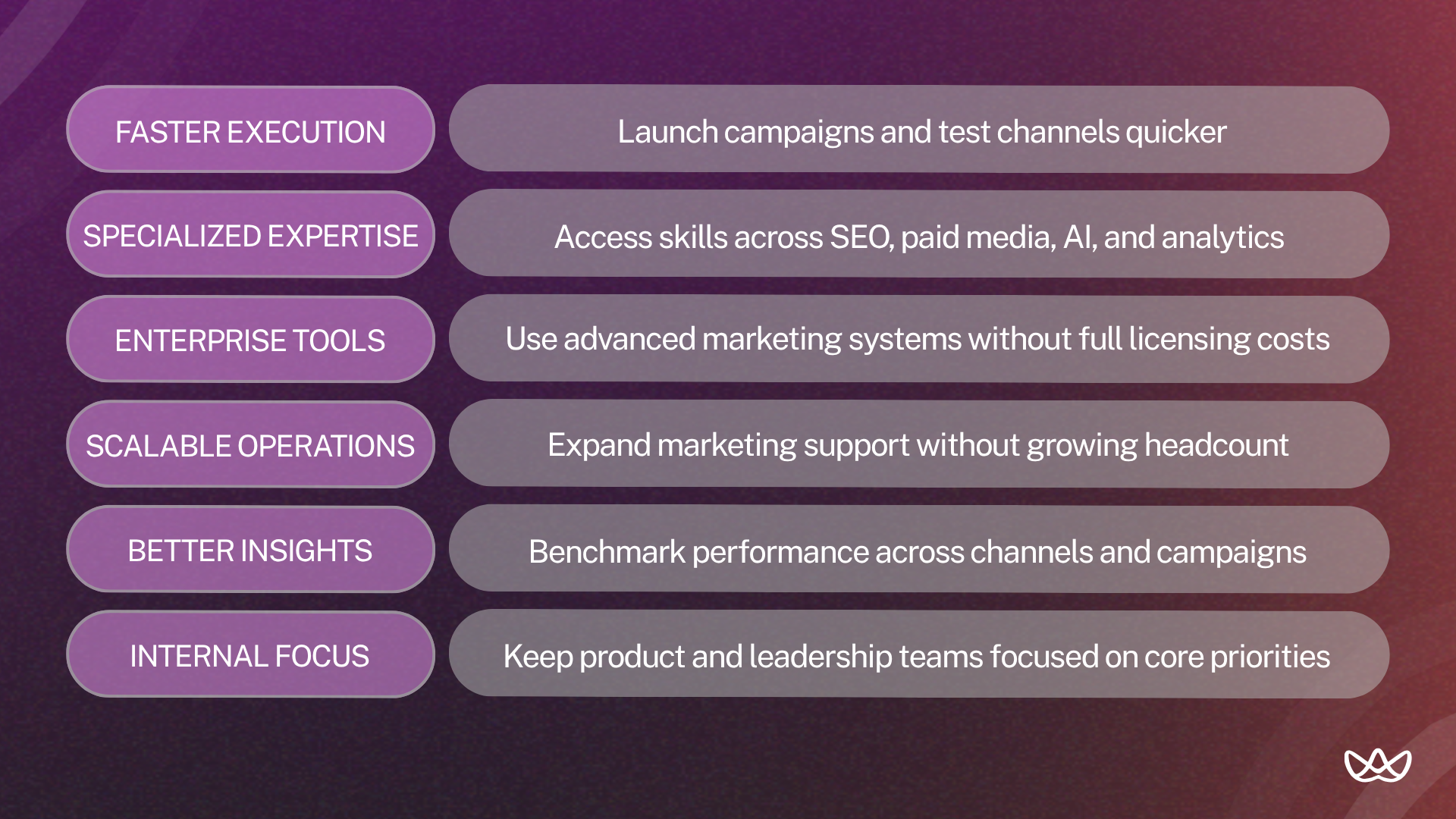
Marketing has become harder to manage with small generalist teams alone. Growth today depends on a mix of technical expertise, faster execution, AI-enabled workflows, and coordinated operations across multiple channels. For many companies, outsourcing parts of the marketing function is a way to access those capabilities without building a large internal team from scratch.
Need for Specialized Expertise
No individual marketing hire combines deep fluency in paid acquisition, marketing automation, SEO, AI workflow design, and performance analytics simultaneously. The skill set that B2B tech marketing demands in 2026 is broad enough that building it into a single role is unrealistic, and building it into a team of generalists produces shallow coverage across every function.
Outsourced teams built around functional specialists solve this structurally: your engagement includes the specific expertise your growth stage requires without requiring you to maintain separate headcount for each discipline permanently.
Pressure to Scale Faster
One of the biggest advantages of outsourced marketing teams is execution speed. When a company identifies a new growth channel or needs to respond to a competitive shift, an external team with established workflows and configured tooling can usually begin testing within weeks. Building the same capability internally through sequential hiring and onboarding often takes significantly longer, especially for smaller teams already operating with limited bandwidth.
Challenges Hiring In-House Marketing Teams
Marketing roles take 40% longer to fill than technical positions on average, which means every month your demand generation function sits vacant is pipeline that will not get built. For a startup where the first several marketing hires define the trajectory of the function for years, a four-month recruiting cycle per role carries real compounding cost.
The problem compounds further when the right candidate does not exist locally at the compensation level the company can offer, which is increasingly common in markets where AI and data marketing skills command premiums that early-stage budgets cannot absorb.
Demand for Omnichannel Marketing Strategies
Modern B2B tech buyers move across LinkedIn, organic search, peer review platforms, email sequences, and community channels before committing to a purchase decision. Managing a coherent message, a consistent tone, and a coordinated follow-up sequence across all of those touchpoints simultaneously requires more infrastructure and process discipline than most small internal marketing teams can sustain without dedicated operations support.
Outsourced teams that already run omnichannel programs for comparable clients bring that infrastructure ready to configure, not ready to build.
Need for Better ROI and Attribution
The benefit of outsourcing is not limited to reducing workload for internal teams. External marketing partners often operate with defined KPIs, attribution frameworks, and pipeline reporting processes that make campaign performance easier to measure consistently. Internal teams that are heavily focused on execution do not always have the time or infrastructure to build those systems properly.
When companies can clearly trace qualified opportunities back to specific channels, campaigns, and acquisition costs, they are in a stronger position to make informed budget and growth decisions.
Most Common Marketing Services Tech Companies Outsource
Tech companies outsource across a broad range of marketing functions, but the services that move external most consistently are the ones that require deep specialization, sustained production volume, or technical configuration that small internal teams cannot maintain at full quality across all channels simultaneously.
SEO and Content Marketing
SEO requires both technical depth and sustained editorial output, a combination that is expensive to maintain internally. Technical site audits, structured data implementation, keyword strategy tied to buyer intent, and a consistent publishing cadence across blog, documentation, and comparison pages each require dedicated focus.
Outsourced content teams that have built editorial systems for SaaS companies bring that capacity without the overhead of managing a full internal editorial operation.
Paid Advertising and Performance Marketing
Paid channels demand continuous optimization that rewards full-time attention. Bid management, audience segmentation, creative testing, landing page iteration, and cross-platform budget allocation across Google, LinkedIn, and retargeting networks each generate daily decision points.
An outsourced paid media team that manages these channels across multiple accounts carries pattern recognition that a single in-house manager working one account cannot accumulate at the same rate.
Email Marketing Automation
Email marketing effectiveness depends on workflow architecture, not just content quality. Behavioral segmentation, trigger-based sequences, deliverability management, and list hygiene require both technical setup and ongoing maintenance that most marketing generalists deprioritize under execution pressure. Outsourced email specialists configure these systems properly from the start, which means your sequences improve through iteration rather than starting from a broken foundation.
Social Media Management
Consistent social media performance requires publishing cadence, community response time, and analytics interpretation that consume more operational bandwidth than most internal marketing teams can reliably allocate.
For B2B tech companies, LinkedIn specifically requires a content strategy that builds authority over time rather than broadcasting product updates. Outsourced social teams with sector experience bring that editorial judgment alongside the production capacity to execute it consistently.
Demand Generation Campaigns
Demand generation is the function that most directly feeds pipeline, which makes inconsistent execution directly visible in sales forecasts. Full-funnel demand programs that span content, paid, email, and event channels require coordination across multiple specialists working from a shared campaign architecture.
Outsourced demand generation teams that have run these programs at comparable growth stages can execute them with the structural discipline that ad hoc internal efforts rarely sustain.
B2B Lead Generation
Qualified lead generation in B2B tech depends on ICP precision, intent data access, and outreach infrastructure that most internal marketing teams do not have configured. Account scoring, buying signal identification, and multi-channel outreach sequences that convert target accounts into pipeline require both the tooling and the operational expertise to run them.
Outsourced lead generation specialists with access to intent data platforms and documented outreach playbooks compress the time from ICP definition to qualified conversations.
Marketing Operations and RevOps
Marketing operations sits at the intersection of technology, data, and process, and many companies do not prioritize it until attribution becomes unreliable or CRM data starts creating reporting problems. CRM configuration, campaign tracking, lead scoring models, and the integrations that connect marketing tools into a usable reporting system all require a level of technical expertise that usually falls outside traditional campaign or content roles.
For digital product companies, outsourcing marketing operations to specialists who have built similar systems before can help avoid the long-term operational issues that often develop when those responsibilities are managed informally alongside day-to-day execution..
AI-Powered Marketing Automation
AI marketing automation is the fastest-growing outsourced category because the expertise required to configure it properly is still scarce internally. Building prompt libraries for content workflows, deploying AI agents for lead qualification, and integrating model outputs into CRM and campaign systems require skills that most internal marketing teams are still developing. Outsourced teams that have already deployed these workflows across multiple clients configure them for a new client in days rather than months, which closes the AI adoption gap that internal builds take quarters to cross.
Benefits of Marketing Outsourcing for Tech Companies
The financial case for outsourced marketing is real, but the operational benefits that compound over a well-structured engagement often produce more long-term value than the direct cost comparison alone.
Faster Time to Market
An outsourced team with existing playbooks, configured tooling, and a track record in your category launches the first campaigns within two weeks of onboarding. An internal team built through sequential hiring reaches equivalent output after three to six months of recruiting, onboarding, and ramp time.
That gap represents real pipeline: every week of faster time to market is a week of demand generation activity that compounds into qualified opportunities later in the quarter.
Access to Enterprise-Level Tools and Systems
A specialized outsourced marketing team typically operates attribution platforms, marketing automation systems, and analytics infrastructure that an early-stage company could not justify licensing independently at the required depth.
Your engagement inherits that tooling stack and the operational expertise to use it, which means your campaigns benefit from enterprise-grade measurement and automation without the enterprise licensing budget.
Scalable Marketing Infrastructure
As your company moves from seed through Series A to Series B, your marketing function needs to scale without requiring a complete rebuild each time the growth stage changes. An outsourced team designed around modular delivery can add capacity to specific channels or functions, paid search, account-based marketing, content production, without restructuring the entire operation. Internal headcount growth does not scale that cleanly, because every new hire brings recruiting lead time, onboarding overhead, and a management layer that grows with the team.
Cross-Industry Insights and Benchmarking
An outsourced team serving multiple tech clients simultaneously accumulates benchmarking data across companies, channels, ICPs, and growth stages that no single internal team can build from one company's experience.
When your outsourced partner tells you your LinkedIn cost per lead is 40% above benchmark for your category, that number comes from real comparative data, not an educated guess. That context improves strategy decisions faster than internal experimentation alone would allow.
Improved Campaign Performance
Outsourced teams that have run similar campaigns for comparable companies enter new engagements with a working hypothesis about what will perform, which reduces the experimentation cost of the first 60 days. Combined with multi-touch attribution that traces every conversion back to its source, this produces campaign performance improvement that compounds across cycles rather than resetting with each new campaign build.
Better Focus for Internal Product Teams
When marketing execution moves to an external partner, founders, product managers, and engineers who would otherwise absorb marketing coordination work return to the decisions that compound their core advantage. The organizational benefit of that focus is difficult to quantify directly, but it shows up in product velocity, customer conversation quality, and strategic clarity at the leadership level.
Challenges and Risks of Outsourced Marketing
Marketing outsourcing also comes with challenges. Most underperforming engagements struggle because of unclear expectations, weak communication, poor alignment with internal teams, or a lack of measurable goals. Many of these issues can be reduced with better structure and coordination from the start.
Maintaining Brand Voice Consistency
Brand voice inconsistency is the most common early friction point in outsourced marketing. Without detailed tone of voice documentation, messaging guidelines, and content standards established before the engagement begins, outsourced writers and campaign managers default to the generic SaaS industry language that floods every channel.
The fix is not better writers. It is a thorough onboarding document that your team reviews and approves in the first 30 days, combined with a structured feedback loop in the first 60 days that surfaces misalignments before they become habitual.
Communication and Collaboration Challenges
Communication overhead grows without deliberate structure. Weekly performance reviews, defined channels for time-sensitive feedback, and shared live dashboards that both sides update in real time reduce the friction of asynchronous collaboration considerably.
For nearshore teams operating within one to three time zones of the client, this challenge is far more manageable than it is with fully offshore arrangements where working day overlap may be limited to a single hour.
Vendor Lock-In Risks
Vendor dependency becomes a structural risk when the outsourced partner owns critical platform accounts, ad account history, audience relationships, or campaign data that the company cannot easily migrate. Addressing this at the contract stage, by requiring the client to retain ownership of all platforms, data, creative assets, and account credentials from day one, removes that dependency before it becomes a leverage point in a later renegotiation.
Data Privacy and Security Concerns
Every outsourced marketing engagement that involves customer data requires explicit data handling agreements, defined data residency standards, and clarity on what the partner can access and what they cannot. For tech companies serving enterprise customers with formal vendor assessment processes, this is not an optional consideration. Enterprise procurement teams will ask about it specifically, and the absence of a clear answer creates deal risk at the worst possible moment.
Misaligned KPIs and Expectations
Misaligned performance metrics are the most common root cause of outsourced marketing engagements that technically complete their contracted scope but fail to produce business value. Defining success as pipeline contribution, qualified opportunity volume, or revenue attribution before the engagement starts, rather than impressions, follower growth, or content pieces delivered, keeps both parties accountable to outcomes that connect to growth. This conversation needs to happen before the contract is signed.
How to Choose the Right Marketing Outsourcing Partner
The evaluation criteria that matter for a tech company differ meaningfully from what a retail or services business would prioritize. These are the factors that carry the most predictive value for whether an engagement actually produces results.
Evaluate Industry Experience in Tech and SaaS
A partner with a track record in SaaS demand generation understands conversion benchmarks, pipeline velocity, ICP targeting mechanics, and the attribution models that connect marketing activity to revenue.
A generalist agency without that vertical context will spend the first three months learning what you need them to bring on day one, and you absorb that learning cost in slower results and more management overhead. Ask specifically which SaaS or B2B tech companies they have run comparable programs for and what the outcomes were.
Assess Technical Marketing Capabilities
Technical marketing capability separates partners that scale with you from ones that plateau at content and creative execution.
Before evaluating anything else, ask directly: can the partner configure your CRM, build attribution models, set up multi-step marketing automation sequences, and integrate multiple data sources into a coherent reporting view? Partners who can answer these questions with specifics are the ones whose output will improve as your stack grows more complex.
Review Case Studies and Performance Metrics
Case studies with specific performance numbers are the most reliable signal of whether a partner operates with the measurement discipline your engagement will require. Ask for pipeline contribution by channel, CAC by acquisition source, and funnel conversion rates from engagements that are comparable to yours in company size and growth stage.
Partners who produce specific numbers have built the measurement infrastructure that serious marketing programs require. Partners who describe results in general terms have not.
Analyze Communication and Reporting Processes
Before signing, understand the specific reporting cadence, the format of performance reviews, the escalation path when something breaks mid-campaign, and how scope changes are priced and handled.
The quality of a partner's operational processes predicts the quality of the ongoing working relationship more accurately than the quality of their initial pitch or proposal. Ask to see a sample report from a current engagement before committing.
Compare Pricing and Engagement Models
Understand precisely what the retainer covers, how scope changes are priced, and how the engagement scales if your growth accelerates faster than projected. The engagement model matters as much as the rate: a managed retainer that includes strategy, execution, and reporting produces different accountability than a project engagement scoped to deliverable completion. Choose the model that matches the nature and continuity of what you actually need.
Most Outsourced Marketing Services for Tech Companies
The services below are among the most commonly outsourced by tech companies, especially when the in-house hiring cost is difficult to justify. The cost ranges reflect approximate U.S.-based salary equivalents.
Marketing Outsourcing Trends for 2026 and Beyond
The broader direction of marketing outsourcing points toward deeper integration between external partners and internal teams, with AI absorbing more of the execution layer and human specialists concentrating on strategy, audience development, and performance judgment. Understanding where the market is heading helps you structure an engagement today that will still make sense eighteen months from now.
Growth of Fractional CMOs and Embedded Teams
The fractional CMO model is growing for a specific structural reason: the cost gap between a full-time senior marketing leader and the strategic value of that role has become large enough that many growth-stage companies can no longer justify the full-time hire.
A fractional CMO brings the same strategic judgment at a fraction of the annual cost, and when paired with an outsourced execution team, covers the full marketing function without the organizational overhead of growing an internal department. For companies between $2M and $15M ARR, this combination is increasingly the standard model rather than the exception.
AI-Driven Marketing Operations
73% of marketers now use AI daily, but daily use for individual tasks is different from AI embedded into the workflow infrastructure itself. The outsourcing partners widening the output gap are the ones who have built AI into their core delivery model at the process level, not added it as a feature on top of a legacy workflow. For clients, the difference shows up in content production speed, campaign testing velocity, the granularity of performance reporting, and the ability to run personalization programs that would require significantly larger teams to operate manually.
Expansion of Global Remote Marketing Teams
Nearshore models continue to grow as companies recognize that time zone overlap and cultural alignment matter more than cost savings alone in a function as communication-intensive as marketing.
The practical friction of a twelve-hour time difference compounds across every feedback loop, every campaign review, and every production iteration. For companies where marketing and product strategy need to stay closely coordinated, the nearshore model removes that friction entirely while still delivering meaningful cost advantages over equivalent U.S. in-house staffing.
Rise of Outcome-Based Marketing Contracts
Outcome-based contracts are gradually replacing activity-based retainers as the expected commercial structure for serious outsourced marketing engagements. Structuring fees around pipeline contribution, qualified lead volume, and revenue attribution rather than hours worked or deliverable count reflects the growing expectation that outsourced marketing partners carry accountability for business results. This shift benefits buyers who want accountability and rewards partners who have built the measurement infrastructure to demonstrate it.
Specialized Micro-Agencies for Tech Niches
Specialized micro-agencies with deep vertical expertise are taking meaningful share from generalist digital agencies. For tech companies with complex products and narrow ICPs, a partner that has spent years in DevTool marketing, cybersecurity demand generation, or product-led growth for B2B SaaS brings a context that eliminates the education overhead built into every new generalist agency relationship. The specificity of that expertise shows up in the first campaign cycle, not after a three-month learning period.
In-House vs Outsourced Marketing Team Comparison
The difference between in-house and outsourced marketing teams is usually less about capability and more about speed, flexibility, and operating structure.
Frequently Asked Questions
Why do tech companies outsource marketing?
The primary drivers in 2026 are access to specialized expertise and execution speed, not cost savings. Marketing roles take significantly longer to fill than most other positions, and the skill combinations that modern B2B tech marketing demands, including demand generation, AI automation, marketing ops, and analytics, are rarely available in a single internal hire. Outsourced teams that carry those combinations are faster to activate and often more cost-efficient to maintain than building the equivalent capacity in-house.
What marketing services are most commonly outsourced?
SEO and content marketing, paid acquisition, demand generation, email automation, and marketing operations lead the list consistently. AI-powered marketing automation is growing fastest within that group, driven by the skill gap in configuring and operating AI workflows that most internal marketing teams have not yet closed at the infrastructure level.
Is outsourcing marketing cost-effective for startups?
For most startups operating below $5M ARR, outsourcing is more cost-effective than building an internal marketing team from scratch. The savings come from eliminating recruiting costs, onboarding time, benefits overhead, and the productivity ramp that every new hire requires before contributing at full capacity. A well-structured outsourced engagement typically generates output from week two of the relationship rather than month four.
How much can tech companies save by outsourcing marketing?
Nearshore models typically deliver 40 to 60% cost savings compared to equivalent U.S. in-house hires. The comparison becomes more favorable when you include recruiting fees, benefits, employer taxes, and the management time that a growing internal team requires. Fully offshore models can reach 70% savings on labor costs but introduce collaboration friction that nearshore models avoid through time zone alignment.
What are the risks of outsourced marketing?
Brand voice inconsistency, vendor dependency on platforms and accounts, and misaligned performance metrics are the three most common failure modes. All three are addressable with the right contract structure, a thorough onboarding process, and performance reporting that measures pipeline contribution rather than activity volume. The companies that experience the most friction in outsourced marketing are the ones that skip those foundations in the name of moving fast at the start.
How do outsourced marketing teams use AI?
The most capable outsourced teams use AI to automate content production workflows, optimize ad targeting and spend allocation in real time, build and maintain lead scoring models, and generate performance reporting that would otherwise require dedicated analyst time. The practical advantage comes from teams that have already deployed these workflows across multiple client engagements and can configure them for a new client in days rather than building the infrastructure from scratch.
Should SaaS companies outsource digital marketing?
For most SaaS companies below $10M ARR, outsourcing the execution layer while keeping product positioning and growth strategy internal is the most efficient model. Above that threshold, the decision depends on the depth of internal capability and how quickly the company needs to expand into new channels or geographies. The question is less about whether to outsource and more about which functions benefit from external specialization and which require the institutional knowledge that only internal ownership provides.
What is the difference between a marketing agency and a fractional marketing team?
A marketing agency delivers defined services as a vendor with scoped deliverables and a fixed engagement structure. A fractional marketing team embeds within the client organization, carries accountability for outcomes rather than deliverable completion, and operates as an extension of the leadership team rather than an external service provider. The fractional model works better when a company needs senior marketing judgment embedded into strategic decisions alongside execution capacity, not just a team running predefined campaigns.
How do you choose the right outsourced marketing partner?
Prioritize demonstrated SaaS or tech industry experience, technical marketing depth beyond content and creative work, specific performance metrics from comparable engagements, and a reporting model tied to pipeline contribution rather than vanity metrics. Ask how the partner would approach your specific ICP and growth stage before discussing pricing. Partners who answer that question with specificity and relevant examples are the ones who have actually done the work at your stage.
Your Next Step
Marketing outsourcing has become a common operating model for tech companies, especially as marketing becomes more specialized and AI-driven. Companies are increasingly using external teams to access expertise, move faster, and scale without expanding internal headcount too quickly.
A few trends stand out:
- Outsourcing adoption continues to grow.
- Companies value speed and specialized expertise more than cost savings alone.
- AI tooling and marketing operations are becoming more important.
- Internal teams are staying focused on product and strategy while outsourced teams support execution.
For most companies, the decision comes down to which marketing functions are more effective to manage externally versus internally. That depends on growth stage, internal capabilities, and execution needs.
If you're ready to expand your remote team in LATAM, start hiring with Floowi Talent and schedule your free meeting today to discuss the right hiring approach for your agency.



.png)


