


.png)



The 2026 FIFA World Cup is happening right now across the US, Canada, and Mexico, and it has turned into one of the largest marketing demonstrations of the year. FIFA is on track to exceed its $13 billion revenue target for the 2023-2026 cycle, with more than $2.8 billion projected in sponsorship and commercial revenue tied directly to the 2026 tournament. Behind every brand campaign that has reached an audience of any size in the past three weeks is a team of marketers who built it, localized it, scheduled it, and made it relevant for the markets it is running in.
More of that work is now being handled by marketing professionals in Latin America. As companies build distributed teams, the region has become a strong choice for businesses looking for experienced marketing talent.
The World Cup Is More Than a Sporting Event, It's a Showcase
The tournament runs 39 days from June 11 to July 19, with 104 matches across 16 host cities. FIFA estimates a global audience of more than 6 billion people will engage with the event in some way. That scale forces brands to compete on more than logo placement, and it gives anyone watching closely a clear view of how the best marketing teams are working today.
How Global Brands Are Competing Through Marketing, Not Just Sponsorships

The seven FIFA Partners for 2026, Adidas, Coca-Cola, Hyundai-Kia, Visa, Aramco, Lenovo, and Qatar Airways, paid significant fees for their tier. Sponsorship rights alone do not generate consumer response, though. What does the work is the campaign that runs around the rights, and the quality of that campaign is now the main competitive surface.
Adidas released "Backyard Legends," a five-minute film starring Timothée Chalamet, Lionel Messi, Bad Bunny, Lamine Yamal, Jude Bellingham, and Trinity Rodman. The brand reported approximately $292 million in pre-tournament World Cup product sales ahead of kickoff, with the US identified as its biggest long-term opportunity.
Coca-Cola launched the "All the Feels" platform with WPP Open X (Ogilvy), built around three films and a reworked version of Van Halen's "Jump" featuring J Balvin, Amber Mark, Steve Vai, and Travis Barker. Lego's "Everyone Wants a Piece," developed with the in-house team and Wieden+Kennedy Amsterdam, generated 314 million views across player accounts within 24 hours of release.
These campaigns share a common structure. They are global in concept, localized in execution, and built for distribution across paid media, social, retail activations, and host-city experiences at the same time. That structure requires a marketing operation that can manage volume across languages and channels without losing creative consistency.
Why LATAM Professionals Are Helping Deliver Campaigns for Global Brands
Latin American marketing teams are involved in many of the campaigns visible on screens right now, and the work shows up in three specific places.
The first is bilingual campaign execution. DraftKings released two campaigns featuring Alex Morgan and Javier "Chicharito" Hernández, the latter in Spanish-language creative where "Goooool" transforms into "Español". The brand is expanding Spanish-language platform functionality and hosting watch parties in Los Angeles, Dallas, Miami, and Hoboken, all markets where Hispanic communities are central to soccer culture. The campaign was built to land in both English and Spanish at the same level of craft, which is the kind of work LATAM-based teams produce as part of standard practice.
The second is cultural translation at scale. PepsiCo's Flamin' Hot ran "Warmest Welcome" with Arjen Robben as a humorous reference to his 2014 tournament history against Mexico, positioning the brand inside a cultural storyline that only works if the team building it understands the specific reference.
AXE released a seven-film campaign with LOLA Madrid that follows superfans from different countries, including one featuring a Mexican supporter building an oversized trophy costume.
The third is operational throughput. Coca-Cola is running three films across a six-month window.
Lay's is running a global "No Lay's, No Game" platform alongside a US-specific campaign at the same time.
That volume of activation, executed simultaneously across multiple languages and host cities, is impossible without distributed marketing operations that can hand off work across time zones without losing momentum.
Latin American teams sit in the same time zones as US business hours, which removes the asynchronous friction that slows down campaigns built with offshore teams further away.
What Businesses Can Learn from the Marketing Behind the World Cup
The campaigns running right now suggest three observations that apply to any business building marketing operations in 2026.
Marketing volume has increased to a level where most teams cannot keep up internally.
The brands that are visible at the World Cup are the ones that built distributed operations early. Campaign performance now depends on cultural fluency in the markets you are reaching.
The brands generating the strongest response are working with creators, agencies, and marketing professionals who understand the cultural specifics, not just the language. And time zone alignment determines whether you can move at the speed of a global moment.
The brands releasing fresh creative in week three of the tournament are working with teams that can iterate within the day, not across multiple overnight handoffs.
Why LATAM Marketing Talent Is Receiving Global Recognition
The talent base in Latin America has grown alongside the digital marketing industry over the past decade, and the work currently visible during the World Cup is making that growth more apparent.
Creative Campaigns Built for Multicultural Audiences
According to Lotame Data Exchange, World Cup fans in Latin America index 3.3x higher in media and entertainment engagement and 3.1x higher in retail and e-commerce activity compared to global averages.
That audience profile rewards campaigns built specifically for the cultural context, not translated versions of campaigns designed elsewhere. Latin American marketing teams build for that audience as a default rather than an exception, which is part of why their work is appearing in campaigns from brands targeting Hispanic and Latin American audiences during the tournament.
Bilingual Professionals Supporting Global Brands
Most professional marketing teams in Mexico City, Bogotá and Buenos Aires São Paulo working with international brands operate in English and Spanish or Portuguese as a routine matter. This is not framed as a special skill in the regional market.
It is the operating baseline for serving global clients. For US brands running bilingual campaigns during the World Cup, this baseline removes a significant operational barrier that often exists when working with single-language teams.
Marketing Operations That Power Large-Scale Campaigns
The volume of campaign output during the World Cup gives a useful view of marketing operations capability. Brands are producing multiple films per platform, dozens of social cuts per campaign, ongoing host-city activations, real-time response content, and paid media iterations on overlapping schedules.
Latin American marketing teams have built operational capability that supports this kind of throughput, particularly through agency partnerships and dedicated nearshore arrangements with US companies. Floowi's LATAM hiring benchmarks for 2025 document hiring cycles of 9 to 15 days for marketing roles, which is fast enough to scale teams in response to campaign volume rather than against it.
The Rise of Nearshore Marketing Teams Supporting U.S. Companies
US companies hiring nearshore marketing teams from Latin America have grown into a stable operating model over the past three years rather than an experiment. The combination of time zone overlap, English proficiency in major cities, and proven digital marketing capability has moved LATAM from "one of several options" to the default starting point for US agencies and growth-stage companies building distributed marketing teams.
The World Cup is reinforcing this pattern by demonstrating, in public, what these teams can produce when the brief is high stakes.
What Makes LATAM Marketing Professionals Stand Out?
A few qualities show up in the work visible during the tournament and in the work US companies hire LATAM teams for throughout the rest of the year.
Creativity Backed by Business Strategy
The strongest campaigns running right now combine creative concept with clear business strategy. Coca-Cola's "All the Feels" platform is structured around three films released across a six-month window, each one supporting a different commercial objective.
Latin American creative professionals are increasingly working in this strategy-first mode rather than as creative-only contributors, and the campaigns reflect that integration.
Strong English Communication Skills
According to the EF English Proficiency Index 2025, Argentina ranks 26th globally with a "high" proficiency band score of 575, the strongest in Latin America. Proficiency varies by country and city, but professional marketing populations in Buenos Aires, Bogotá, Mexico City, and São Paulo routinely operate in fluent English for client work.
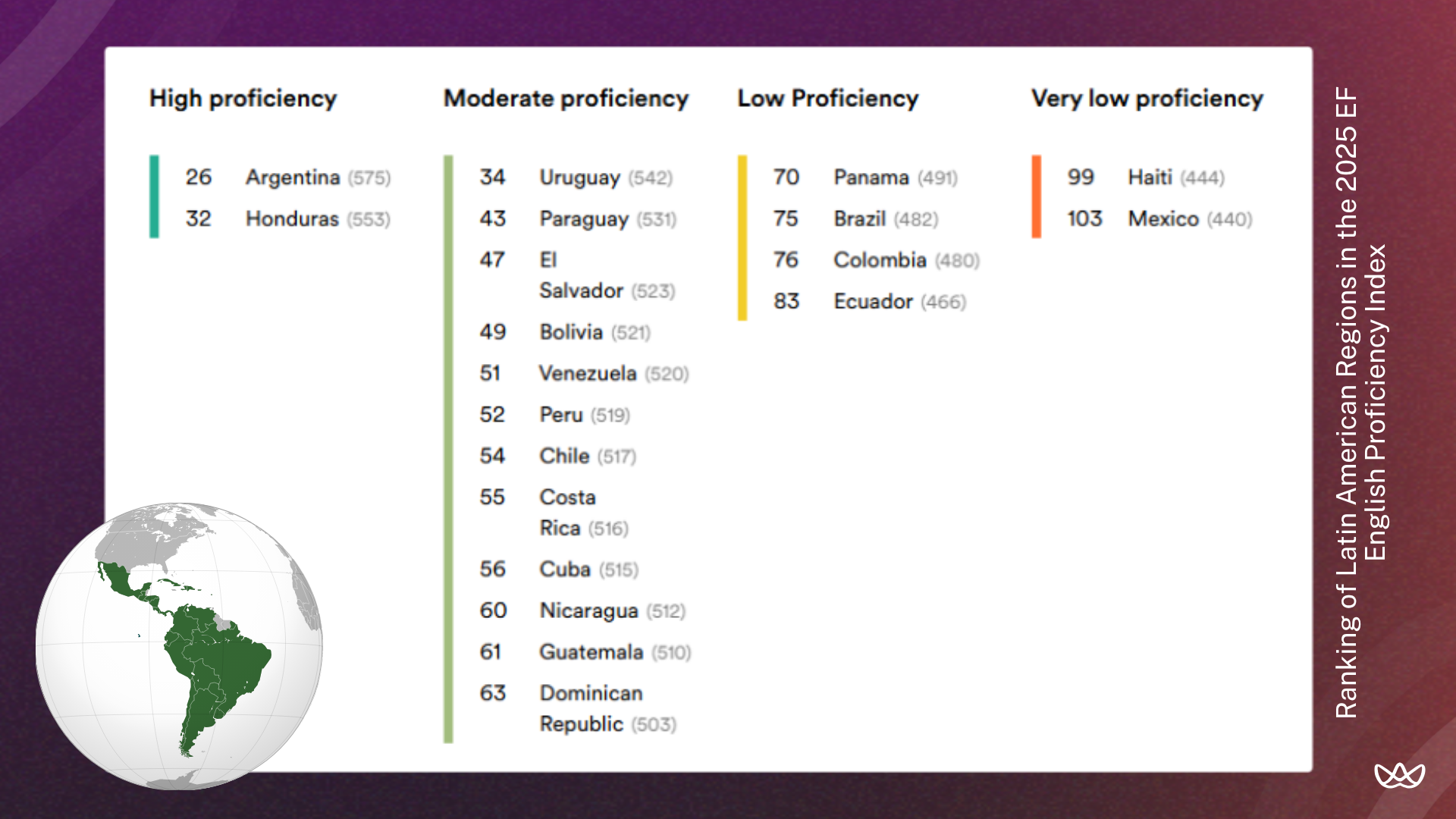
This matters during high-volume periods like a World Cup, where written briefs, async feedback, and real-time campaign updates all need to move clearly between teams in different countries.
Experience Supporting U.S. Marketing Teams
Many Latin American marketing professionals have multiple years of direct experience with US clients, US agencies, and US-style marketing operations. This is different from generic remote marketing experience because it includes the specific conventions, tools, and communication patterns that US teams use. A LATAM marketer who has run paid campaigns for US e-commerce brands, managed HubSpot for US SaaS companies, or built content for US media properties brings transferable context that significantly shortens onboarding.
Expertise Across Modern Marketing Technology
The tooling baseline for LATAM marketing teams working with US companies now includes HubSpot, Salesforce, Klaviyo, Google Ads, Meta Ads Manager, SEMrush, Ahrefs, Figma, and increasingly AI-assisted production tools like Runway, Descript, and Adobe Firefly integrations. This is the same tool stack US in-house teams use, and the proficiency levels are increasingly equivalent.
Ability to Execute High-Volume Campaigns
The World Cup is a useful test of high-volume execution. Brands are producing weekly creative across multiple formats, with same-day adjustments during the tournament itself.
The marketing teams that are delivering this volume at quality have built operational capability for high throughput. Many of those teams are based in LATAM, working through agency partnerships or nearshore staffing arrangements with US companies.
How Nearshore Marketing Talent Helps Businesses Scale Faster
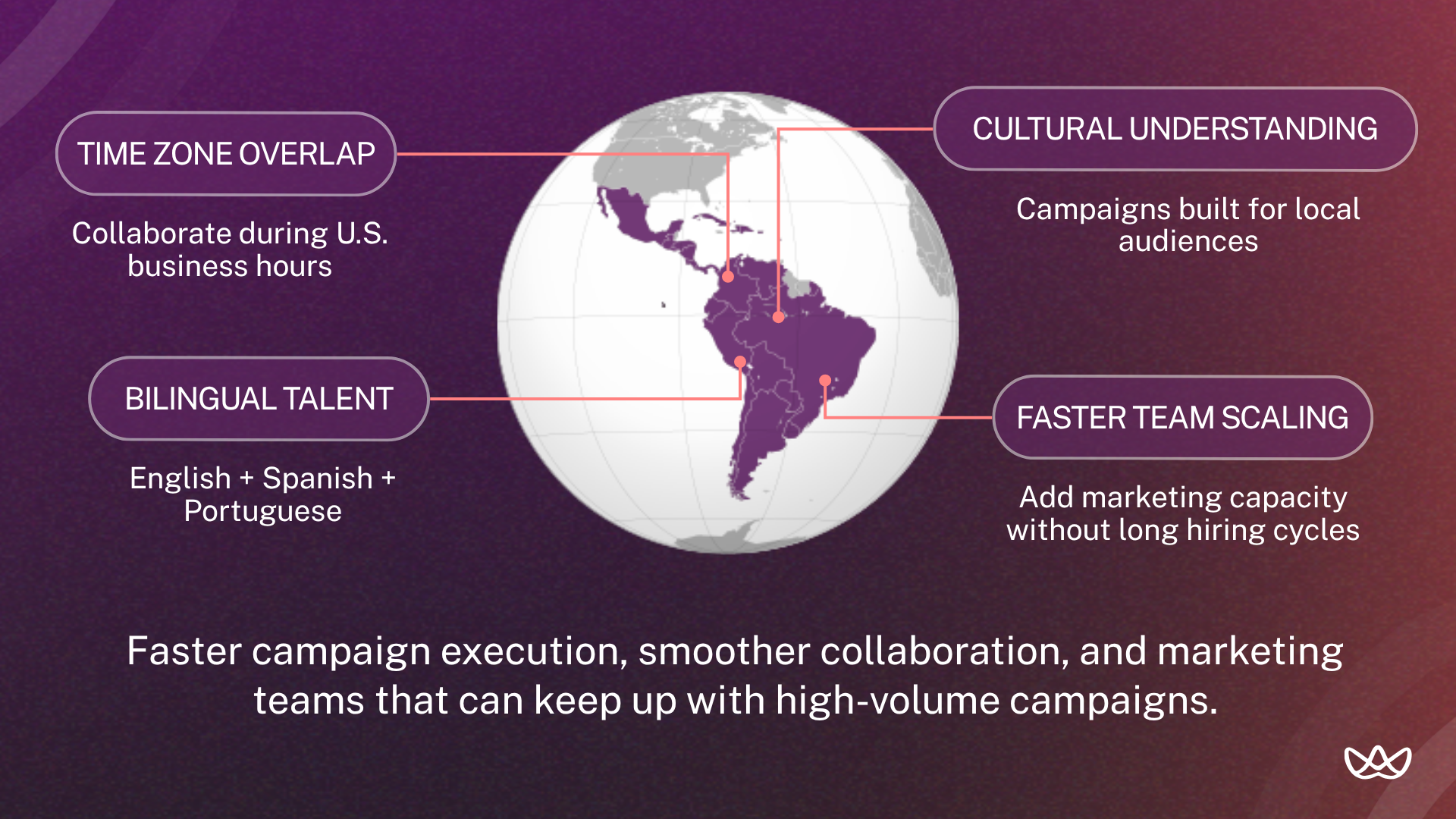
The structural advantages of nearshore LATAM marketing teams are easier to see during a period like the World Cup, when execution speed and volume are visibly tested.
1. Real-Time Collaboration Across U.S. Time Zones
Mexico, Colombia and Argentina all operate within 0 to 4 hours of US business hours. For campaign work, this means daily standups happen in real time, feedback gets actioned the same day, and creative iterations move within the working day rather than across overnight handoffs.
During high-tempo periods this is the difference between adjusting a campaign in 8 hours versus 24 hours.
2. Scalable Teams Without Increasing Internal Overhead
Hiring full-time US marketing employees adds salary, benefits, equipment, and recruiting overhead that compounds quickly. A US-based senior marketing manager costs $48,000 to $128,000 per year in base salary alone, with all-in costs reaching $100,000 to $170,000. Equivalent LATAM hires through a managed nearshore arrangement run $48,000 to $60,000 per year.
For teams scaling against a campaign cycle, the cost difference translates into either more headcount for the same budget or significantly more campaign budget freed up for media.
3. Specialized Talent Without Long Recruitment Cycles
Posting a marketing job and running an internal hiring process in the US typically takes 4 to 12 weeks from job description to start date. Nearshore staffing partners shorten this meaningfully because they have pre-vetted candidate pools and handle the screening process.
Floowi's hiring data shows typical placement cycles of 9 to 15 business days, which is fast enough to scale a team during a campaign window rather than missing it.
4. Higher Marketing Agility During High-Demand Campaigns
The World Cup is a clear example of a high-demand campaign window. The brands that are visible right now built distributed marketing operations before the tournament started. The brands trying to catch up now are struggling to keep pace.
The general principle applies to any campaign window: distributed teams scale up and down faster than single-location teams, and they handle volume spikes without the burnout that single-location teams hit when output requirements double.
How to Identify When Your Business Needs Additional Marketing Talent
Most companies do not plan their marketing hiring around specific signals. They react when something is already breaking. The signals below matter because they often appear before the breakage becomes expensive.
1. Campaign Execution Is Slowing Things Down
When campaign launches are slipping because creative, copy, or production assets are not ready on time, the bottleneck is usually marketing capacity rather than strategy.
If your team is consistently behind on the content calendar, behind on email production, behind on landing page updates, or behind on social cadence, the capacity gap is real and adding more headcount is the most direct fix.
2. Your Internal Team Is Focused on Operations Instead of Strategy
When senior marketers are spending their week on tactical execution instead of strategy, campaign planning, and analysis, you are using expensive time on cheaper work. The classic signal is a marketing director or head of marketing handling production tasks because no one else is available.
Adding execution capacity below that level frees senior time for the strategic work it is supposed to do.
3. You Need Specialized Marketing Skills That Don't Exist In-House
Specialized skills like paid media optimization, lifecycle email marketing, video editing, motion graphics, SEO at scale, marketing automation, and conversion rate optimization rarely all exist in a single in-house team.
When you find yourself sending out an increasing share of work to freelancers or agencies because no one internal has the specific skill, that is the moment to consider whether one of those skill areas should be a dedicated hire.
4. You're Scaling Faster Than Your Marketing Team Can Support
When the business is adding customers, product lines, or markets faster than the marketing team can produce content and campaigns for, the gap compounds quickly.
Each new product or market expansion adds to the marketing workload, and a team that was sized for the previous quarter cannot meet the next quarter without intentional investment. This is the most common scaling failure in growth-stage companies.
What to Look for When Hiring Remote Marketing Professionals
The factors below are good indicators of whether a remote marketing hire will be productive, regardless of where the professional is based.
Technical Expertise
Tool proficiency is verifiable. A paid media specialist should be able to describe campaign structure, bidding strategies, and optimization approaches in enough detail to confirm they have used the platform extensively.
A content marketing manager should be able to walk through a brief, a content calendar, and performance reporting workflow with specifics. Surface-level familiarity with tools is common on resumes and reveals itself quickly in conversation.
Communication Skills
For remote marketing roles, written communication carries most of the workload. Slack messages, brief documents, async feedback, and reporting summaries all depend on clear written English. Spoken English in interviews does not always predict written English quality. Test both during the hiring process, with at least one written sample evaluation.
Strategic Thinking
The most useful test of strategic thinking is to ask a candidate to walk through a specific campaign they owned. What was the brief? What channels did they use? What were the results? What would they do differently?
Candidates who answer these questions with specifics demonstrate strategic ownership. Candidates who answer in generalities are usually describing campaigns they were adjacent to rather than running.
Marketing Technology Experience
The technology stack matters because onboarding speed depends on tool familiarity. Candidates with hands-on experience in your specific stack reach productivity in two to three weeks. Candidates without it can take two to three months. For HubSpot-heavy companies, hire HubSpot-experienced marketers.
For Klaviyo-heavy e-commerce, hire Klaviyo specialists. The match matters more than total years of marketing experience.
Cross-Functional Collaboration
Marketing roles increasingly require working with product, sales, design, and customer success teams. Candidates who can describe how they have worked across functions, the specific handoffs they managed, and how they handled conflicts between teams are better fits for the actual job than candidates who describe marketing in isolation.
Marketing Candidate Evaluation Scorecard
How Businesses Can Build High-Performing Nearshore Marketing Teams with Floowi
The process below is the one Floowi uses with US companies hiring LATAM marketing talent. It is built to remove the delays that typically slow down nearshore hiring.
Step 1. Book a Talent Discovery Call
A 30-minute call with the Floowi team to understand the role, your company culture, your existing tool stack, and what success looks like for the hire. This is the foundation for sourcing. The clearer the picture from this call, the more aligned the candidate shortlist will be.
Step 2. We Source and Screen for You
Recruiters search the vetted pool of 500+ marketing professionals, run skills assessments specific to the role, and verify English fluency and time zone alignment. The screening covers portfolio review for creative roles, platform certifications for paid media and automation roles, and live skill demonstrations for technical roles.
Step 3. You Meet 3 Top Candidates
Review the pre-vetted profiles and interview the candidates you want to evaluate further. Choose your hire or pass without obligation. This step typically happens within the first 10 business days of starting the process.
Step 4. Create a Structured Onboarding Process
A structured onboarding process accelerates productivity meaningfully. Share brand guidelines, provide tool access, and walk through three reference projects that represent the type and quality of work you expect. Document feedback norms and weekly cadence in the first week. Teams that invest in onboarding see productive output within 7 to 10 days.
Teams that skip onboarding often take 30 to 45 days before the hire is producing reliably.
Step 5. They're on Your Team
Floowi handles contracts, payroll, compliance, and onboarding logistics. The new hire shows up on day one with access to your tools and a clear understanding of your workflows, ready to integrate into your team rather than spend weeks setting up.
Why Businesses Choose Pre-Vetted Marketing Talent
Pre-vetted hiring solves specific problems that show up consistently when companies try to hire through open marketplaces or build their own LATAM recruiting process.
Reduced Time-to-Hire
The typical timeline through a pre-vetted nearshore partner is 9 to 15 business days. Through open marketplaces or direct sourcing, the same hire takes 6 to 12 weeks because the screening process sits entirely with the employer. The time difference adds up quickly when you are hiring against a campaign window or business launch.
Lower Hiring Risk
Pre-vetting reduces the risk of a bad hire because the candidates have already passed skills assessments, English proficiency checks, and portfolio review before reaching you. A bad hire in marketing typically costs the equivalent of 6 to 12 months of salary in lost productivity, restart costs, and team disruption. Reducing the probability of a bad hire is worth the partner fee on its own.
Access to Specialized Marketing Expertise
Pre-vetted pools are organized by specialization, which means you can find a HubSpot automation specialist, a Klaviyo email marketer, or a paid social specialist with specific platform experience without sourcing across hundreds of generalist candidates.
Specialization match shortens onboarding and improves hit rates on the first month of work.
Flexible Team Scaling
Adding the second, third, and fourth hire through the same partner gets faster than the first because the partner already understands your tools, culture, and quality bar. This compounding effect makes pre-vetted hiring particularly effective for companies building marketing teams rather than filling single roles.
How Floowi Connects U.S. Businesses with Pre-Vetted LATAM Marketing Talent
Floowi works specifically with US companies hiring LATAM marketing, creative, and design talent. The model is built around three commitments: speed, fit, and operational simplicity.
Access Marketing Professionals Already Experienced with U.S. Companies
The Floowi candidate pool includes marketing professionals with direct US client experience across SaaS, e-commerce, agencies, and professional services. This experience translates into faster onboarding and fewer cultural translation issues than hiring marketers without US client history.
Build Nearshore Teams Faster with Pre-Vetted Experts
The 9 to 15 business day placement cycle is consistent across most roles. For agencies and growth-stage companies hiring multiple roles, the partner relationship scales with the team rather than restarting the hiring process each time.
Scale Marketing Operations with Flexible Hiring Models
Engagement models include contractor, dedicated remote, and EOR-supported full-time. Teams scale up during campaign windows and down during quieter periods without the rigid commitment structures that typically make scaling slow.
Why Businesses Partner with Floowi Instead of Building Recruiting Processes from Scratch
Building an internal LATAM recruiting process requires sourcing infrastructure, screening expertise, compliance knowledge across multiple countries, and payroll capability in each market.
For most US companies, that overhead is significantly more expensive than working with a specialized partner that has the infrastructure already in place. The partner model also produces better candidate quality because the screening is the partner's core expertise rather than a secondary process.
Your Next Move
The World Cup is a reminder that great marketing takes more than good ideas. It takes teams that can create, adapt, and launch campaigns quickly across different markets.
That's one reason more US companies are hiring marketing talent in LATAM. The region offers skilled professionals, strong time zone overlap, and the ability to support fast-moving campaigns.
If you're planning your next marketing hire, don't treat LATAM as a backup option. It's become one of the strongest talent markets for marketing teams. Start hiring with Floowi to connect with vetted marketing professionals across LATAM and build your team faster.
Frequently Asked Questions
Why are U.S. companies hiring LATAM marketing talent?
The main reasons are time zone alignment with US business hours, strong English proficiency in major professional cities, established digital marketing capability, and meaningful cost savings compared to US-based hires. According to Floowi's 2025 LATAM Hiring Benchmarks, companies typically see 50 to 70 percent cost savings versus US-based equivalent hires, with placement cycles of 9 to 15 business days.
What makes LATAM marketing professionals different?
The most consistent differences are cultural proximity to US consumer markets, bilingual capability that supports campaigns targeting both English and Spanish-speaking audiences, and operational experience working with US companies as part of regular client work. The Latin American professional marketing population has built a tooling baseline that matches US in-house teams, including HubSpot, Salesforce, Klaviyo, Google Ads, Meta Ads Manager, and increasingly AI-assisted production tools.
Can LATAM marketers work with U.S. teams?
Yes, and many already do as their primary client base. Time zone overlap with US business hours, English fluency in major professional cities, and familiarity with US workflows make integration with US teams straightforward in practice. Most LATAM marketing professionals working with US companies attend daily standups, participate in real-time Slack workflows, and operate within the same campaign cadence as US in-house teams.
How do bilingual marketing professionals improve campaign performance?
Bilingual marketers improve performance by removing the translation step between strategy and execution. Campaigns that need to land in both English and Spanish at the same level of craft can be built natively in both languages rather than translated from one to the other. DraftKings' Spanish-language campaign with Javier "Chicharito" Hernández running right now is one example of how this approach works during the World Cup. According to Lotame's analysis of World Cup audiences, LATAM World Cup fans index 3.3x higher in media engagement than global averages, which makes cultural and linguistic fluency in the creative a meaningful performance factor.