


.png)



Virtual digital marketing assistant services allow you to delegate SEO, content, paid ads, and reporting to remote professionals instead of expanding your in-house team. In 2026, offshore specialists typically charge $8–$30 per hour, LATAM (nearshore) talent ranges from $12-$22, and U.S.-based support falls between $25-$50. Managed monthly models often run from $800 to $3k+, depending on scope.
If you’re comparing freelance platforms, managed services, or a dedicated nearshore hire, the model you choose will impact your costs, how quickly you get support, and how much control you keep.
Let’s break down what to look at before you decide.
What Is a Virtual Digital Marketing Assistant?
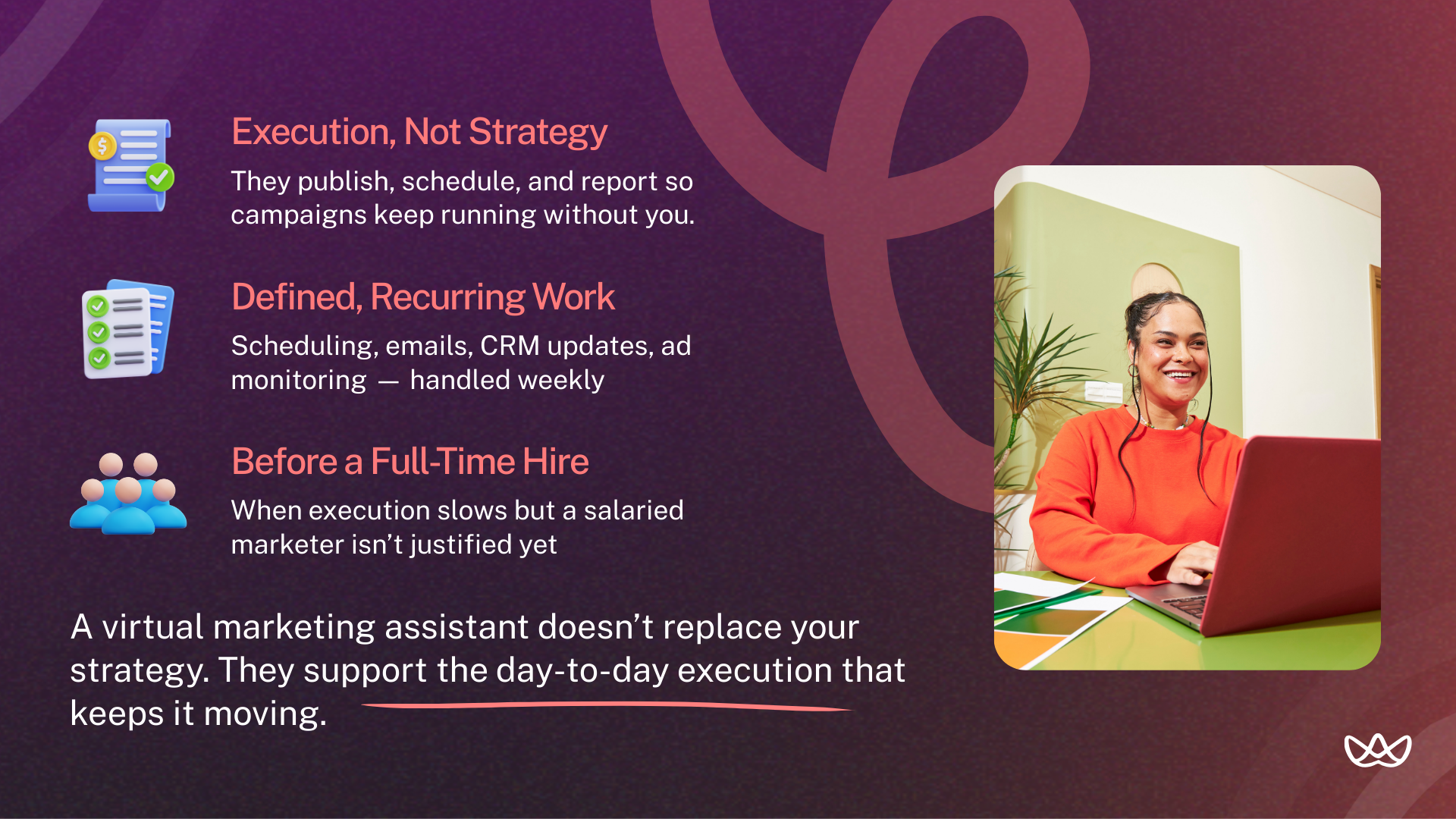
A virtual digital marketing assistant is a remote professional who handles the day-to-day execution of your marketing operations. That includes tasks like keyword research, content scheduling, paid ad management, email campaign setup, analytics reporting, social media posting, and lead nurturing - essentially anything that keeps your marketing engine running without requiring you to be in the weeds.
This role usually involves working inside marketing tools, following established processes, updating campaigns, and tracking basic performance metrics. You define the strategy and priorities. They help implement and maintain them consistently.
How They Differ from Traditional Marketing Assistants
A traditional marketing assistant typically works on-site, focuses on administrative support, and operates within a narrow scope - print materials, event coordination, spreadsheet updates.
A virtual digital marketing assistant works remotely, operates across a wider digital toolset, and often specializes in one or more channels like SEO, PPC, email marketing, or social media. They're built for the way marketing actually works today: async communication, distributed teams, and performance-driven execution.
When Your Business Should Hire One
You should seriously consider a digital marketing VA when:
- Your team is spending time on repeatable marketing tasks instead of strategy
- You're running campaigns but have no consistent person managing them
- You need more marketing output but can't justify a full-time hire
- You're scaling a channel (SEO, paid ads, email) and need dedicated execution support
If any of those apply, a virtual marketing assistant is likely a cost-effective next step.
How We Evaluated These Virtual Digital Marketing Assistant Services
Each provider below was assessed across six criteria: digital specialization depth, pricing transparency, onboarding speed, scalability, contract flexibility, and support structure.
These factors influence how effective the service will be and how much additional coordination it requires from your team.
Top Virtual Digital Marketing Assistant Services/Providers in 2026
The virtual digital marketing assistant services market includes several types of providers, ranging from freelance marketplaces to specialized recruitment firms and managed VA platforms. The best option depends on how specialized your marketing needs are, how quickly you need support, and how much oversight you want from the provider.
1. Floowi
Floowi connects U.S. companies with nearshore digital marketing professionals across Latin America - SEO specialists, paid media managers, content creators, social media managers, and analytics professionals. The model is built around speed and quality: most hires happen within 15 days, candidates go through a rigorous vetting process, and the team provides ongoing support after placement.
According to Floowi's 2025 LATAM Hiring Benchmarks, companies working with LATAM nearshore talent save 50–70% versus equivalent U.S. hires, while maintaining full time-zone alignment and strong English proficiency. Marketing and revenue roles (SEO, paid media, email) rank among the fastest-growing categories in LATAM - making Floowi a particularly strong fit if digital marketing execution is your primary need.
- Digital specialization level: High - focused on marketing, creative, and digital roles
- Pricing model: Managed monthly model
- Onboarding speed: 9-15 days
- Ideal company type: Marketing agencies, SaaS startups, e-commerce brands
- Weakness: Not the right fit if you need general admin or non-marketing support
Best for: Marketing agencies and growth-stage startups that need pre-vetted, specialized LATAM talent fast.
2. Belay
Belay matches clients with dedicated U.S.-based virtual assistants. Their talent pool skews toward executive assistance and operations, with some professionals experienced in content and social media. Onboarding takes 2-4 weeks, and pricing sits at the higher end for VA services.
- Digital specialization level: Moderate
- Pricing model: Monthly retainer starting around $1,400/month
- Onboarding speed: 2–4 weeks
- Ideal company type: Small businesses, solopreneurs, executives
- Weakness: Limited depth in performance marketing (SEO, PPC, analytics)
Best for: Executives needing a reliable, U.S.-based virtual assistant with some marketing capability.
3. Prialto
Prialto provides managed virtual assistant services with a strong emphasis on structured workflows. Their assistants are overseas-based but work within a supervised team model. Marketing support is available but tends to be secondary to operations.
- Digital specialization level: Low to moderate
- Pricing model: Monthly retainer, starting around $1,500/month
- Onboarding speed: 1–2 weeks
- Ideal company type: Mid-size B2B companies
- Weakness: Not suited for specialized digital marketing tasks
Best for: Teams needing managed, process-driven support with reliable consistency.
4. Time Etc.
Time Etc. operates on a prepaid hours model, making it easier to scale up or down without long-term commitments. Assistants are experienced and U.S. or UK-based. Marketing tasks are supported but at a generalist level.
- Digital specialization level: Low to moderate
- Pricing model: Prepaid hours starting around $29/hour
- Onboarding speed: Within a week
- Ideal company type: Solopreneurs, small businesses
- Weakness: Limited for technical digital marketing roles
Best for: Solo founders or small teams needing affordable, flexible, task-based VA help.
5. TaskBullet
TaskBullet uses a bucket system where you prepurchase a set number of hours. It's Philippines-based, making it affordable. Marketing tasks are supported, though quality can vary depending on the assistant matched.
- Digital specialization level: Moderate
- Pricing model: Hourly buckets starting around $8-$12/hour
- Onboarding speed: 1-2 weeks
- Ideal company type: Small businesses, e-commerce
- Weakness: Inconsistent quality control; no guarantee of marketing specialization
Best for: Businesses that want bucket-hour pricing with no monthly commitment.
6. Wing Assistant
Wing provides a dedicated assistant along with a task management platform and customer success support. They handle marketing tasks including social media, content scheduling, and research. The model is more structured than freelance platforms, with an assigned backup assistant for continuity.
- Digital specialization level: Moderate
- Pricing model: Monthly flat rate starting around $699/month (part-time)
- Onboarding speed: 1-3 days
- Ideal company type: Startups, SMBs
- Weakness: Less depth in performance marketing; assistants are generalists
Best for: Teams wanting a fully-managed, dedicated VA at a flat monthly rate.
7. MyTasker
MyTasker is India-based and offers a wide range of services including digital marketing tasks at competitive rates. Plans are structured around monthly hours. Onboarding is fast, but specialization depth is limited compared to dedicated marketing-focused platforms.
- Digital specialization level: Low to moderate
- Pricing model: Monthly plans starting around $140/month
- Onboarding speed: 24-48 hours
- Ideal company type: Freelancers, small businesses, startups
- Weakness: Generalist model; limited strategic marketing capability
Best for: Businesses needing affordable, task-flexible virtual support across admin and marketing.
8. WoodBows
WoodBows offers both U.S.-based and India-based assistant options. Their marketing VAs handle tasks like email campaigns, content, and social media. Client reviews highlight reliable communication and task management.
- Digital specialization level: Moderate
- Pricing model: Monthly plans starting around $449/month
- Onboarding speed: 24–48 hours
- Ideal company type: SMBs, solopreneurs
- Weakness: Senior digital marketing expertise varies by assistant
Best for: U.S. or Indian VA options across marketing, operations, and customer support.
9. Virtual Employee
Virtual Employee operates as a staffing model where you hire dedicated full-time professionals from India. You can build specific roles - SEO, content, PPC - and treat the hire like a remote employee. Pricing is competitive, and the talent pool is large.
- Digital specialization level: High for specific roles
- Pricing model: Monthly from approximately $549/month full-time
- Onboarding speed: 1–3 weeks
- Ideal company type: Growing companies, agencies needing scale
- Weakness: Less time-zone alignment with U.S. teams than LATAM
Best for: Companies looking to build a dedicated offshore team in India with specific marketing roles.
Platform Comparison - Services, Features, and Specializations
You can compare core services, industries served, language support, onboarding timelines, and engagement models across the providers below to see which structure aligns with your team.
How Much Does a Virtual Digital Marketing Assistant Cost?

U.S.-based marketing VAs typically charge $25–$50 per hour, depending on experience and specialization. Offshore professionals usually range from $8-$20 per hour. Managed monthly models, where a company handles recruitment, onboarding, and ongoing support, generally fall between $800 and $3k+ per month depending on scope and region.
Hourly Rate Ranges (US vs Offshore)
In the U.S., entry-level marketing assistants with basic digital skills often charge $25–$30 per hour. More experienced specialists who can manage campaigns independently tend to fall in the $35-$45 range. Senior or manager-level marketers usually start at $45+ per hour.
Offshore pricing varies more widely. In the Philippines and India, marketing-skilled VAs commonly range from $8-$15 per hour. In LATAM, rates typically fall between $12-$22 per hour. LATAM professionals often work in U.S. time zones and bring strong English proficiency, which can make collaboration smoother compared to teams with larger time differences.
Retainer Packages vs Pay-As-You-Go
Retainer models suit ongoing marketing work such as continuous SEO support, content production, paid media management, or recurring reporting. They provide predictable monthly costs and continuity.
Pay-as-you-go arrangements are more common for short-term projects, campaign launches, or temporary workload increases. As workflows stabilize, many teams shift toward a retainer structure to maintain consistency and familiarity with internal processes.
Hidden Fees and Long-Term Value
It’s important to review setup fees, replacement policies, and contract terms. Some platforms charge additional fees for rematching or require 6-12 month commitments without a trial period.
Beyond the hourly rate, consider the internal time required for onboarding, feedback, and oversight. Models that include structured post-placement support can help reduce that administrative burden.
Pricing by Region - U.S., Philippines, India, LATAM
If you’re deciding where to hire from, regional differences affect more than just hourly rates. Time-zone overlap, communication style, and depth of digital experience can influence how smoothly the working relationship runs.
Ranges represent mid-level digital marketing professionals. Senior specialists typically fall at the higher end depending on experience and scope.
What Services Can a Digital Marketing VA Provide?
A digital marketing VA supports the execution layer of your marketing strategy. Instead of planning campaigns, they handle the ongoing work that keeps channels active, campaigns optimized, and data organized so your team can focus on direction and growth.
1. Traffic Generation
An experienced digital marketing assistant can own the execution of traffic-driving tasks including keyword research, on-page SEO optimization, link building outreach, paid search campaign setup and management, content publishing, and social media scheduling.
These tasks require steady execution. Results build over time when campaigns are monitored and adjusted consistently.
2. Lead Generation
Lead generation execution includes managing lead capture forms, running drip email campaigns, setting up landing pages in tools like HubSpot or Unbounce, managing CRM data entry and segmentation, and coordinating LinkedIn outreach sequences.
A skilled VA here directly supports your pipeline - not just your content calendar.
3. Conversion Optimization
Conversion-focused work includes A/B testing landing pages, reviewing heatmaps and session recordings, updating copy based on performance data, and managing retargeting ad creative. This requires someone who understands both the data and the customer journey - a combination that goes beyond basic administrative support.
4. Reporting & Analytics
One of the highest-value tasks you can delegate is building and maintaining performance dashboards.
A digital marketing VA can set up Google Analytics 4 reports, pull weekly PPC performance summaries, compile SEO ranking updates, and present insights in formats your team can act on.
Virtual Assistant vs In-House vs Freelancer
Each hiring model involves different considerations around cost, speed, oversight, and flexibility. The right option depends on whether you need ongoing execution, strategic ownership, or short-term project support.
Types of Virtual Digital Marketing Assistant Services
Not every service follows the same hiring model. The structure you choose will determine how much control you retain, how specialized the talent is, and how much support you receive after placement.
Freelance Marketplaces
Platforms like Upwork, Fiverr, and Toptal let you hire individual freelancers directly. You set the scope, manage the relationship, and handle payments. The upside is flexibility and access to a large talent pool. The downside is that vetting, onboarding, and quality control are entirely on you.
Managed VA Platforms
Services like Wing Assistant, Belay, and Prialto handle matching and ongoing support. You get more structure and accountability than a freelance hire, with a customer success layer between you and the assistant. These platforms work well for admin-heavy roles but often lack depth for specialized digital marketing execution.
Specialized Recruitment Firms (Where Floowi Fits)
Floowi operates as a nearshore recruitment partner focused specifically on marketing, creative, and digital roles. Instead of placing general virtual assistants who handle marketing tasks occasionally, the focus is on professionals whose primary experience is in areas like SEO, paid media, content, social media, and analytics.
The hiring cycle typically runs 9–15 days, and candidates work within U.S. time zones. For agencies and growing marketing teams that need dedicated execution support without a long recruitment process, this structure offers a more defined alternative to general VA platforms.
Virtual Digital Marketing Assistant vs Digital Marketing Agency
If you’re deciding between hiring a VA or working with an agency, the distinction is practical. Agencies usually take ownership of strategy and campaign direction. A VA supports the ongoing execution behind that strategy.
The right choice depends on whether you need someone to design the roadmap or someone to keep it moving week after week.
Execution vs Strategy
Agencies usually lead with strategy. That includes audits, campaign structure, positioning, and channel planning. A virtual assistant focuses on execution such as managing campaigns, scheduling content, updating ads, pulling reports, and maintaining systems.
The roles can complement each other, but they serve different functions within your marketing operations.
Cost Difference
Agency retainers often range from $1K to $25K+ per month, depending on scope and level of involvement. A managed virtual digital marketing assistant typically falls between $1.5K and $3.5K per month.
If most of your workload involves ongoing execution rather than strategy development, the cost structure of a VA may align more closely with that need.
Best Use Cases
Hire an agency when you need full-funnel strategy, creative direction, or multi-channel campaign buildout with a senior team behind it. Hire a VA when you have a defined strategy and need consistent, cost-effective execution - publishing content, managing ad campaigns, pulling reports, engaging on social.
Many companies use both: agency for strategy, VA for ongoing execution.
How to Hire the Right Digital Marketing VA
Hiring a digital marketing VA works best when you approach it with clarity. The more specific you are about the tasks, tools, and outcomes you expect, the easier it becomes to find someone who fits your workflow.
Define Your Goals and Required Tasks
Before reaching out to any provider, take time to review your current marketing workload and identify the tasks that consistently require execution time.
Instead of using a broad label like “marketing VA,” define the actual function you need support with, whether that’s paid media management, SEO updates, email campaign builds, content publishing, or CRM maintenance. Clear definition at the start makes the hiring process more focused and efficient.
Evaluate Skills and Case Studies
When reviewing candidates, focus on experience that directly relates to the responsibilities you plan to delegate. Ask for examples of ad accounts they’ve managed, reports they’ve built, landing pages they’ve supported, or workflows they’ve handled.
While resumes provide background context, relevant work samples and specific examples give you a more accurate sense of how they approach execution.
Use Trusted Platforms or Agencies
Evaluating digital marketing talent requires attention to both technical ability and communication clarity.
If you don’t have the internal bandwidth to screen for tool proficiency, campaign structure knowledge, and workflow alignment, working with a service that pre-vets candidates can reduce the time and coordination required during the hiring process.
Set Expectations, KPIs, and Trial Periods
Before the engagement begins, align on deliverables, response times, reporting cadence, and what progress should look like at 30, 60, and 90 days.
Establishing these expectations early creates accountability on both sides, and a short paid trial period, typically 2-4 weeks, provides a structured way to assess fit before moving into a longer-term arrangement.
Tips for Working Effectively with a Marketing VA
Once you’ve hired the right person, structure matters. Clear systems, defined processes, and regular communication determine how productive the working relationship will be over time.
Tool Stack for Collaboration
At minimum, set your VA up with: a project management tool (Asana, Trello, or ClickUp), a communication channel (Slack), and access to the relevant marketing platforms (Google Ads, GA4, your CMS, your email tool). A shared drive (Google Drive or Notion) for SOPs and brand assets removes ambiguity and reduces back-and-forth.
Setting Up SOPs and Workflow Automation
Document every repeatable process your VA will own. A clear SOP - even a short Loom video - cuts onboarding time in half and prevents recurring errors.
Connect tools where it makes sense: Zapier or Make can automate task handoffs between platforms, reducing manual steps.
Regular Performance Reviews and Feedback
A weekly 15-minute check-in and a monthly review against KPIs keeps the work aligned and gives your VA clarity on priorities. Don't wait until the quarterly review to surface issues - shorter feedback loops produce better output and faster course corrections.
Common Use Cases for Digital Marketing VAs
Virtual digital marketing assistants are most effective when they support ongoing execution that would otherwise compete with strategic priorities. Below are common ways teams use them across different marketing functions.
Scaling Social Media for E-commerce Brands
E-commerce teams often rely on a VA to manage day-to-day social execution across platforms like Instagram, TikTok, and Pinterest. That typically includes content scheduling, basic graphic formatting, caption writing, community engagement, influencer outreach coordination, and weekly performance tracking.
Instead of hiring a full-time social media manager, brands use a digital marketing assistant to maintain consistency while internal leadership focuses on product, partnerships, and paid acquisition.
Supporting SEO for Local or Service-Based Businesses
Local businesses frequently use a digital marketing VA to handle ongoing SEO work such as keyword research, blog publishing, on-page updates, internal linking, citation submissions, and ranking reports.
SEO requires consistent, repeatable execution. A VA helps maintain publishing cadence and site updates without requiring the business owner or marketing lead to manage the details each week.
Managing Email and CRM Workflows for B2B Teams
For B2B startups and SaaS companies, marketing assistants often manage email sequences, CRM hygiene, list segmentation, and campaign reporting inside tools like HubSpot or ActiveCampaign.
In this setup, leadership defines the messaging and targeting strategy, while the VA builds workflows, loads contacts, schedules sends, monitors performance metrics, and maintains the system over time.
Your Next Step
Virtual digital marketing assistants deliver the most value when they own execution - consistent, repeatable, results-oriented tasks that would otherwise eat your team's time. The clearer that ownership is from the start, the smoother the integration tends to be.
Define the role around specific responsibilities, align on expectations early, and choose a hiring model that fits how your team already operates. When scope and structure are aligned, the assistant supports momentum instead of adding coordination overhead.
You can also connect with Floowi to explore pre-vetted nearshore marketing talent and find the right fit for your team. Book your free consultation today.
Frequently Asked Questions
What does a digital marketing virtual assistant do?
A digital marketing VA supports the execution side of your marketing. That typically includes SEO updates, content publishing, paid ad management, email campaign setup, social media scheduling, CRM organization, analytics reporting, and lead support. Their role is to keep channels active and organized so strategy turns into consistent output.
What is the difference between a virtual digital marketing assistant and a general VA?
A general VA focuses on administrative work such as inbox management, calendar scheduling, and data entry. A digital marketing VA works inside marketing platforms like Google Ads, GA4, HubSpot, or Meta Ads Manager and handles channel-specific execution. The difference is specialization and tool familiarity.
How much does a VA charge per hour?
Rates vary by location and experience. Offshore digital marketing VAs typically range from $8-$22 per hour. U.S.-based professionals usually start around $25 per hour and increase with experience. Highly specialized consultants can charge significantly more.
When should a business hire a virtual digital marketing assistant?
Consider hiring when recurring marketing tasks begin taking time away from planning and growth. It’s also a practical step when you’re expanding a specific channel but don’t yet need a full-time in-house hire.
Is it better to hire a freelance digital marketer or a VA service?
Freelancers provide flexibility and direct control but require you to manage screening and oversight. Managed VA services add structure, support, and replacement coverage. The right option depends on how much internal bandwidth you have to manage the relationship.
What tools should a digital marketing VA already know?
Most marketing VAs should be comfortable with Google Analytics 4, Google Ads, Meta Ads Manager, a CMS like WordPress or Webflow, and an email platform such as Mailchimp, Klaviyo, or HubSpot. Familiarity with SEO tools like SEMrush or Ahrefs and scheduling platforms like Buffer or Hootsuite is also common.
How quickly can I see results after hiring a marketing VA?
Timelines depend on the channel. Paid ads and email campaigns generate data within weeks, allowing for early adjustments. SEO and content typically require several months of consistent execution before measurable traffic gains appear. Workflow and reporting improvements are often noticeable early in the engagement.
Can I hire a digital marketing VA for just SEO or social media?
Yes. Many providers allow you to hire for a defined role, such as an SEO specialist, social media manager, or paid media assistant, rather than a general marketing profile.
What KPIs should I set for a digital marketing VA?
KPIs should align with the channel they manage. For SEO, track organic traffic and keyword movement. For paid media, monitor cost per lead, return on ad spend, and click-through rate. For social media, focus on engagement and posting consistency. For email, track open rates, click rates, and list growth.
How do I onboard a virtual digital marketing assistant?
Provide access to tools, brand guidelines, and historical campaign data. Share documented processes and clarify reporting expectations. A structured 30-day review helps align priorities and identify adjustments early.
What is the average monthly cost of a virtual digital marketing assistant?
Monthly costs depend on region and engagement model. Offshore managed support often ranges from $800–$2,000 per month. LATAM nearshore roles commonly fall between $1.8K–$3.5K per month. U.S.-based managed plans typically start around $1.4K per month and increase with specialization.
Is it better to hire a digital marketing VA or an in-house marketer?
The decision depends on workload and budget. An in-house marketer in the U.S. often costs $60K–$90K per year plus benefits and overhead. A VA provides channel-specific execution with more flexibility in scope and cost. Some teams begin with a VA and expand their structure as marketing demands grow.


